
Other Readings:
How To Think: Think About What Happens When You Leave
32 Business & Financial Lessons For Fiber Engineering & Construction Firms
You’re Building a Path for Light
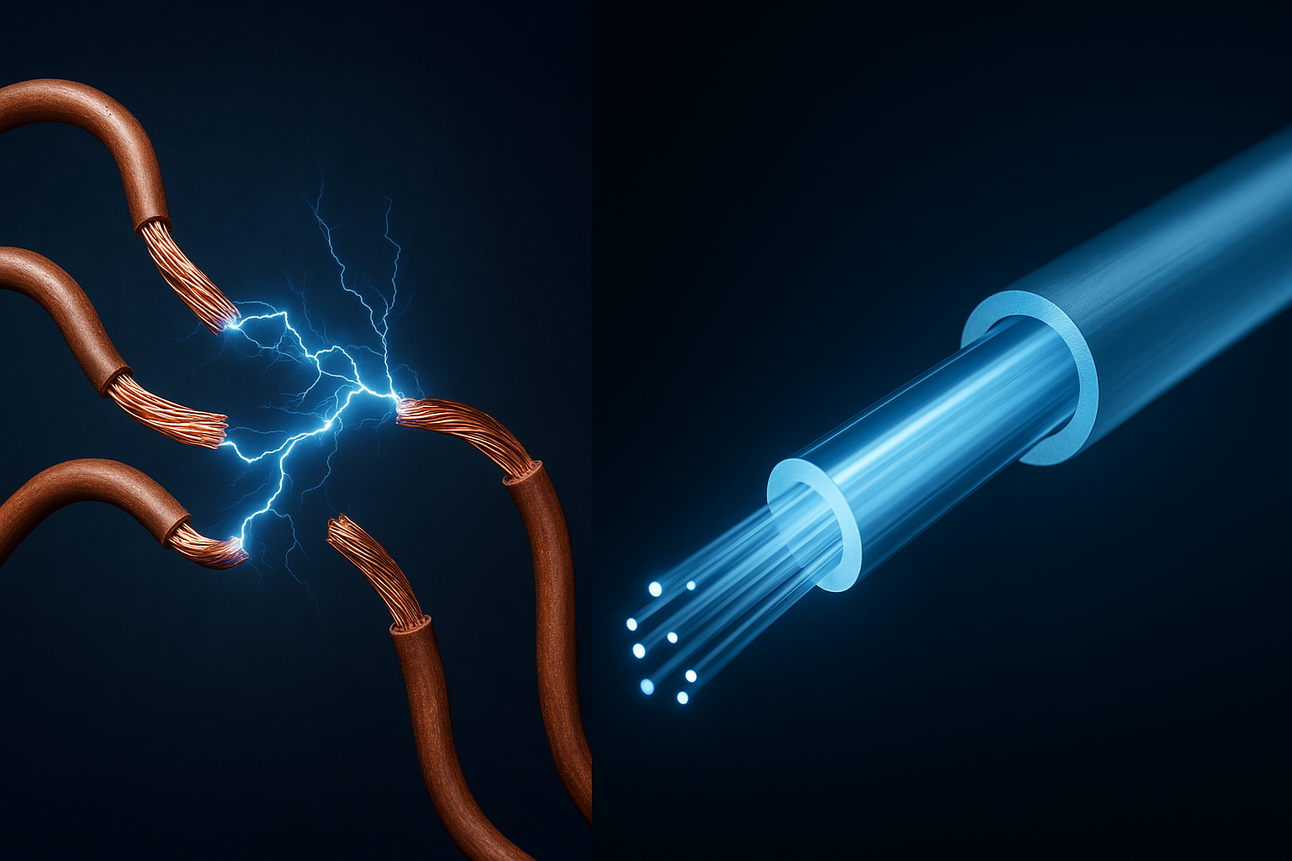
Most people still treat fiber like it’s just another cable. Like coax or power, trench it in, lash it up, connect both ends, and once the signal’s live, the job’s done. But fiber doesn’t carry electricity. It carries light. And that one detail changes everything about how you build it, whether it’s in the ground or hanging on a pole.
Copper moves voltage. It’s forgiving. You can bend it, crush it a little, get it wet, and it still works. It behaves like a pickup truck, rugged, durable, and able to keep moving through rough conditions. Fiber isn’t like that. Fiber’s more like a bullet train. It’s fast, efficient, and entirely dependent on the condition of the tracks beneath it. Misalign those tracks even slightly, and the whole system fails.
That’s the deal with fiber, whether it’s buried or aerial. Inside that cable is a strand of glass, thinner than a human hair, surrounded by a layer that keeps the light from escaping. The signal moves by bouncing forward inside that glass at exact angles. It doesn’t drift. It doesn’t wiggle. It follows the path you give it. That means any crush, twist, sharp bend, or pull that deforms that path, even a little, weakens the signal.
Weaken the Signal: What does this mean?
And the damage doesn’t always show up on Day 1.
The fiber might pass tests. The job might get signed off. But a few months later, someone’s calling about slow speeds. A tech is out there trying to track down packet loss. And eventually, someone’s digging it back up or climbing that pole to find the stress that got baked in during install.
Pass The Test: What does this mean?
Slow Speed: What does this mean?
Packet Loss: What does this mean?
That’s why fiber work isn’t just about connecting A to B. It’s about protecting everything in between. Underground, that means smooth duct paths, level vaults, clean slack coils, and no water intrusion. Aerial, it means proper sag, good span tension, no pinches at hardware, and slack loops that are sized right, not strangled against the strand just to make it look tidy.
This is where the frustration usually starts. Specs tell you bend radius limits, vault spacing, sag allowances, but don’t always explain the why. So crews go by feel. They tighten a loop, stretch a route, skip a vault. Not because they’re careless, but because the logic behind the spec was never made clear.
Fiber doesn’t respond to feel. It responds to physics.
A tight bend might seem fine. The cable looks intact. But inside that glass, the light is already leaking. Slack that’s too tight creates tension inside the strand. Sag that’s too shallow or uneven puts stress at every attachment. Every one of those “it’ll be fine” moments adds up. Not immediately, but eventually.
Leaking? What happens when light is leaking?
Crews that understand this work differently. They sweep duct paths. They level vaults. They avoid over-pulling or cinching cable too tight. On poles, they walk the span after lashing, adjust tension, and store aerial slack in clean, wide coils. They don’t just chase footage. They build with long-term stability in mind.
Because the light depends on it.
At the end of the day, you’re not just installing cable. You’re laying down the track for one of the fastest forces on Earth. And it’ll only go as far as the conditions allow.
That’s the job. And it’s one worth doing right.
What’s Actually Happening Inside the Cable
Ask most crews what fiber does, and you’ll hear something like, “It gives people internet.” Maybe a few will say, “It sends light.” But very few can explain what’s actually happening inside that cable or why it matters to the way they install it.
Let’s fix that.
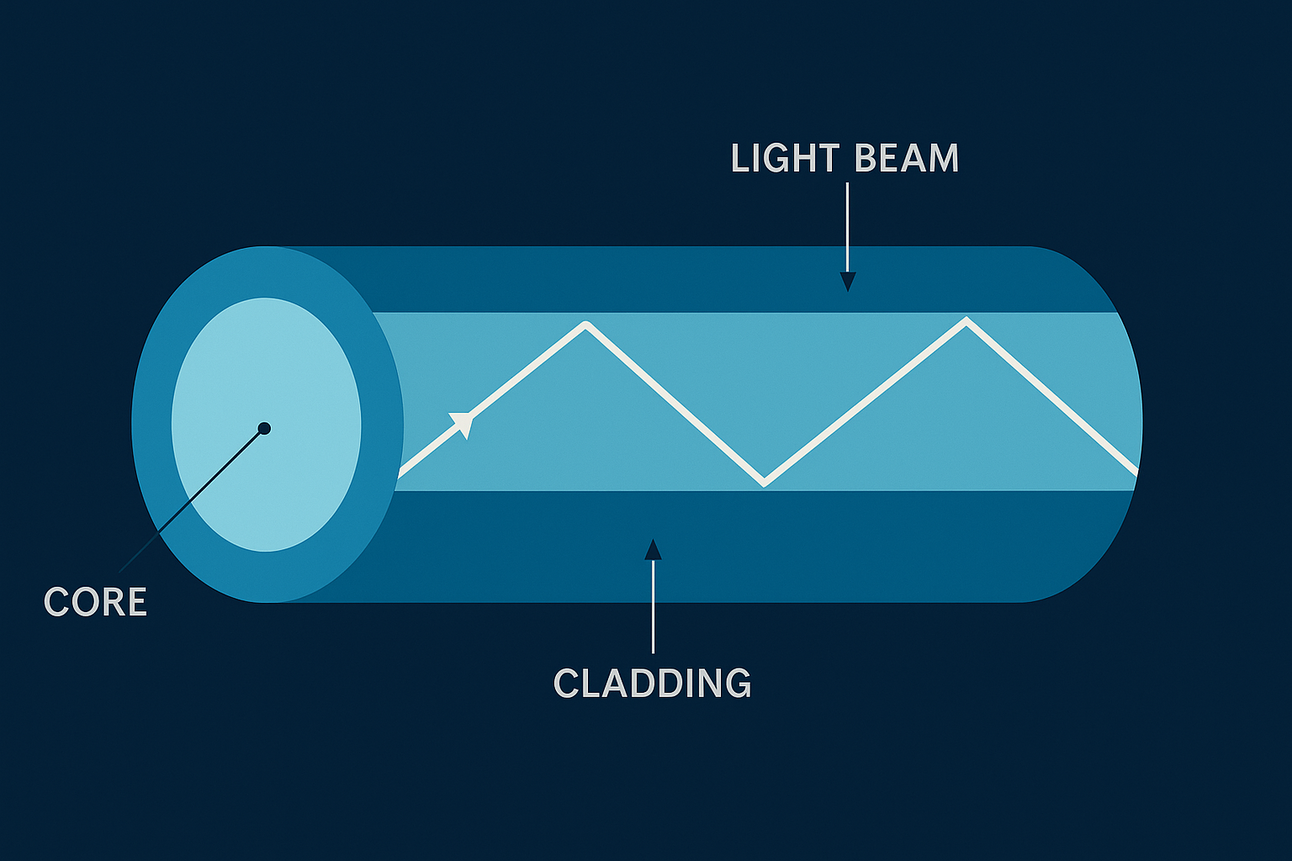
The signal traveling through a fiber line isn’t electricity. It’s light. Literal pulses of light. But it’s not blasting through the cable like a flashlight down a tube, it’s bouncing, at perfect angles, inside a strand of glass that’s thinner than a hair. That strand is called the core, and it’s surrounded by another layer of glass called the cladding. That cladding reflects the light back into the core, like mirrors lining a hallway, so the signal stays contained and moves forward.
The whole process is called total internal reflection. And it only works if everything inside that cable stays perfectly aligned.
Now think about what that means on a jobsite.
If you kink a fiber, even slightly, those perfect angles get thrown off. The light leaks out or scatters. If the duct gets crushed, if the slack coil is wound too tight, if the cable is pulled past its tension rating, you don’t always snap the glass… but you do distort the path inside. That shows up as attenuation, a weakening of the signal, or packet loss, where pieces of data just don’t make it through.
Scatters: What does this mean?
Tension Rating: What is that?
Distort the Path: What does this mean?
This is true underground and in the air. Buried duct pushed against a rock can create a microbend. So can a tight aerial loop or poorly aligned hardware at a pole. These issues don’t always trigger alarms during install. But six months later, someone’s trying to troubleshoot a weak signal and it leads all the way back to how the fiber was handled on Day 1.
Imagine the light as a race car speeding through a glass tunnel. Every smooth stretch keeps it fast and clean. But every bump, twist, or crack you introduce slows it down or sends it off course. And once it loses momentum, it never really recovers. The same thing happens to a signal inside a damaged fiber.
This is why you hear so much about microbends and macrobends in fiber training:
A macrobend is a large, visible curve, like wrapping fiber around a pipe that’s too small.
A microbend is an invisible pressure point, caused by crushed duct, tight lashing, over-pulled cable, or dirt compacted inside a vault.
Both disrupt the light. And neither is fixed by splicing or patching from the outside. If the path inside the glass is compromised, the damage is done.
And this isn’t just about fiber breaking. In fact, fiber is incredibly strong, stronger than steel by weight. But optical performance has nothing to do with brute strength. It’s about keeping that internal light path intact.
So if you’re lashing up cable on a pole, pay attention to sag and tension. If you’re placing slack in a vault, give it space. If you’re pulling fiber through conduit, use the right lubricant and don’t rush it. Every one of those choices affects the ride that signal takes from one end to the other.
Lubricant: What it does for the glass!
You don’t have to be a physicist. But you do need to understand this:
What you do outside the cable directly affects what happens inside the cable.And when the inside goes wrong, you don’t see sparks, you see slow speeds, dropped calls, failed tests, and return visits.
That’s the reality of working with light.It travels fast, but only when the path is built right.
How To Think Series:
If Speed is Your Solution, You’re Solving The Wrong Problem
What Will Hold Up, Not Just Pass Today
How It’s Suppose To Look Like When It’s Done Right
Think About What Happens After You Leave
Other Readings:
10 Lessons From The Field
Mini Guide To Field Leadership
Field Installation Checklist
32 Lessons To Younger Self About Fiber Projects
32 Business & Financial Lessons for Fiber Engineering & Construction Firms
This is one of the standards taught in the Fiber Done Right Academy, Valor’s training library for fiber construction.
Related reading: What Is Fiber (Part 2) and The Parts of a Fiber Network (Part 1).