
What You Are Learning
In this lesson you will learn why finding rock on a fiber route changes almost everything about how the job can be built. You will learn what the words rock, bedrock, boulder, weathered rock, and rippable mean in plain language. You will learn how rock changes the choice of method, including trenching, rock sawing, hammering, horizontal directional drilling, and jack and bore work. You will also learn why rock affects schedule, tool wear, bore steering, depth, spoil handling, and cost risk.
By the end, you should be able to recognize signs of rock in the field, explain why a crew cannot simply push through it with soil equipment, and know why the right response is to stop, document, and report what you found. You will not learn how to blast rock or how to break rock. That work belongs to qualified specialists. Your job as a reader and observer is recognition and reporting.
Start With the Basics
Think about digging a garden with a shovel. In loose soil the shovel slides in and you lift dirt out. Now imagine the shovel hits a solid slab a few inches down. The shovel stops. You can scrape, pry, and work around the edge, but you cannot shovel through solid stone the way you shovel through soil.
Fiber construction is the same problem at a larger scale. Most underground fiber is placed in a trench or in a bore hole below the surface. Both methods assume the ground can be cut, moved, or displaced by the equipment on the job. Soil usually can. Rock often cannot, at least not with the same tool, at the same speed, or to the same depth.
That is why rock is a constructability question. Constructability means whether a design can actually be built as drawn, with available equipment, in the ground that is really there. A route can look perfect on paper and still fail in the field if the ground is solid rock where the plan expected soil.
What Is It?
Rock is a naturally occurring solid mass made of minerals. Geologists group rocks into three broad families. Igneous rocks form when molten material cools and solidifies. Sedimentary rocks form when layers of sediment are deposited, buried, and cemented together. Metamorphic rocks form when an existing rock is changed by heat and pressure without fully melting. You do not need to name the family to understand the build problem. You need to understand that rock is a continuous solid, not loose particles like soil.
Bedrock is the solid rock layer that lies under soil and loose surface material. In some places bedrock is deep. In other places it sits close to the surface or sticks out at the surface as an outcrop. When a trench or bore reaches bedrock, the work changes from digging loose material to cutting or breaking solid material.
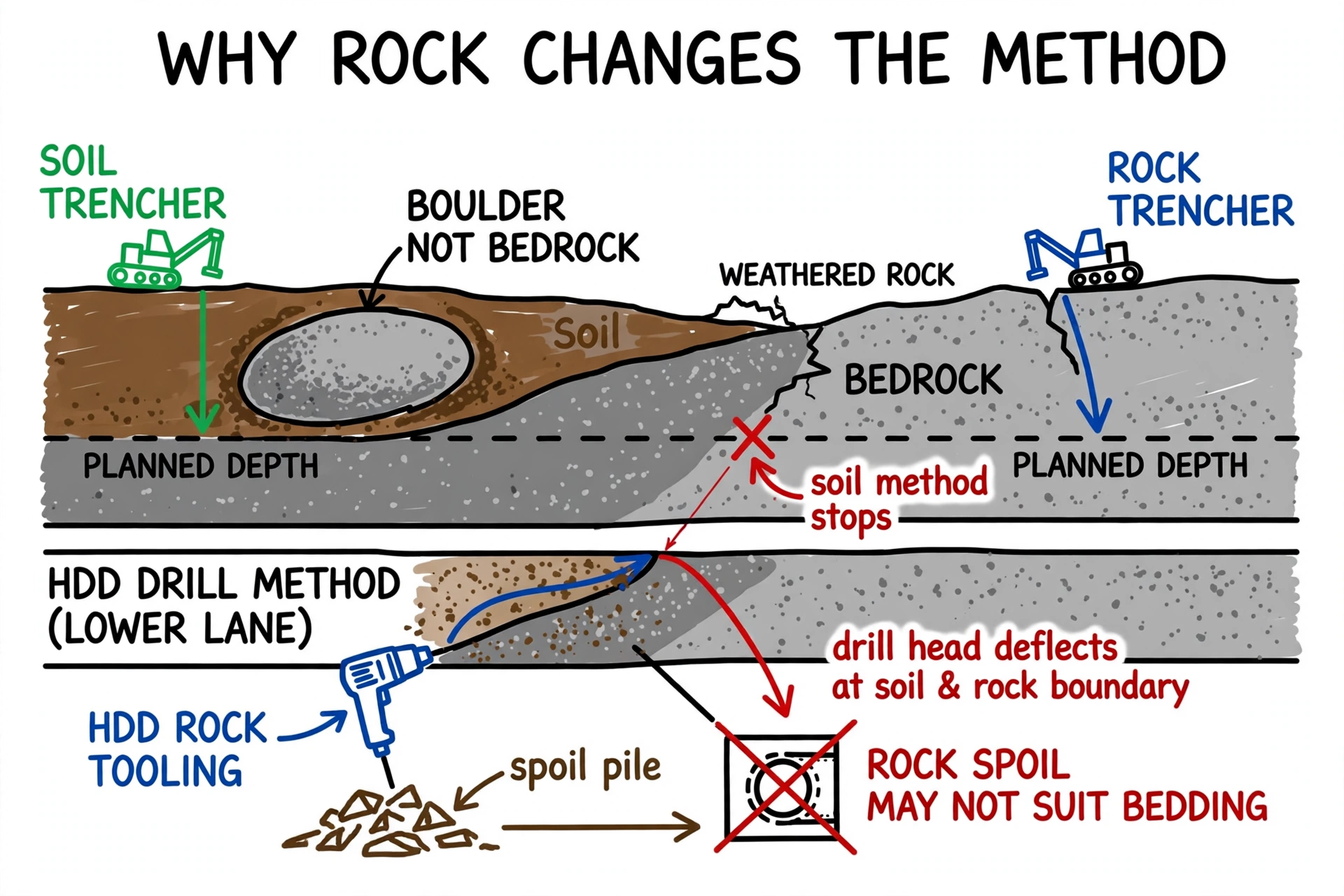
A boulder is a large separate piece of rock that is not connected to the bedrock layer. A boulder sits in or on the soil like a giant stone buried in dirt. A single boulder can stop a trencher or deflect a drill head, even when the surrounding ground is soil. Crews sometimes use the word boulder loosely for any large rock chunk, so always ask whether the rock is an isolated piece or part of a continuous layer. The answer changes the fix. One boulder may be removed or avoided. Continuous bedrock requires a different method for the whole segment.
Weathered rock is rock that has been broken down at or near the surface by water, temperature change, plant roots, and chemical action over time. Weathering is the process that breaks rock into smaller pieces and weakens it in place. Weathered rock often looks crumbly, cracked, stained, or layered, and it may dig easier than fresh solid rock below it. The trap is that weathered rock at the top can give a crew false confidence. A few inches deeper, the same formation may become solid and much harder to cut.
Rippable is a construction and contract word, not a pure geology word. Ripping is the process of breaking up rock by dragging a heavy steel tooth or teeth through it, usually with a large dozer or excavator. Rippable rock is rock that a specified ripper and machine can break up in that way. Unrippable rock is rock that the specified equipment cannot rip productively, so another method is needed. The Federal Highway Administration notes that ripping is generally limited to softer, moderately firm, or fractured rock, and that dense formations may need other methods. Whether rock counts as rippable on a given job depends on the rock, its fractures, and the exact equipment named in the contract or used in the field test. There is no single universal line that fits every job.
That last point matters because the word rock means three different things in three different conversations. In geology, rock describes the material itself. In field talk, a crew may call any hard digging rock, including hardpan, dense clay, cobble, or a single boulder, even when the geology word or the contract word would be narrower. In a contract, rock is whatever the contract definition says it is for payment purposes. Some contract definitions describe rock by the equipment needed to remove it, by a minimum volume, or by a test method written into that contract. Those definitions vary by agency and by project, and they control payment even when the geology word would be broader or narrower. Never assume a field observation automatically matches the contract definition.
What Does It Look Like?
You can often see rock before equipment hits it. Look for outcrops, which are places where bedrock sticks out of the ground on a slope, road cut, ditch bank, or creek bank. Look for ledge, which is a flat or stepped shelf of exposed rock. Look for loose rock fragments and angular chunks in the soil, in spoil piles, or along a fence line, which can signal shallow rock below.
In a trench, rock looks different from soil. Soil spoil is usually loose, granular, or clumpy. Rock spoil contains sharp, angular pieces with fresh broken faces. A trench bottom in rock may be uneven, stepped, or toothed from ripper marks. An excavator bucket may scrape and spark or leave polished scratch marks on a rock surface instead of cutting in. A trencher chain may bounce, chatter, or ride up instead of holding depth.
In drilling, you cannot see the rock directly, so you read the signs. The drill may advance much more slowly. Torque and vibration may rise. Cuttings returning to the entry pit may change from mud and sand to angular rock chips. The locator may show the drill head pushing off line or refusing to steer as expected. None of those signs alone proves solid bedrock. Cobble, a boulder, or a change in soil layers can produce similar signs. That is why documentation and confirmation matter.
Weathered rock has its own look. It may break apart in layers, crumble at the edges, show rust colored or dark staining, and contain visible cracks filled with soil or roots. Fresh rock below it tends to look cleaner, denser, and more uniform, and it resists a tool instead of crumbling the way the weathered layer above it does. As a beginner, describe what you see in plain words and photos rather than guessing a rock name.
What Does It Do?
Rock does not do a job in the fiber network the way a duct or a splice closure does. Its role is that of a ground condition that controls what building methods will work. In that sense, rock functions as a constraint. It sets limits on how deep a trench can go with a given machine, how straight a bore can be steered, how much wear cutting tools will take, and how much material can be reused as bedding or backfill.
Rock also provides information. A rock outcrop at the surface tells an experienced builder that shallow rock is likely nearby, even where soil covers it. Rock in a test pit or boring log tells a designer that the planned depth or method needs review. Rock encountered during construction tells the project team that the assumed ground conditions were incomplete, and the plan, schedule, and price may need to be revisited under the contract process.
Where Does It Fit?
Rock fits into the build at the planning, design, and construction stages, long before fiber is pulled or spliced.
At planning, geologic maps, soil surveys, prior project records, and site walks give early warnings. None of them guarantees what a specific trench will find, because rock depth can change over a short distance.
At design, the proposed alignment, depth, and method are chosen. If rock is shallow, a designer may shift the alignment, raise or change the placement method, choose aerial placement where permitted, or specify rock capable equipment. Those are design and owner decisions, not field improvisations.
At construction, rock fits into method selection. A soil trencher with a standard chain is built for soil and soft ground. A rock chain, a rock wheel or rock saw, or a larger rock trencher is built for harder cutting, but each has limits in depth, width, and rock type, and the manufacturer instructions for that machine control its proper use. An excavator with a hydraulic hammer, which is a powered breaking tool mounted on the excavator arm, can break rock in a trench, but it is slower than soil digging and it changes the trench shape and spoil. Horizontal directional drilling, often shortened to HDD, uses specialized rock tooling such as hardened bits, roller cone bits, and dual rod rock systems when standard soil bits cannot cut or steer in rock. Jack and bore, which pushes a steel casing through the ground from a pit, also has practical limits in solid rock and in mixed ground with boulders, and it cannot be steered the way HDD can. Blasting, which is the controlled use of explosives to fracture rock, is sometimes used on large excavation work, but it is a separate specialty with its own permits, qualified blasters, and safety rules, and it is not a normal fiber crew task.
Rock also fits into what happens after the opening is made. Bedding is the material placed under and around a duct or cable to support and protect it. Project specifications often require bedding and backfill to be free of sharp rock that could damage the duct, and excavated rock spoil may not meet that requirement. When that is the case, suitable material must be brought in and rock spoil must be hauled or handled as the contract and local rules require. That requirement is specification dependent, so check the project documents instead of assuming rock spoil can or cannot be reused.
Why Does It Matter?
Rock matters first because it can stop the planned method. A trencher that cannot hold depth leaves a duct too shallow. A bore that cannot be steered in rock can miss the target, damage the drill tooling, or fail to reach the required depth. A jack and bore that meets solid rock may not advance at all. When the method fails, the whole segment must be replanned.
Rock matters because it changes schedule in general terms. Rock work is slower than soil work, requires different equipment to be delivered, and may require approvals, permits, or specialty subcontractors. A delay is not just the time spent cutting rock. It includes the time to recognize the condition, document it, get a decision, mobilize the right equipment, and verify depth and alignment afterward.
Rock matters because it wears tools. Cutting teeth, chains, bits, and hammer tools wear faster in abrasive rock than in soil. Vermeer guidance on HDD bits makes the same point from the drilling side: different ground needs different bits, harder formations need carbide protected and rebuildable tooling, and a bit that steers well in soil may not survive or steer well in rock. Tool wear is a normal and expected cost of rock work, and planning must account for inspection and replacement instead of running tooling until it fails.
Rock matters because it affects quality. A trench cut in rock may have an uneven bottom. A bore in mixed ground, with soil on one side of the drill head and rock on the other, tends to push the head toward the softer side, which makes steering corrections harder. If depth cannot be achieved, the finished plant may be more exposed to future digging, surface loads, or drainage work. Cover depth requirements come from the project specifications, codes, and permits for that job, so do not use a depth number from memory. Check the documents for the segment you are looking at.
Rock matters because it affects cost and contract risk. Rock excavation usually costs more than soil excavation because it needs heavier equipment, more time, and more tool replacement. Who pays that extra cost depends on the contract. Many public and private contracts include a differing site conditions concept. Under the federal version in FAR 52.236-2, a contractor who encounters subsurface or latent physical conditions that differ materially from what the contract indicated, or unknown physical conditions of an unusual nature, must promptly give the contracting officer written notice before the conditions are disturbed. If the conditions do materially differ and cause an increase or decrease in the cost of the work or the time required, an equitable adjustment shall be made and the contract modified in writing, provided the required written notice was given. Private contracts, including AIA style contracts, use similar ideas with their own wording and notice rules. The lesson for a field observer is simple and practical: if rock was not expected, do not disturb more of it than needed, document it with photos, measurements, location, and time, and notify through the proper chain promptly. A claim that is not noticed and documented as the contract requires can be lost even when the rock is real.
What Does Good Look Like?
Good rock handling starts before construction. The route is walked, available boring and map information is reviewed, and known rock areas are flagged on the plan with a method that matches the ground. Equipment is selected from manufacturer guidance for the expected formation, not from hope. The crew knows in advance what to do if rock is found, who to call, and what records to keep.
In the field, good looks like early recognition and honest reporting. The operator stops before destroying tooling or forcing depth that is not there. The trench or bore is checked for actual depth and alignment. The rock is described accurately, as an isolated boulder, a weathered layer, or continuous bedrock, with photos that include a scale reference and a location reference. Spoil is kept separate when bedding suitability is in question, until the inspector or project lead decides.
Good also looks like the right method for the rock that is actually present. Rippable fractured rock is ripped by suitable equipment. A narrow utility trench in solid rock may be cut with a rock saw by a trained operator. HDD in rock uses rock rated tooling and a drill designed for it, with a locator plan that accounts for harder steering. If blasting is ever proposed, good looks like the work being handed to a qualified blasting specialist who meets the OSHA blasting rules and any state or local licensing and permit requirements that apply, with the fiber crew clear of that operation. Good never looks like an unqualified person trying a specialist method because the schedule is tight.
Finally, good looks like a clean record. Daily reports note where rock started and ended, how deep it was, what method was used, and what changed. The as built record, which is the final drawing of what was actually installed, shows the true depth and path, including any approved change made because of rock.
What Can Go Wrong?
The most common failure is assuming soil and mobilizing soil equipment into rock. The trencher cannot hold depth, teeth and chains are damaged, and the day is lost. Forcing equipment is worse. It can damage the machine, throw material, create an unsafe trench, and still fail to produce a compliant installation.
A second failure is misreading the rock. A crew may treat the weathered top layer as the whole story and promise a production rate the solid rock below cannot support. Or a crew may treat one boulder as continuous bedrock and call for a costly method change that the rest of the segment does not need. Careful observation and, where the contract provides for it, test pits or borings reduce both errors.
A third failure is a bore that walks off line in mixed ground. When one side of the drill head is in rock and the other is in soil, the head tends to deflect. The bore may end up too shallow, too deep, or off alignment, and a ream or pullback may bind on a rock ledge. In the worst case the product pipe or duct is damaged during pullback over sharp rock.
A fourth failure is bad spoil handling. Rock spoil placed directly against a duct as bedding or initial backfill can point load and damage the duct. Large angular rock in backfill can also settle unevenly and leave a surface depression or a hump after the job looks finished.
A fifth failure is a paperwork failure. The crew digs through the rock, says nothing, and asks for extra payment later. Without prompt notice, photos, and measurements taken before the condition was disturbed, the owner and contractor have no shared record to price the change, and the differing site conditions process in the contract may not help.
Safety failures are the most serious. Hydraulic hammers, rock saws, and ripping equipment throw fragments and create noise, dust, and vibration that require the controls in the equipment manual and the job safety plan. Blasting adds explosives risk and is governed by OSHA construction rules that permit only authorized and qualified persons to handle and use explosives, with blasters qualified by training, knowledge, or experience. Reading this lesson does not qualify you for any of that work.
What Should Someone Notice in the Field?
Notice the surface first. Outcrops, ledge in a ditch or road cut, rock fragments in the soil, and shallow soil over a hard layer are all early warnings. A probe rod or shovel test by a qualified worker, where permitted, that refuses at a consistent shallow depth across several spots suggests a layer, while refusal at one spot only suggests a boulder or buried debris.
Notice what the equipment is telling you. Slower advance, bouncing or chattering, inability to hold trench depth, polished scratches on a bucket, angular fresh chips in the spoil, and a trench bottom that is stepped instead of smooth all point to rock. On an HDD job, notice rising torque, poor steering response, and rock chips in the returning cuttings.
Notice the change points. Record where soil digging changed to rock, with a station, address, or GPS point as the job requires. Record how deep the rock surface was at that point. Photograph the rock in place, the spoil, and the trench bottom before more work disturbs it.
Notice what you should not conclude. Do not conclude that rock in one hole means rock for the whole route. Do not conclude that no rock at the surface means no rock at trench depth. Do not name a rock type or a hardness value unless you are qualified and the job requires it. Report observations, not guesses dressed up as facts.
Practical Example
The following example is hypothetical.
Hypothetical example: A crew is assigned to trench a short underground fiber segment along a rural road. The plan assumes soil digging for the full segment, and a mid size trencher with a soil chain is delivered. For the first part of the morning the trencher holds depth and the spoil is loose soil with small stones.
Midway along the segment the chain begins to bounce and the trench gets shallower even though the operator has not changed a setting. The spoil changes to angular light gray chunks with fresh faces. The foreman stops the trencher before the chain is damaged, checks the trench, and finds a continuous rock layer at a shallow depth, with a crumbly weathered top and solid rock below it. The foreman photographs the rock in the trench wall with a tape for scale, records the location and the depth to rock, and calls the project lead instead of forcing the machine forward.
The project lead reviews the contract definition of rock and the notice requirement, notifies the owner representative in writing the same day, and holds the segment while a decision is made. The decision is to bring in a rock capable method for that segment and to import suitable bedding material, because the rock spoil is angular and the project specification requires bedding that will not damage the duct. The rest of the route that is still in soil continues with the original trencher. The daily report and the as built record show exactly where the rock segment started and ended, what method was used, and what depth was finally achieved.
The teaching point is not the rock itself. It is the sequence: recognize early, stop before damage, document before disturbing more ground, notify as the contract requires, and change the method by decision, not by force.
Key Terms
Rock: A naturally occurring solid mass made of minerals, forming a continuous material rather than loose particles like soil.
Bedrock: The solid rock layer beneath soil and loose surface material. It may be deep, shallow, or exposed at the surface.
Boulder: A large separate piece of rock that is not connected to the bedrock layer. One boulder can stop or deflect equipment even in soil ground.
Weathered rock: Rock that has been weakened and broken down near the surface by water, temperature change, roots, and chemical action. It often digs easier than fresh solid rock below it.
Weathering: The process that breaks rock down in place at or near the surface, through physical breaking and chemical change.
Ripping: Breaking up rock by dragging a heavy steel tooth or teeth through it with a large machine, so an excavator can remove the loosened material.
Rippable: A contract and construction description for rock that a specified ripper and machine can break up productively. The meaning depends on the equipment and test named for that job.
Horizontal directional drilling (HDD): A trenchless method that drills a steerable pilot hole underground, enlarges it, and pulls duct or pipe through it.
Bedding: Material placed under and around a duct or cable to support it and protect it from sharp or uneven surfaces.
Differing site conditions: A contract concept that addresses subsurface or hidden conditions that differ materially from what the contract indicated, or unknown unusual conditions, usually requiring prompt written notice before the conditions are disturbed, with an adjustment to cost or time that can run up or down when the contract criteria and notice are met.
Constructability: Whether a design can actually be built as drawn with available methods in the real ground, access, and site conditions.
Spoil: Material excavated from a trench or bore pit. Rock spoil is often angular and may not be suitable as bedding, depending on the project specification.
Check Your Understanding
- What is the difference between bedrock and a boulder, and why does the difference matter for the build?
Answer: Bedrock is a continuous solid rock layer under the soil. A boulder is one large separate piece of rock in or on the soil. Continuous bedrock usually requires a method change for the whole segment, while a single boulder may be removed or avoided.
- Why is rippable not a fixed property of a rock by itself?
Answer: Rippable describes whether a specified machine and ripper can break the rock productively. It depends on the rock, its fractures and weathering, and the equipment and test named in the contract or used in the field.
- A trencher holds depth in soil, then begins to bounce, the trench gets shallower, and the spoil turns to angular fresh chunks. What should the crew do first?
Answer: Stop before the tooling is damaged, check and document the condition with photos, location, and depth to rock, and report it through the proper chain. The crew should not force the soil machine through solid rock.
- Why can rock spoil be a problem even after the trench is successfully cut?
Answer: Angular rock spoil can point load and damage a duct if it is used as bedding or initial backfill. Many project specifications require suitable bedding material, so rock spoil may need to be kept separate and replaced with imported material. The specification for the job controls.
- What does a differing site conditions clause generally require the contractor to do when unexpected rock is found, and why does timing matter?
Answer: It generally requires prompt written notice to the owner or contracting officer before the conditions are disturbed, so the condition can be investigated and recorded. Late notice or a disturbed condition can defeat the request for an adjustment to price or time, even when the rock is real.
Lesson Takeaway
Rock affects the build because it changes what the ground will allow. Soil equipment cannot cut solid rock to depth, a drill cannot steer in rock the way it steers in soil, and angular rock spoil cannot automatically be trusted around a duct. The word rock also changes meaning between geology, field talk, and a contract, and the contract definition is the one that controls payment. A good builder respects all three meanings, recognizes rock early, documents it before disturbing it, and lets qualified people with the right equipment make the method change.
Sources and Technical References
U.S. Geological Survey, on rock families and weathering products forming sedimentary rocks, and igneous and metamorphic rock formation: https://pubs.usgs.gov/publication/70227310
Maine Geological Survey, Bedrock Geology Frequently Asked Questions, definition of bedrock as the solid rock beneath soil and sediment, commonly encountered in shallow excavation: https://www.maine.gov/DACF/mgs/explore/bedrock/faq.htm
Wisconsin Geological and Natural History Survey, Bedrock Geology, definition of bedrock as the solid, well cemented rock layer under soil or sediment: https://home.wgnhs.wisc.edu/wisconsin-geology/bedrock/
Federal Highway Administration, Context Sensitive Rock Slope Design, Rock Excavation Methods overview of blasting, ripping, and breaking, with advantages and limitations: https://www.fhwa.dot.gov/clas/ctip/context_sensitive_rock_slope_design/ch_3_1.aspx
Federal Highway Administration, Context Sensitive Rock Slope Design, Ripping section, noting ripping is preferred where feasible, costs less than blasting, and is limited to soft to moderately firm fractured rock: https://www.fhwa.dot.gov/clas/ctip/context_sensitive_rock_slope_design/ch_3_7.aspx
Iowa Department of Transportation, Construction Manual 6.30, example of a state agency definition in which rock excavation is excavation that cannot be made with normal common excavation equipment and any excavation requiring ripping or blasting is treated as rock excavation. This is one agency example only. Definitions vary by contract: https://iowadot.gov/erl/archiveapril2019/CM/content/CM%206.30.htm
Vermeer Pro Tips, Which Bit Fits: Best HDD Bits for Your Ground Conditions, manufacturer guidance matching HDD bits to soil, cobble, and soft rock, and noting steering difficulty in rock formations such as sandstone, shale, and limestone. Manufacturer ratings for specific bits apply to those products only: https://protips.vermeer.com/underground/2024/09/12/which-bit-fits-best-hdd-bits-for-your-ground-conditions/
Vermeer Pro Tips, New Vermeer Ultra X3 HDD Bits, manufacturer description of rock bits with carbide protection and steering features for challenging formations. Product specific ratings are the manufacturer figures for those bits, not general field rules: https://protips.vermeer.com/underground/2025/12/22/new-vermeer-ultra-x3-hdd-bits-expand-your-drilling-capabilities/
Vermeer, D23x30DR S3 Navigator rock drill announcement, manufacturer description of a dual rod HDD machine and rock tooling including tricone and PDC bit options for hard rock bores: https://www.vermeer.com/em/news/vermeer-introduces-new-d23x30dr-s3-navigator-hori
Federal Acquisition Regulation 52.236-2, Differing Site Conditions clause text, requiring prompt written notice before conditions are disturbed for conditions differing materially from the contract or unknown unusual conditions: https://www.acquisition.gov/far/52.236-2
OSHA construction blasting rules, 29 CFR 1926.900 and 1926.901, providing that only authorized and qualified persons handle and use explosives and that a blaster must be qualified by training, knowledge, or experience. Cited for general awareness only. This lesson does not teach blasting: https://www.ecfr.gov/current/title-29/subtitle-B/chapter-XVII/part-1926/subpart-U
Flagged for verification: No universal numeric threshold for rippable versus unrippable rock is stated in this lesson, because published charts are machine specific and contract definitions vary. Any project that needs a numeric test must use the test and equipment named in its own contract documents and geotechnical report. No production rates or cost figures are stated as rules for the same reason.
Previous lesson: Lesson 104: Why Do Soil Conditions Affect the Build? |
Back to Level 5 hub
|
Next lesson: Lesson 106: Why Does Groundwater Affect the Build?