What You Are Learning
By the end of this lesson you will be able to explain what underground and aerial fiber construction are, describe what each one looks like and how fiber gets installed by each method, and give the real-world reasons a project chooses one, the other, or a mix of both. You will also be able to spot each method in the field and name what can go wrong with each.
Start With the Basics
Lesson 1 introduced the outside plant, or OSP: all the physical network hardware that sits outside buildings. Here is a practical way to think about what Lesson 2 covers. To get fiber from one place to another, the cable has to travel somewhere. There are only two choices for where it travels. Either it goes above the ground, hung in the air from poles, or it goes below the ground, buried in the earth. That is the whole comparison in one sentence. Everything else in this lesson is about how each choice works, what it looks like, and why people pick one over the other.
What Is It?
Underground construction is fiber cable installed below the surface of the ground. The cable may be pulled through a tube (called conduit, covered in Lesson 4), or it may be buried directly in the earth (called direct burial). Underground construction is the umbrella term for every method that puts the cable in the dirt.
Aerial construction is fiber cable installed above the ground, supported by poles. A pole is a tall round or square post, usually made of wood, set into the ground. Utility poles carry electric wires and communication wires overhead, and fiber is simply one more kind of wire hanging on them. The fiber cable is not strong enough to hold its own weight across long stretches of air by itself, so it is supported in one of two ways. It can be lashed, meaning tied with a thin wrapping wire, to a separate steel support cable called a messenger strand (often shortened to just “strand”). Or the fiber cable itself can be built with a support element inside its own body, which is called a self-supporting cable. In both cases, the poles hold everything up.
One important detail: in aerial construction, the company installing fiber almost never owns the pole. Poles are typically owned by an electric utility, a telephone company, or a municipality, and the fiber company gets written permission to attach to them. That permission, and the work of preparing a pole to accept a new attachment, is a business topic worth knowing exists, but the details belong to later lessons on permitting and construction business.
What Does It Look Like?
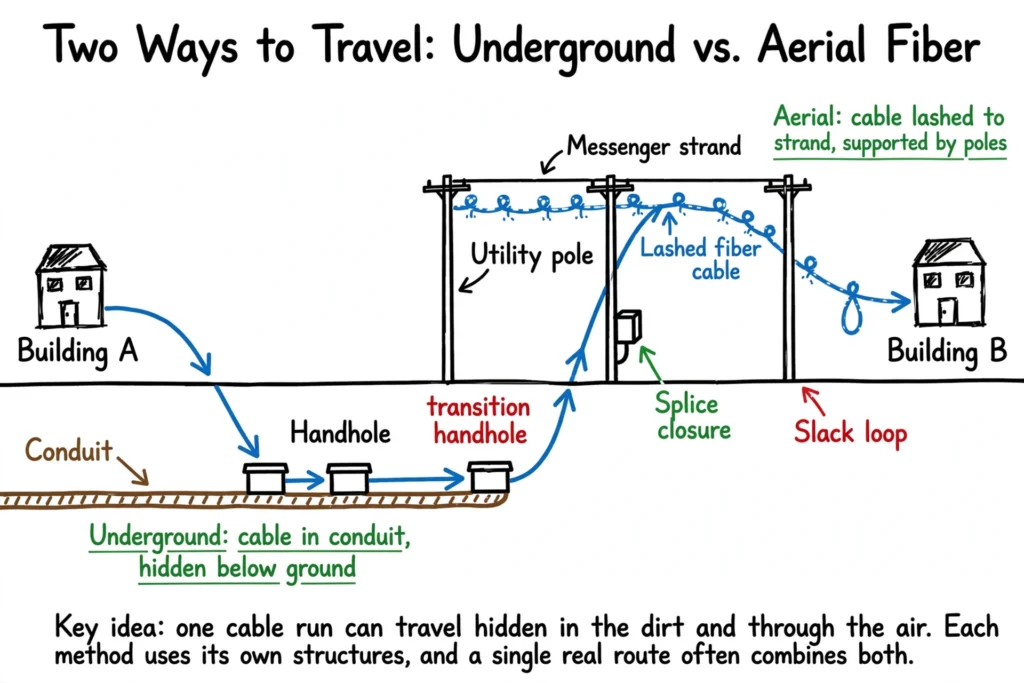
Underground. Once construction is finished, you see almost nothing. The cable is hidden. What you see instead are the places where workers need to reach it. You might see a row of small green or gray lids flush with the grass along a street. Those are handholes (covered in detail in Lesson 5): shallow buried boxes with removable lids where cables can be accessed for connections. At intervals you may also see narrow disturbed strips of soil or pavement where a trench was dug and refilled. During construction, underground work is more visible: trenches or bored holes, reels of conduit, and excavation equipment. But the finished product is designed to disappear.
Aerial. Aerial fiber is highly visible. You see poles, usually wood, standing in a line along streets or alleys. Between poles, cables run through the air in long shallow curves. The fiber cable often hangs just below a slightly thicker steel strand, held to it by the spiral wrapping of lashing wire. At poles, the cable makes small loops before continuing to the next span. Those loops, called slack loops or drip loops, store extra cable for future work and let water drip off instead of running into the connection point. You may also see enclosed boxes mounted on poles at intervals. Those are splice closures (called closures for short): weatherproof cases where fiber strands are joined together. Compared with underground, aerial looks busier and more exposed, because every part of it is in the open.
Variations. Underground includes both conduit installation and direct burial, plus boring methods that drill under roads without digging them up. Aerial includes lashed cable, figure-eight cable (a self-supporting style shaped like the number 8, with the strength element in the upper loop), and all-dielectric self-supporting cable, known as ADSS (all-dielectric means it contains no metal at all, which matters near power lines). You do not need to memorize these variants now. You only need the core picture: cable in the dirt versus cable in the air.
What Does It Do?
Both methods do the same thing in the network: they get the fiber cable from point A to point B safely. The difference is only the path the cable takes and how it gets there.
Underground installation, at a beginner level. First, the route is prepared. That may mean digging a trench, or boring a hole underground without opening the surface. If conduit is used, the conduit tube is placed in the trench or pulled through the bore, and handholes are set at intervals along the route. Then the fiber cable is pulled or blown through the conduit from one handhole to the next. Pulling means exactly what it sounds like: a rope is threaded through the conduit first, the cable is attached, and workers or a winch pull the cable through. Blowing is a common alternative: compressed air pushes the cable through the conduit, which is gentler on the cable over long runs. Connections between cable sections are made at the handholes and sealed inside closures.
Aerial installation, at a beginner level. First, the poles are prepared and the messenger strand is strung from pole to pole and tensioned. Then the fiber cable is raised into position beside the strand. A tool called a lasher travels along the strand and spirals lashing wire around the strand and cable together, binding them as it goes. Self-supporting cable skips the lashing step: it is simply pulled across the spans and attached at each pole with special hardware. Connections between cable sections are made at poles, with closures mounted on the pole or on the strand itself, and slack loops stored there for future access.
Where Does It Fit?
Underground and aerial are choices made during route design, the step where engineers decide exactly where the cable will go. Many real networks are hybrids: aerial along one stretch, underground along another. A single route might run aerial through a rural area where poles already exist, then drop underground where it crosses a city that requires buried utilities, then go aerial again on the other side.
What underground interacts with. Underground construction works with trenches, bores, conduit systems, and handholes. It runs into roadways, sidewalks, existing buried utilities (water, gas, electric, sewer), tree roots, and property boundaries.
What aerial interacts with. Aerial construction works with poles, strands, lashing wire, and pole-mounted closures. It shares pole space with electric power lines, telephone wires, and cable television lines. The fiber company is usually a guest on someone else’s pole, which means coordination with the pole owner is part of the job.
Why Does It Matter?
The choice between underground and aerial is one of the biggest decisions in any fiber project, and it affects almost everything else.
Cost. Aerial construction generally costs less per foot of route than underground, because there is no digging. The poles often already exist, so the fiber company pays for attachment and labor rather than excavation. Underground construction costs more because digging, boring, restoring pavement, and placing handholes are all expensive. This is a general industry observation, not a rule: crowded poles that need replacement work can erase the savings, and easy rural trenching can be cheap.
Schedule. Aerial is usually faster to build. No excavation means fewer crews, fewer permits, and faster daily production. Underground is slower: digging and restoration take time, and underground permits often involve more authorities.
Reliability. Underground cable is protected from weather. Storms, falling trees, and vehicles cannot easily damage what they cannot reach. Aerial cable is exposed to all of those things. On the other hand, underground cable is vulnerable to dig-ups: other contractors excavating in the same area can cut it by accident. Each method has its own threat, and neither is invulnerable.
Maintenance access and restoration. Aerial faults are easy to find, because a broken pole or a cable hanging on the ground is visible. Repair crews can usually reach the problem quickly. Underground faults are harder to locate and require excavation to fix, which makes repairs slower and more expensive. So underground tends to fail less often from weather, but is harder to repair when it does fail.
Permitting. Both methods require permits, but from different authorities and with different complications. Underground permits deal with digging in public rights of way and working around other buried utilities. Aerial permits deal with attaching to poles you do not own, and the pole owner’s preparation work can take significant time.
What Does Good Look Like?
Good underground work is characterized by cable installed without damage during the pull or blow, handholes placed at intervals that make the cable reachable, conduit with continuous, sealed paths, and the surface restored so the route does not look disturbed when finished. Documentation matters here: because you cannot see the cable, good practice includes accurate records of exactly where it lies. Contract documents will spell out acceptance requirements such as conduit condition, burial depth, and surface restoration; those specifics vary by contract, and no universal numbers exist.
Good aerial work is characterized by cable lashed neatly and snugly to the strand with no loose hanging sections, consistent spacing above the ground, clean transfers at each pole, closures mounted securely with properly stored slack, and everything clear of trees, buildings, and other cables. The strand must be properly tensioned and terminated, because the strand carries the load.
A general note: “good” in the sense of accepted industry practice is separate from what a particular contract requires. A job can follow standard practice and still fail a stricter contract specification, and vice versa. Acceptance criteria come from the contract, not from this lesson.
What Can Go Wrong?
Underground. The most common failure is a cable cut during later excavation by another party, sometimes called a fiber cut or a dig-up. It stops service instantly and is expensive to repair. Other problems include cable damaged during installation (pulled too hard or bent too sharply during the pull), water entering poorly sealed closures or handholes, and rodents chewing cable. Handholes that are not set level can sink or fill with debris.
Aerial. The most common failure is storm damage: trees falling on spans, wind and ice loading breaking strands or poles, and vehicles hitting poles. Lashing wire that was applied poorly can unravel. Cable that sags too low can be snagged. And because aerial plant shares poles with power lines, there is always the safety hazard of electrical proximity, which is why aerial work near power is restricted to qualified workers.
Neither list should scare you. These are the routine failure modes the industry designs around, and every network is built expecting some of them to happen over its lifetime.
What Should Someone Notice in the Field?
If you are new and you are walking or driving a route, here is what to look for. This is recognition only. Noticing a condition is not the same as being qualified to fix it or to work on it.
Underground signs. Look for handhole lids at regular intervals along a route; they are the fingerprints of buried cable. Look for narrow restored strips in grass or pavement, and for small warning markers or signs that say fiber is buried nearby. If you see excavation happening near handholes, that is worth noting, because accidental damage during digging is the main threat to buried cable.
Aerial signs. Look for poles and follow the lines between them. You can see the messenger strand, the lashed fiber cable below it, and the slack loops at the poles. Look for cable hanging much lower than its neighbors, cable visibly dragging or disconnected from the strand, poles that lean heavily, or splice closures that are open or hanging loose. Any of these are worth reporting to someone responsible.
Safety boundary. If you see a cable down on the ground near a pole, or anything touching power lines, do not approach it and do not touch it. Downed lines can be energized. That is a recognition-only situation for beginners: notice it, stay clear, and tell someone qualified.
Practical Example
This example is hypothetical, created to teach the comparison.
Two office buildings sit three miles apart. Building A is in a downtown district where the city requires all utilities to be buried. Building B is in a rural area with an existing line of utility poles along the country road.
The route designers choose a hybrid route. From Building A, the fiber runs underground for the first mile through the downtown area, using conduit and handholes, because the city rules require it and because the downtown streets are crowded with pedestrians who should never see overhead cable. Where the downtown ends and the country road begins, the route transitions: the underground conduit ends at a handhole, and the cable rises up a pole to become aerial. The remaining two miles run aerial, lashed to strand on the existing poles, because the poles are already there, the airspace is clear of trees, and building aerial is faster and less expensive than trenching two miles of country road.
The hybrid route gets the reliability and neatness of underground where it matters, and the speed and lower cost of aerial where conditions allow. Most real networks look something like this: not one method or the other, but the right method for each stretch.
Key Terms
- Underground construction: fiber cable installed below the surface of the ground, either in conduit or buried directly.
- Aerial construction: fiber cable installed above the ground, supported by poles.
- Conduit: a tube, usually plastic, placed underground to protect cable and allow future cable to be pulled through. (Full detail in Lesson 4.)
- Handhole: a small buried box with a removable lid that gives workers access to underground cable for connections and maintenance. (Full detail in Lesson 5.)
- Utility pole: a tall post, usually wood, set in the ground to carry wires overhead. Poles are usually owned by a utility or municipality, and fiber companies attach to them with permission.
- Messenger strand: a steel support cable strung between poles; the fiber cable is lashed to it. Often shortened to “strand.”
- Lashed / lashing: tied to the messenger strand with a thin wire spiraled around both cable and strand.
- Self-supporting cable: fiber cable built with its own internal support element, so it can span between poles without a separate messenger strand. ADSS (all-dielectric self-supporting) is one common type.
- Closure (splice closure): a weatherproof case where fiber strands are joined together, mounted underground in handholes or on poles in aerial plant.
- Slack loop (drip loop): a loop of extra cable stored at a pole or handhole, used for future repairs and to let water drip off the cable.
- Direct burial: an underground method in which cable is placed directly in the earth without conduit, using specially armored cable.
- Make-ready: the work of preparing a utility pole to accept a new attachment (a business and permitting topic; mentioned here only so you recognize the term).
Check Your Understanding
1. In one or two sentences, explain the difference between underground and aerial fiber construction.
2. A new office park requires that no overhead wires be visible anywhere on the property. Which construction method must be used, and what underground access points would you expect to see along the route?
3. Why can aerial construction often be built faster and for less money than underground, and what is one situation where that advantage might disappear?
4. You are driving a route and you see a cable hanging much lower between two poles than its neighbors, with no tension on it. What is the practical meaning of that observation, and what should you do?
5. A project runs underground through a town and aerial through the countryside. What is this called, and why would an engineer design the route this way?
Answer key
1. Underground construction places fiber cable below the surface of the ground (in conduit or buried directly). Aerial construction hangs fiber cable above the ground, supported by utility poles, either lashed to a steel messenger strand or as self-supporting cable.
2. Underground construction. You would expect to see handholes, the small lidded boxes flush with the ground that give workers access to the buried cable.
3. Aerial is generally faster and cheaper because there is no digging, and the poles often already exist, so the main work is attachment and labor rather than excavation. The advantage can disappear if the poles need extensive preparation or replacement work, or if the trenching is easy and the poles are crowded, damaged, or owned by someone who makes attachment slow.
4. The cable has likely detached from its support or the span has been damaged, and it could fail or be snagged by traffic. As a beginner you should not touch it or attempt any repair. Report it to whoever is responsible for the route.
5. A hybrid route. The engineer uses underground where conditions require or reward it (city rules, appearance, protection) and aerial where conditions allow it (existing poles, clear airspace, lower cost and faster build).
Lesson Takeaway
Underground and aerial are the two ways fiber cable travels between places: below the ground or above it on poles. Each has honest trade-offs. Underground costs more and builds slower, but it hides the cable from weather and damage; it is harder to repair when it fails. Aerial is cheaper and faster, and faults are easy to spot and reach, but the cable is exposed to storms, trees, and vehicles. Real projects often mix both, matching the method to each stretch of route. You should now be able to recognize each method in the field, describe how fiber is installed by each, and explain why the choice matters.
Sources and Technical References
- FOA (Fiber Optic Association) Online Reference Guide, OSP sections on outside plant installation methods (underground in conduit, direct burial, aerial suspension): https://www.thefoa.org/tech/ref/ (general reference index; the FOA guide is the standard industry training reference)
- Fiber Optic Association guidance, as cited in industry training: outside plant installations generally use single mode fiber, and cable is installed underground in conduit, by direct burial, or by aerial suspension
- ecmag.com, “Looking Good! Guidelines for aerial fiber optic cable installation”: https://www.ecmag.com/magazine/articles/article-detail/looking-good!-guidelines-for-aerial-fiber-optic-cable-installation
- outsideplantcabling.com, “Different Types of Cables For Aerial Fiber Cable Installation” (lashed cable, figure-eight, ADSS descriptions): https://outsideplantcabling.com/different-types-of-cables-for-aerial-fiber-cable-installation/
- fs.com, “Underground Fiber Optic Cable Installation: A Complete Best Practices Guide” (conduit pulling vs. direct burial methods): https://www.fs.com/blog/underground-fiber-optic-cable-installation-9372.html
Anything I could not verify: I could not confirm a universal burial depth, pole clearance height, sag percentage, or pulling tension from an authoritative public source, so no such numbers appear in this lesson. Federal versus state and local permit requirements vary too widely to generalize, so the lesson treats permitting differences only in general terms. Specific acceptance criteria (depth, clearances, restoration standards) belong to contract documents and manufacturer specifications, which differ per project.
← Previous: Lesson 1: What Is OSP? | Level 1 Hub | Next: Lesson 3: What Is a Pathway? →