
What You Are Learning
By the end of this lesson you will understand what “outside plant” means and why the phrase exists, what physical things make up an outside plant network, what that network actually does for a living, why its quality matters so much to everyone downstream, and how to recognize the main OSP components when you see them in the field. Everything else in this library builds on these ideas, so take your time here. You do not need any background to read this lesson. Every technical word is defined before it is used.
Start With the Basics
Here is an ordinary fact that is easy to miss: the internet does not live in the sky. It lives in the ground and on poles. When you send a message, watch a video, or make a call, your information travels as light through glass threads called fibers. Those fibers run for miles between towns and buildings. But glass threads thinner than a hair cannot survive lying in the open air or the dirt. They need housing. They need protection from water, crushing, sunlight, and shovels. They need a path to follow, a way to get from one place to another, and places where people can reach them to fix or extend the network later.
All of that housing, protection, and path is called outside plant. The word “plant” here is an old telephone-industry word meaning the physical equipment of the network. “Outside” means outside buildings. So “outside plant,” shortened to OSP, means everything in the network that lives outside buildings: the cables, the tubes they run through, the poles they hang from, the boxes buried at street level where workers can open them, and everything that holds it all together. Lesson 2 will go deeper into underground versus aerial construction, and lessons 3 through 5 will cover pathways, conduit, and handholes in detail. This lesson stays at the big picture.
What Is It?
Outside plant, or OSP, is all of the physical network infrastructure installed outside of buildings. It is the part of a communications network that connects buildings, neighborhoods, towns, and equipment sites to each other across open ground.
Let us unpack that definition carefully, because every word does work.
“Physical network infrastructure” means the actual objects you could touch, not software or settings. Cables, tubes, poles, boxes, and cabinets.
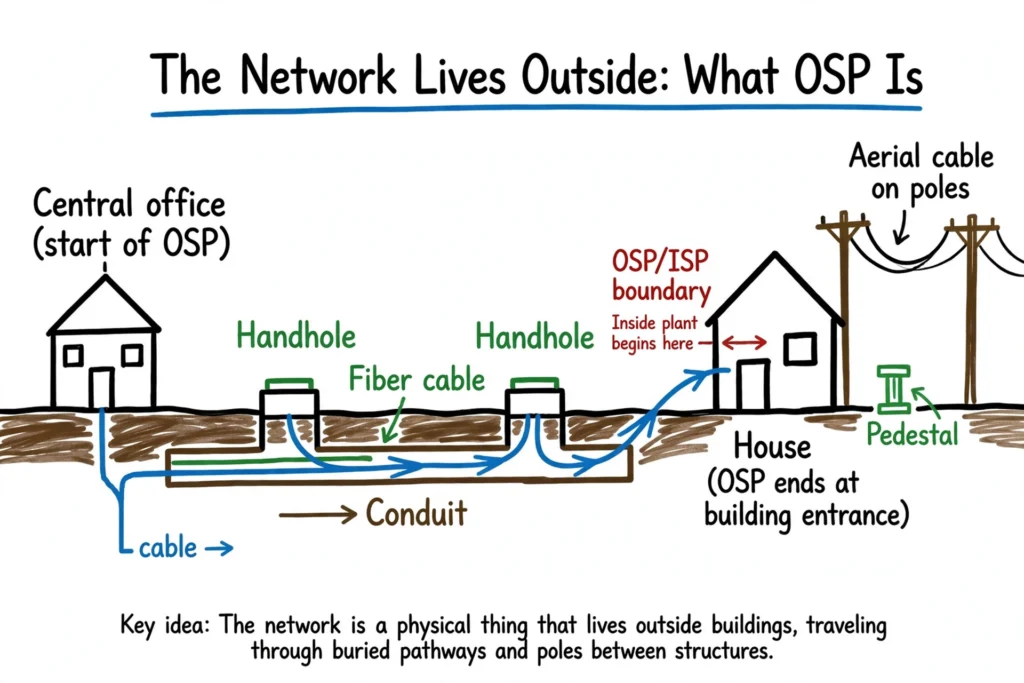
“Installed outside of buildings” is the boundary line that gives the term its meaning. The network world is split in two. Everything outside buildings is outside plant. Everything inside buildings (the wiring inside an office, the equipment room where servers sit, the cable in your wall) is called inside plant, or ISP. Where the two meet is described with several standard terms you will hear used almost interchangeably: the building entrance, the entrance facility, and the point of entrance (the exact spot the cable enters, defined in the National Electrical Code). As a working rule, OSP is everything up to the building, and ISP is everything inside it. There is one wrinkle worth knowing early: the electrical code allows outside plant cable to run up to 50 feet inside a building before it must transition to indoor-rated cable, so the boundary is a practical rule, not a wall.
“Connects buildings, neighborhoods, towns, and equipment sites to each other” describes its job: it is the between-places network. The internet inside a building is useless if it cannot reach the next building, the next town, and the wider world. OSP is that reach.
A final note on the term itself: OSP comes from the telephone industry, where “plant” meant all the physical equipment of the system. You will also hear people say “OSP” when they really mean just the cable, or just the construction work. Strictly, it means the whole outside infrastructure. In this library, we use it in the strict sense.
What Does It Look Like?
This is the section that changes how you drive to work. Once you know what to look for, OSP is everywhere, and it is mostly hiding in plain sight.
Most OSP is buried and invisible. What you see on the surface are the access points: small rectangular lids flush with the ground in grass, sidewalks, or dirt. These lids cover underground boxes called handholes (lesson 5 covers them fully), where cables pass through and where workers can reach them. You may also see short square or round green or gray pedestals sticking up a foot or two in yards and easements. These are small outdoor cabinets where cables terminate or connect. Along roads, you will see utility poles carrying thick black cables strung between them. Those cables may belong to the power company, the telephone company, or a fiber network, and sometimes to more than one. Fiber cable is often lashed to a steel support wire on poles, appearing as a thick black bundle.
Manholes are the larger cousins of handholes: round or rectangular heavy lids in streets and parking lots, big enough for a person to climb down into a concrete chamber below, where large cables pass through and splices live.
Some OSP is underwater. Submarine cable, meaning cable laid across lakes, rivers, or oceans, is also OSP. You will probably never see it, but it counts.
What Does It Do?
OSP does one job: it moves information between places as pulses of light. Here is the chain in plain language.
Your computer or phone turns what you type or say into digital data. Equipment at the edge of the network turns that data into flashes of laser light. Those flashes enter a fiber, which is a strand of glass about as thick as a human hair, and travel through it by bouncing off the inside walls of the glass. This works over miles because the glass is extremely pure, so very little light is lost along the way.
The fiber itself cannot survive the world, so OSP wraps it in layers of protection: strong plastic jackets, sometimes steel armor, and tubes and pipes that keep out water, crushing, and digging equipment. Then OSP puts that protected cable where it needs to go: buried in the ground, hung on poles, or run through conduits under streets. At intervals along the route, OSP provides access points (handholes, manholes, cabinets, poles) where workers can reach the cable to connect new customers, fix damage, or extend the network.
At the far end, the process reverses. Light comes out of the fiber, equipment turns it back into digital data, and it arrives at its destination. None of that happens without the physical plant in between. The light is the signal. OSP is everything that lets the light get there.
Where Does It Fit?
OSP is the middle of the network’s physical story, and it touches everything else.
Before OSP comes planning and design: engineers decide where the network needs to go, what it needs to carry, and how it should be built. Permits are pulled, routes are walked, and existing utilities are located. Then construction crews build the OSP: they dig trenches or drill bores, place conduit, set handholes and poles, pull or hang the cable, and splice the fibers together.
After OSP comes everything that makes the network alive: technicians test the fibers to prove they carry light properly, equipment is installed and turned on, and customers are connected. From then on, OSP lives a long working life of maintenance. Crews open handholes to add connections, repair crews fix cable cut by digging equipment, and the network grows as new areas are built.
OSP also interacts with the world around it constantly. It shares poles with electric utilities. It crosses under roads, railroads, and waterways. It runs through other utilities’ territory, which is why locating existing utilities before digging is one of the most important steps in the whole process. Almost every later lesson in this library is about one piece of this picture: how OSP is planned, built, protected, tested, documented, and maintained.
Why Does It Matter?
OSP matters because it is the part of the network that is hardest to fix and easiest to damage.
A mistake in a building’s wiring can be fixed by walking down the hall. A mistake in OSP means digging up a street, closing a lane of traffic, or climbing a pole in bad weather. OSP lives in an unforgiving environment. Underground, it faces digging equipment, shifting soil, water, and rocks. On poles, it faces storms, ice, falling trees, and vehicle strikes. Every choice made during construction, from how deep the conduit is buried to how cable is stored in a handhole, determines whether the network survives that environment for decades or fails in the first few years.
It also matters because OSP is where the money goes. The physical construction of a fiber network is the most expensive part of the whole project, far more than the electronics that light it up. A network owner can replace a piece of equipment in an afternoon. Rebuilding a badly constructed OSP route can cost more than building it right the first time. Quality in OSP is not a luxury. It is the difference between a network that pays for itself over decades and one that bleeds money on repairs.
Finally, OSP matters because it is shared infrastructure in a literal sense. It runs through public rights-of-way, across private property under easements, and on poles owned by someone else. Building it badly does not just hurt the network owner. It disrupts roads, damages other utilities, and creates hazards for the public. That is why permits, inspections, and standards exist around OSP work, and why later lessons cover them in detail.
One more reason, and it is the reason this library exists: excavation damage is one of the leading causes of fiber service interruptions. A backhoe digging in the wrong place can cut a cable serving thousands of customers in a single second. Understanding OSP, including how it is marked, documented, and protected, is the first step toward preventing that.
What Does Good Look Like?
At this stage, “good” is a big-picture idea. The details come in later lessons. But you can already learn the shape of it.
Good OSP is planned before it is built. The route is walked, existing utilities are located, permits are in hand, and the design accounts for the ground conditions, crossings, and access needs along the way. Nothing about a good build is improvised.
Good OSP is built to survive its environment. Buried cable has proper depth and protection for its location. Aerial cable has proper clearances and support. Every part of the plant is installed the way its manufacturer and the project specifications require, not the fastest way that fits in the trench.
Good OSP is accessible. Workers can reach what they need to reach: handholes are findable and openable, cable has service slack stored where it can be used, and nothing is buried that should not be buried.
Good OSP is documented. Someone recorded where everything went, how deep it is, and what was installed. Years later, when a crew needs to dig nearby or fix a problem, those records are what keep them from guessing.
Good OSP is verifiable. Its quality was checked while it could still be seen, before backfill covered it or the crew left the site. “Looks good” is not a measurement, and later lessons teach what real verification looks like.
What Can Go Wrong?
Almost everything that can go wrong with OSP comes down to three causes: it was planned poorly, built poorly, or damaged after it was built.
Poor planning shows up as routes that cannot actually be constructed: a bore path that crosses an unmarked utility, a handhole placed where equipment cannot reach it, a design that ignores rock or groundwater. These problems are discovered in the field, where they are expensive to solve.
Poor construction shows up as the network’s slow failure. Shallow cable gets cut by the next person who digs. Unsealed conduit fills with water and debris. Cable pulled too hard develops invisible damage that shows up as mysterious signal loss months later. Splices done carelessly fail. None of this is visible on the day the crew leaves, which is why verification during construction matters so much.
Damage after construction is the most dramatic category. Excavation equipment striking a buried cable is the classic case: one bucket can take thousands of customers offline. Vehicle strikes take down poles. Storms and ice bring aerial cable down. Rodents chew through unprotected cable. Every one of these is a reason OSP is built with protection, depth, marking, and documentation in the first place.
The common thread: OSP problems are expensive because OSP is hard to reach. The lesson underneath every later lesson in this library is that doing it right the first time is always cheaper than fixing it later.
What Should Someone Notice in the Field?
You do not need to be a builder to start reading OSP. Here is what a beginner can notice right now.
Look down. In grass, sidewalks, and dirt near roads, look for small rectangular lids flush with the surface. Those are handhole or vault lids. Their markings often say what is inside: telephone, fiber, communications, or a company name. A lid that is cracked, missing, or sitting crooked is worth noting.
Look for pedestals. Short green or gray boxes sticking up a foot or two in yards and along easements are telecom pedestals. They should be upright, closed, and undamaged. One that is leaning, open, or smashed has a story.
Look up. On utility poles, find the thick black cables. The highest wires are electric. Communications cables, including fiber, ride lower, often lashed to a thinner steel support wire. If you see a cable hanging much lower than the others, sagging heavily, or lying on the ground, that is a problem.
Look for construction. Open trenches with colored pipe (often orange for telecom), reels of cable on trailers, boring equipment, and utility locate marks (painted lines and flags on the ground) all mean OSP is being built or repaired nearby. Locate marks follow a standard color code: orange marks communications lines. That is worth knowing even before the lesson that covers it.
Notice what is missing. A street with no visible lids, pedestals, or poles may still have OSP; it may just be well hidden or served from a nearby route. Absence of evidence is not evidence of absence underground.
Practical Example
Consider a hypothetical example. A small internet provider decides to serve a new subdivision of 200 homes. Before a single shovel hits the ground, the OSP story is already underway.
Engineers design a route: fiber will run underground along the main road in conduit, with handholes every few hundred feet, then branch to each street. A main cable with hundreds of fibers runs the length of the road. At each handhole, smaller cables split off toward groups of homes. Near each home, a terminal on a pedestal or handhole provides the connection point, and a final short cable, the drop, runs to the house.
Construction takes weeks. Crews trench or bore along the road, place conduit, set handholes, pull cable, and splice fibers. Inspectors verify depth and workmanship before trenches are backfilled. Testers prove every fiber carries light properly.
Then the subdivision goes quiet. For years, the OSP just sits there, invisible, doing its job. A new family moves in: a technician opens the nearest handhole, connects their drop, and they have internet that afternoon. A homeowner plants a tree and cuts a drop: a repair crew fixes it the same day because the records show exactly where the cable runs.
Every piece of that story, the conduit, the handholes, the cable, the splices, the drops, the records, is OSP. And every lesson in this library explains one part of how that story gets built right.
Key Terms
- Outside plant (OSP): all of the physical network infrastructure installed outside of buildings, including cables, pathways, poles, and access structures.
- Inside plant (ISP): the network infrastructure inside buildings, such as indoor wiring and equipment rooms. Do not confuse this abbreviation with “internet service provider,” which uses the same letters in a different context.
- Fiber (optical fiber): a thin strand of glass that carries information as pulses of light.
- Conduit: a protective tube, usually plastic, installed underground to hold and protect cables.
- Handhole: a small underground box with a removable lid, providing workers access to buried cable.
- Manhole: a larger underground chamber, big enough for a person to enter, where major cables pass through.
- Pedestal: a small above-ground cabinet where cables terminate or connect, commonly seen in yards and easements.
- Building entrance / entrance facility / point of entrance: the standard terms for where outside cable enters a building and the inside plant begins.
- Right-of-way: land reserved for public infrastructure like roads and utilities, where much OSP is built.
- Easement: a legal right to use someone else’s property for a specific purpose, such as running cable across it.
Check Your Understanding
1. In your own words, what does “outside plant” include, and where is its boundary with inside plant?
Answer: OSP includes all physical network infrastructure outside buildings: cables, conduit and pathways, poles, handholes, manholes, pedestals, and cabinets. The boundary with inside plant is the building entrance (also called the entrance facility or point of entrance): OSP is everything up to the building, ISP is everything inside it, with the practical wrinkle that code allows OSP cable to run up to 50 feet inside before transitioning.
2. Why is OSP harder to fix than inside plant, and what does that imply about construction quality?
Answer: OSP is buried, on poles, or otherwise exposed to the environment, so fixing it means digging, traffic control, or climbing in bad weather instead of walking down a hall. That implies quality during construction matters enormously, because problems are expensive to reach and repair later. Doing it right the first time is always cheaper.
3. Name three things you could observe on a drive through a neighborhood that indicate OSP is present.
Answer: Any three of: rectangular lids flush with the ground (handholes/vaults), green or gray pedestals in yards or easements, thick black cables on utility poles (lashed to a steel support wire, riding below the electric wires), manholes in streets, open trenches with orange pipe, cable reels on trailers, or orange locate marks on the ground.
4. What is the single most common cause of sudden, widespread fiber outages, and what OSP practices help prevent it?
Answer: Excavation damage, a digging machine striking buried cable. Prevention comes from proper burial depth and protection, accurate locating and marking (orange marks for communications), good as-built records showing where cable runs, and careful coordination before anyone digs.
Lesson Takeaway
Outside plant is the entire physical network outside buildings: the cables, pathways, poles, and access structures that carry the internet between places. It is the most expensive part of a fiber project to build and the hardest part to fix, which is why planning, workmanship, accessibility, documentation, and verification matter so much. You can already start recognizing it: lids in the ground, pedestals in yards, cables on poles, orange marks on pavement. Every lesson from here on explains one piece of how this plant gets built right.
Sources and Technical References
- FOA (Fiber Optic Association) Guide: definition and overview of outside plant fiber networks — https://www.thefoa.org/
- NEC Article 770 (optical fiber cables) and Article 800 (communications circuits): point of entrance and the 50-foot rule for unlisted OSP cable inside buildings (NEC 770.48, 770.50).
- NTSB safety study citing FCC-appointed NRSC reliability data: excavation damage identified as the single largest cause of fiber service interruptions (53% of facility outages).
- APWA Uniform Color Code: orange designates communications; red designates electric power lines, cables, and conduit.
← Previous: Level 1: See the OSP Network | Level 1 Hub | Next: Lesson 2: Underground vs. Aerial →