What You Are Learning
By the end of this lesson, you will understand what conduit is, what it is made of, the common types you will hear about on a fiber project, what job it does for the network, how it is put together in the ground, and how to recognize it when you see it in the field. You will also understand why conduit matters to the cost and success of a fiber build, and what good and bad conduit work looks like at a beginner level.
Start With the Basics
Think of the fiber cable as the valuable thing that carries the internet signal. It is thin, fragile, and expensive to replace. You would not bury it bare in rocky dirt where shovels, rocks, and settling soil can reach it. Conduit is the pipe you put the cable inside. It is the protective tunnel that lives underground so the fiber does not have to face the dirt on its own. In lesson 3, you learned that a pathway is the continuous protected route fiber travels. Conduit is the physical pipe that makes the underground version of that pathway real.
What Is It?
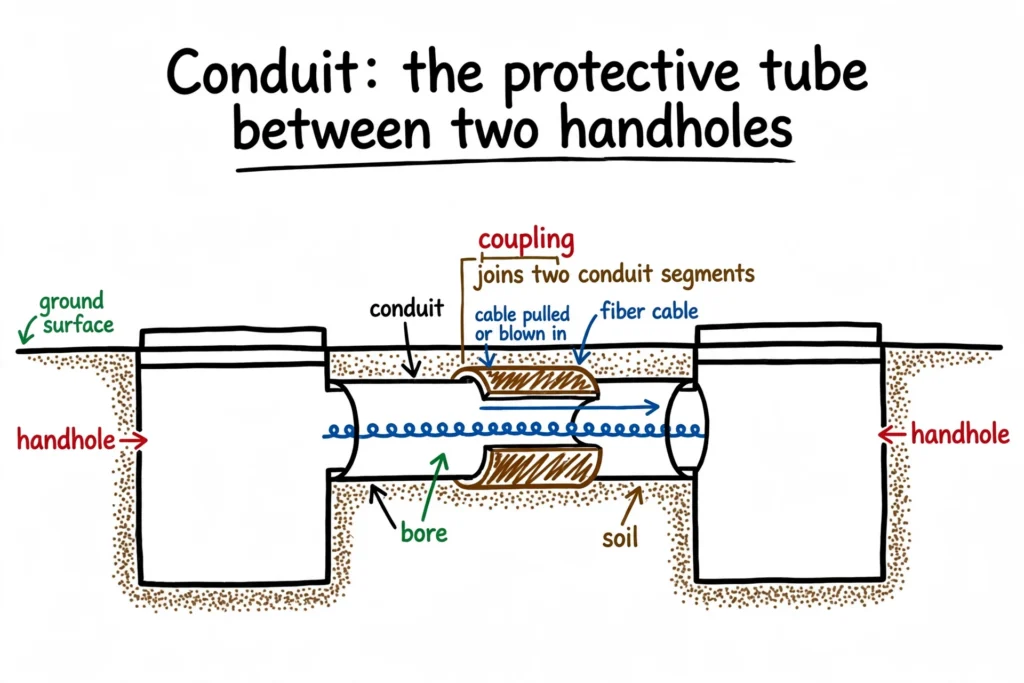
A conduit is a tube, usually made of plastic, that is installed underground (or sometimes inside a building or on an aerial structure) to hold and protect cables. The word “duct” is often used to mean the same thing, and in the fiber world you will hear both terms used almost interchangeably. Inside a conduit, there is an empty space called the bore. The fiber cable goes into that bore during a later step called cable placement. “Placement” simply means the process of getting the cable into the conduit and into its final position along the route.
A few related terms you need now, because everyone on a job site will use them:
- Innerduct: a smaller tube placed inside a larger conduit. The big outer pipe gives overall protection, and the innerducts divide its bore into separate smaller tunnels. That way, several cables can share one big conduit without tangling, and each one can be installed or replaced on its own.
- Microduct: a very small tube, used with small-diameter fiber cables. Several microducts are often bundled together inside one conduit, which lets a network pack many cables into the space of one pipe.
- Coupling (or coupler): a short, slightly wider sleeve that joins two conduit segments end to end. It slides over the ends of both pieces and holds them together, forming one continuous tube. (Rigid PVC pipe is the exception: it usually glues into socket fittings instead. Your project’s specs decide which kind you use.)
- Cable placement: the step where fiber cable is put into the conduit, usually by pulling it through with a rope or by blowing it through with compressed air.
- Proofing: a check performed before cable goes in, to confirm the conduit is open, clear, and undamaged. This lesson only mentions proofing so you know the step exists; a later lesson covers it in detail.
Note that in this lesson, “conduit” always means the protective tube in an outside plant pathway, not the electrical conduit an electrician runs inside a house. Same idea, different world.
What Does It Look Like?
The most common sight is a large coil or reel of colored plastic pipe. Flexible conduit arrives wound on wooden or steel reels, like a giant spool of hose. Rigid conduit sometimes arrives in straight sticks, usually about ten or twenty feet long. When you see an open trench with pipe in the bottom, that pipe is conduit waiting to be covered with soil. Where the trench ends at a structure, the conduit sticks up out of the ground and enters the structure through an opening. (Lesson 5 will define a handhole, the small underground box this pipe usually connects to.)
The color you will see most often on a fiber job is orange. Orange is a common industry choice for telecom conduit because it stands out in a trench and signals “communications line, dig carefully.” Other colors are used too. Some conduit is black with colored stripes, and gray conduit is common on electrical work (a clue you are looking at a different trade’s pipe, not fiber’s). Along the outside of the conduit, manufacturers print markings: the material, size, and a running footage count that tells you how many feet of pipe are behind that point. Those printed numbers are how crews know how much conduit they have used.
A coupling looks like a short, slightly wider section of pipe at a joint. Where two segments meet, the coupling wraps both ends so the bore stays smooth and continuous. (Coupling styles vary: push-on and heat-fused sleeves for HDPE duct, glued socket fittings for rigid PVC.) Conduit segments are joined this way roughly every stick length on rigid pipe, and less often on long coiled runs, which is why coiled HDPE is popular: fewer joints mean fewer places for things to go wrong.
What Does It Do?
Conduit does three jobs.
First, it protects the cable. Soil presses in, rocks shift, water flows, and someday another crew will dig in the same area. The conduit takes that abuse so the fiber does not have to. A crushed conduit usually means the cable inside it took a beating too. Every cable is rated for how much crush it can take, and a crushed pipe has almost certainly blown past that rating, so treat the cable as damaged until someone qualified checks it.
Second, it creates a smooth path for getting the cable in. The inside of the conduit is slick, sometimes with a special low-friction lining, so the fiber cable can be pulled or blown through hundreds or thousands of feet from one access point to the next. Without that smooth tube, installing cable along an underground route would be nearly impossible.
Third, it preserves the future. Because the cable sits inside a tube rather than buried directly in the dirt, it can be pulled out and replaced with a bigger or newer cable later, using the same conduit. That ability to remove and replace cable without digging the route up again is a major reason fiber networks are built with conduit instead of burying the cable directly.
How does the fiber actually get in? At a concept level, there are two main methods. Pulling means attaching the cable to a rope (often with a swivel so the cable does not twist) and drawing it through the conduit from one end. Blowing (also called jetting) means using compressed air to push the cable through, with the air carrying it along inside the tube; it is gentler on the cable and can cover longer distances. Both methods depend entirely on the conduit being a smooth, continuous, unobstructed tube. If the conduit is crushed, kinked, or full of dirt, neither method works.
Where Does It Fit?
Conduit goes in during pathway construction, which happens before the fiber cable arrives. The sequence is roughly: dig the trench (or bore the hole underground without trenching), lay the conduit, join the segments with couplings, run the conduit into structures like handholes, cover it back up, then verify it is usable (proofing), and only then place the fiber cable. In other words, conduit is the shell that gets built first so the valuable part can be installed second.
It typically runs from handhole to handhole, handhole after handhole, forming the underground chain of the network’s pathway (see lessons 2 and 3 on underground pathways and the pathway concept). Where trenches are dug, conduit is laid in the open trench. Where the ground cannot be dug up (under a road or driveway, for example), conduit is installed by boring, a method that pushes or drills a hole horizontally underground without opening a trench, and the conduit is then pulled into that hole.
Conduit also interacts with inspection. Inspectors look at conduit before it is buried: they check that it is continuous, that joints are properly coupled, that ends are protected, and that it enters structures correctly. Some of that inspection happens while the trench is still open, because once the trench is backfilled (filled back in with soil), problems are hidden and much more expensive to fix.
Why Does It Matter?
Everything that happens later depends on the conduit. If the conduit is damaged or poorly installed, the fiber cable cannot be placed, or it gets damaged during placement, or it fails years later and cannot be replaced. A crushed section of pipe becomes a problem for the entire network segment, because cable must pass through every inch of the run.
The cost impact is real. Fixing conduit after the trench is buried means re-digging, which costs labor, equipment time, and schedule days. A blocked run discovered during cable placement can stop an entire crew and delay the rest of the project, since fiber work behind that run cannot proceed until the pathway is fixed. Building the conduit right the first time is one of the cheapest ways to protect a project’s budget and schedule.
What Does Good Look Like?
Good conduit work has a few recognizable characteristics:
- Continuous runs. The conduit forms an unbroken tube from one access point to the next. No gaps, no missing sections.
- Proper joints. Where segments meet, they are joined with the right couplings, fully seated, so the bore is smooth and the joint does not separate when the soil moves or cable is pulled through.
- Protected ends. Conduit ends that are not yet connected to a structure are capped, plugged, or taped shut so dirt, water, and debris cannot get inside.
- Correct routing into structures. The conduit enters handholes and other structures cleanly, in the right position, without sharp bends at the entry point.
- No damage. The pipe is not crushed, kinked, gouged, or flattened anywhere along the run.
One important distinction: everything above is general good practice. A real project also has contract specifications, which are the written technical requirements the customer and contractor agreed to. Specifications may require specific materials, sizes, colors, installation methods, and test results. Good practice gets you in the right neighborhood; the contract’s specifications define exactly what counts as acceptable on that particular job.
What Can Go Wrong?
- Crushed or flattened conduit. Heavy equipment driving over a shallow or unprotected run, or rocks pressing against the pipe, can crush it. The bore narrows or closes, and cable cannot pass.
- Kinked conduit. If flexible conduit is bent too sharply during installation, it can kink like a garden hose. The kink pinches the bore shut.
- Separated joints. Couplings that were not properly joined can pull apart when soil settles or when cable is pulled through. The gap lets dirt and water in and can catch or damage the cable.
- Blocked runs. Dirt, gravel, or water that gets in through open ends can fill or clog the bore. A conduit full of debris is a conduit that cannot accept cable.
- Open ends left unprotected. Conduit ends left uncapped in a trench or sticking out of the ground will collect soil and water. This is one of the most common and most avoidable problems.
The consequence is the same in every case: the pathway cannot do its job, so fiber cannot be installed or replaced, and someone has to dig it up and fix it. Stated plainly, without exaggeration: bad conduit work converts a cheap step done right into an expensive step done twice.
What Should Someone Notice in the Field?
You do not need to be an installer to notice conduit and spot the obvious problems. Here is what a beginner should look for:
- Color and markings. Orange pipe with printed markings along its length is very likely telecom conduit. Read the printed text; it tells you the material and size.
- Open ends that should be capped. If you see a conduit end sticking up out of the ground or out of a trench with nothing covering it, that is worth noting. It should be capped or plugged.
- Visible damage. Crushed, flattened, kinked, or gouged pipe is visible to the naked eye. A coupling that has slid off or a joint with a visible gap is also visible.
- Conduit entering structures. Where pipe meets a handhole or building, look for whether it enters cleanly and whether the opening around it looks sealed or finished.
An important boundary: noticing and reporting is not the same as being qualified to install, repair, or inspect conduit to a professional standard. Observation helps the project; hands-on conduit work and formal inspection belong to trained people following the project’s specifications and safety rules.
Practical Example
The following is a hypothetical example invented for teaching. It did not happen.
A crew finishes laying conduit along a 500-foot trench on a Thursday afternoon. It is getting late, so they leave the open conduit ends at both ends of the trench uncapped overnight, planning to cap them in the morning. Overnight it rains. By morning, both ends have several feet of muddy water and silt inside the pipe. When the cable crew arrives the next week to pull fiber, the rope snags in the silt, the conduit is blocked, and the placement crew has to spend a full day flushing and clearing the run before any cable can go in. A two-minute job (capping the ends) would have prevented a full day of delay. This is why protected ends are on the “what good looks like” list.
Key Terms
- Conduit (duct): a protective tube installed underground (or elsewhere) that holds and protects cables. “Duct” is used to mean the same thing in fiber work.
- Bore: the hollow inside of a conduit; the space the cable travels through.
- Innerduct: a smaller tube placed inside a larger conduit, creating separate channels so multiple cables can share one conduit without tangling.
- Microduct: a very small tube used with small-diameter fiber cables; often bundled with other microducts inside a larger conduit.
- Coupling (coupler): a short sleeve that joins two conduit segments end to end, keeping the bore continuous.
- Cable placement: the process of installing fiber cable into conduit, by pulling or by blowing.
- Pulling: installing cable by drawing it through the conduit with a rope.
- Blowing (jetting): installing cable by pushing it through the conduit with compressed air.
- Proofing: a check, done before cable placement, that confirms the conduit is open, clear, and undamaged. Covered in detail in a later lesson.
- Backfill: soil placed back into a trench over the conduit after it is installed.
- Boring: an underground installation method that creates a horizontal hole without digging an open trench, used where the surface cannot be disturbed.
Check Your Understanding
1. In your own words, why is fiber cable placed inside conduit instead of being buried directly in the dirt? What problems does the conduit solve?
2. A friend sees orange pipe coiled on a reel at a job site and asks what it is for. Explain what it is and what will eventually go inside it.
3. A crew finishes a conduit run on Friday and leaves both ends open over the weekend. What is the risk, and what should they have done instead?
4. Why does a crushed section of conduit matter even if the rest of the 1,000-foot run is in perfect shape?
5. Two neighboring projects both need fiber along the same street. One buries the cable directly; the other installs conduit and places the cable inside. Ten years later, both need bigger cables. Which project has the easier job, and why?
Answer key:
1. Conduit protects the cable from soil pressure, rocks, water, and future digging; it provides a smooth tube so cable can be pulled or blown in; and it allows the cable to be removed and replaced later without re-digging. Direct burial leaves the cable exposed to all of those hazards and makes replacement require new digging.
2. It is conduit (also called duct), the plastic pipe that forms the underground pathway for fiber. The empty bore inside it will hold fiber optic cable, which gets pulled or blown in later, after the conduit is installed and verified usable.
3. The open ends can fill with dirt, water, or debris over the weekend. That blocks the bore and prevents cable placement, or forces an expensive cleaning step. They should have capped, plugged, or taped the ends shut.
4. The cable must travel through the entire run. A crushed section narrows or closes the bore at that point, so cable cannot pass it. One bad section breaks the whole pathway, like one blocked tunnel on an otherwise clear road.
5. The conduit project has the easier job. The old cable can be pulled out of the conduit and the new cable pulled or blown in through the same tube, with no digging. The direct-burial project has to dig the street up again to install the new cable.
Lesson Takeaway
Conduit is the protective plastic tube that forms the underground pathway for fiber cable. You now know what it is made of (commonly HDPE or PVC), the types you will hear about (duct, innerduct, microduct), how segments join (couplings), and what it does (protects the cable, provides a smooth installation path, and allows future replacement). You can recognize it in the field by its color, its printed markings, its coils or sticks, and the way it enters structures. And you know the basics of what good looks like: continuous runs, proper joints, capped ends, clean entries into structures, and no damage.
Sources and Technical References
- Fiber Optic Association (FOA), “Fiber Optic Ducts and Microducts” by Vladimir Grozdanovic: duct and microduct types, materials (HDPE, PVC), sizes, and installation by pulling or blowing/jetting. https://foa.org/tech/ref/install/Ducts.pdf
- Dura-Line (HDPE conduit manufacturer), MicroDucts HDPE product data: microduct sizes, low-friction coextruded lining (SILICORE), sequential footage markings, pull string and pre-installed fiber options. https://duraline.com/-/ods/Resource/462/3068/Original/DL_MD_HDPE.4.23.pdf?version=1680554175
- Dura-Line, FuturePath hybrid conduit product data: multiple conduit/microduct sizes in one installation, installation methods (plow, directional bore, trench, microtrench), applicable standards (ASTM F-2160, ASTM D-3350, NEMA TC-7, UL 651A, UL 1990). https://www.duraline.com/-/ods/Resource/163/3057/Original/DL_FP%20Hybrid_3way_5.23.pdf?version=1683032943
- NYSDOT specification item for fiber optic innerduct (example of contract-level specification): HDPE innerduct, color per plans, drag line (muletape) requirement. https://ht.dot.ny.gov/spec-repository/680.9912–11.pdf (cited only as an example of how contract specs define innerduct, not as a universal requirement)
- Millennium (fiber contractor), “Pulling vs. Blowing Fiber: A Beginner’s Guide”: blowing method concept, proofing before placement, cable preparation. https://www.mymillennium.us/blog/pulling-vs-blowing-fiber/
- Cabling Installation and Maintenance, “A comparison of conventional fiber and blown cable”: pulling vs blowing distances and speeds as reported by the author (figures are that article’s reported values, not universal rules). https://www.cablinginstall.com/design-install/cabling-installation/article/16466307/a-comparison-of-conventional-fiber-and-blown-cable
Items I could not verify or chose not to claim: exact universal conduit burial depths, wall thicknesses, and bend radii vary by project specification, manufacturer, and local code; this lesson states none of them as universal. Common U.S. conduit sizes (e.g., 1.25-inch or 2-inch HDPE) were not stated because sizes are set by the project design and contract, not by an industry-wide rule.
← Previous: Lesson 3: What Is a Pathway? | Level 1 Hub | Next: Lesson 5: What Is a Handhole? →