
What You Are Learning
By the end of this lesson, you will understand what a handhole is, what it does, and how to recognize one in the field. You will know why these small underground structures matter to fiber construction crews, what a healthy handhole looks like, and what a problem looks like. You will not be qualified to open one or work inside one. That takes training and authorization. Recognition is your job; the crew’s work is the crew’s job.
Start With the Basics
Think of the last time you saw a green or gray lid in a yard or beside a sidewalk. It looked like a flat box sitting at ground level, maybe with words stamped into the top like “Fiber Optic” or “Communications.” That is probably a handhole.
Here is the basic idea before we add any terminology. Fiber cable travels underground inside protective tubes. Nobody can reach into those tubes once they are buried. So at certain points along the route, the builder places a box in the ground with a removable lid. When a crew lifts the lid, they have a working space right at the tube. They can pull cable through it, coil up extra cable, and get to the places where cables are joined. Then they close the lid and the box disappears back into the landscape.
The name is literal. It is a hole you can reach into with your hand. It is not a hole you climb into. That distinction matters, and it is the whole basis of this lesson.
What Is It?
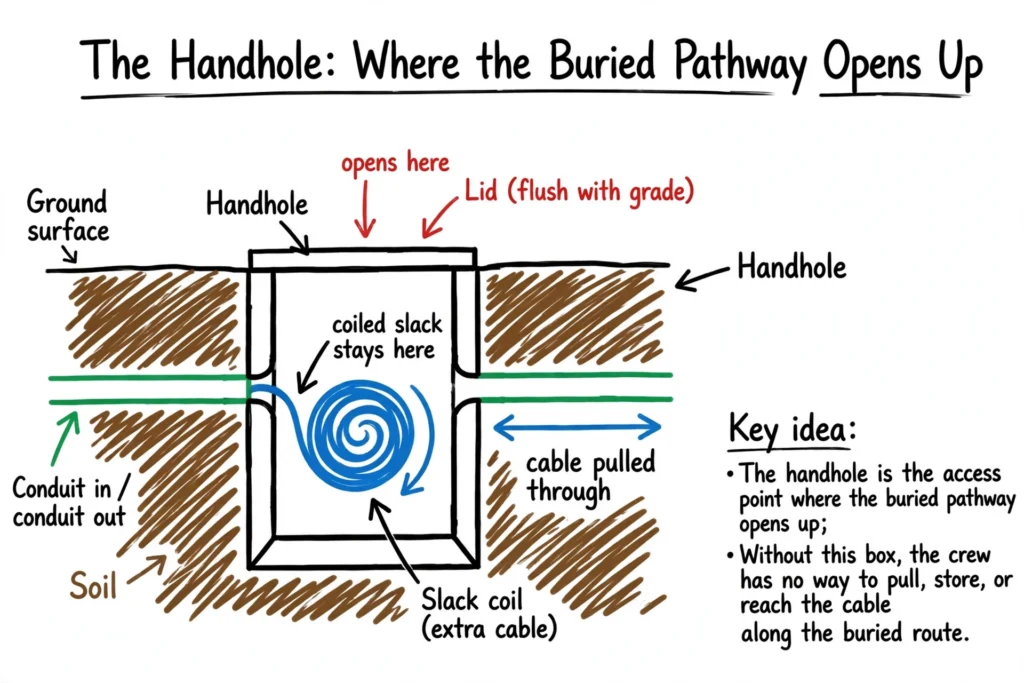
A handhole is a small underground enclosure set in the ground so its lid sits at or near ground level. It is typically a box with four walls, an open bottom (some designs have a closed bottom), and a removable lid. Conduit runs pass through it or terminate in it, and the interior provides a protected space where crews can pull fiber cable through, store coiled slack (extra cable kept on purpose for future use), and access splice closures (the sealed cases that hold the joined fibers, which a later lesson covers in detail).
The handhole is not where the fiber signal is processed or amplified. It is an access point and a storage space. Its job is to make the underground pathway workable: a place where the buried run opens up so people can do the pulling, coiling, and splicing work that the rest of the network depends on.
A vault or manhole is the bigger cousin. Those are large enough for a person to enter and work inside, and they have their own rules about confined spaces and permits. A handhole is smaller and intended to be worked from the surface. A later lesson covers that comparison in detail, so for now remember just this: if you reach into it, it is a handhole; if you climb into it, it is something else.
What Does It Look Like?
A handhole is a box set in the ground, usually rectangular, with a lid that sits flush with the surrounding surface. The box itself can be made of polymer concrete, HDPE (high-density polyethylene, a tough plastic used in utility products), or fiberglass, and it usually has an open bottom so it rests on soil or a gravel bed. The lid may be a single piece or split into two halves, and larger or traffic-rated lids may bolt down.
The lid is what you will actually see. Typical markings stamped or molded into a telecom handhole lid include “Fiber Optic,” “Communications,” “Telecom,” or the name of the cable owner. Manufacturers sell standard lid nameplates and markers that include those options, along with blank and custom choices, and some project specifications require a particular label. (A warning from the research: some project specs require NO marking at all, so a blank lid does not automatically mean an empty or abandoned handhole. Read the marking if one is there; do not over-interpret the absence of one.) Lids are often green or gray, though concrete lids exist too.
Handholes sit along the conduit route, commonly in grass strips, planting beds, or easements (the legal corridors where a utility is allowed to build) beside sidewalks and roads, near buildings where cable enters, and at road or railroad crossings. They are part of the designed route, not placed at random, and a later lesson covers placement rules.
When the lid is lifted, conceptually you would see conduit entering through the walls, coils of fiber cable looped inside, and splice closures (sealed boxes or cylindrical cases holding the joined fibers) mounted or resting in the box. You will likely never see this as a beginner, and that is fine. The surface view is your world: a lid, a marking, a location.
Common variations: round handholes exist as well as rectangular ones. Some handholes are rated for traffic loading (heavier lids for driveways and parking lots) and some are light duty for grass. The project specification, not a universal rule, decides which type goes where. No universal dimensions exist; handhole sizes vary widely by manufacturer and application, from small boxes for a single conduit run up to large splice handholes that hold several coils and splice cases.
What Does It Do?
A handhole does three practical things, and industry installation guidance confirms all three.
First, it is an access point for pulling cable. When a crew installs fiber cable underground, they do not push hundreds or thousands of feet of cable through a buried tube from one end. They feed cable into the tube at one handhole and pull it out at the next, using a pull rope, a pull line, or a cable-blowing machine. The handhole is the window into the run where the pulling equipment goes.
Second, it stores slack. Slack is extra cable left intentionally in a coil. Fiber cable cannot be stretched or cut short and spliced on the spot without work, so crews leave slack at intervals: at splice points, at building entrances, and along long runs. The coil sits in the handhole, protected and available if the cable needs to be pulled back, repaired, or re-spliced later. Per industry sizing guidance, even the smallest intermediate handholes must be large enough to hold the slack coil; sizing is built around the coil, not just the box.
Third, it provides access to splices. Where two cable reels meet end to end, or where a branch cable feeds off the main run, the fibers are spliced and the splice is protected inside a splice closure. Larger handholes are placed at splice locations specifically to hold the coil and the closure together, with room for the crew to open the closure and work on the fibers.
In plain terms: conduit runs terminate or pass through the handhole, fiber pulling happens through it, slack lives in it, and splices are reached through it. Everything the cable needs along the buried route, the handhole provides access to.
Where Does It Fit?
Handholes are installed during pathway construction, which was the subject of Lesson 3. The crew digs the trench or bores the path, places the conduit (Lesson 4), and sets handholes at the designed locations along the route. The conduit runs connect handhole to handhole, so the handholes are the nodes and the conduit is the line between them. If you remember nothing else from this lesson’s placement in the sequence, remember that: handholes plus conduit equals the underground pathway.
Fiber cable pulling and splicing happen later, using the handholes as working points. Inspection happens at multiple stages: the inspector checks handhole placement and condition during construction, and again when cable is pulled and spliced. Maintenance happens for the life of the network, which is one reason buried or paved-over lids are such a serious problem. The handhole is where the design meets the field, where the inspector checks the work, and where future crews come back when something needs repair. It touches every phase of the project except the cable manufacturing itself.
Why Does It Matter?
The handhole is the main designed way into the buried pathway. If a handhole is missing, buried under fresh asphalt, crushed by a vehicle, or flooded, the crew cannot pull cable through that point, cannot reach the slack, and cannot get to the splice closure. The work does not simply get harder; at that location, it stops.
That is why handholes matter out of proportion to their size. A lost or damaged handhole can force a crew to dig a new one, re-expose the conduit, or reroute the run, which means rework, delay, and cost. On most projects, the cheapest phase to get the handhole right is during initial installation, when the trench is open and the crew is already there. Problems found later usually cost more, because the ground has to be opened again.
What Does Good Look Like?
A good handhole, in general good-practice terms, looks like this:
- The lid sits flush with the surrounding grade (the surface level of the ground around it), not sticking up as a trip hazard and not sunken in a hole that collects water.
- The lid is marked to identify what is inside (Fiber Optic, Communications, or the owner’s name), where the project calls for a marking.
- The handhole is accessible. Nothing is built over it, parked on it, or grown over it so badly that the lid cannot be found and lifted.
- Conduit enters the handhole cleanly through the walls, trimmed back sensibly (industry guidance suggests trimming innerduct to a short stub inside the box, about six inches, so it does not consume working space) and sealed so water, dirt, and animals cannot flow freely into the box.
- The interior is organized: slack coils are neatly looped and secured, splice closures are mounted or supported, and there is room to work.
Important distinction: these are general good-practice characteristics. Whether a handhole is accepted on a specific job is decided by the contract specifications and the owner’s requirements, not by a universal checklist. Some projects require bolted lids, some require traffic-rated covers in driveways, some specify exact markings, some do not. “Good” on your project means whatever the contract documents say. The list above is what a healthy handhole looks like in the industry broadly, and it is the baseline a beginner should learn to recognize.
What Can Go Wrong?
Several things go wrong with handholes in the field, and all of them have the same consequence: the crew cannot use the handhole for its job.
- Buried or paved-over lids. This is one of the most common problems. A road gets repaved, a landscaper adds soil, a property owner pours a sidewalk extension, and the lid disappears. The handhole is now inaccessible without digging it out, and sometimes nobody knows where it is until a crew pulls a tape from the next handhole and hits a dead end.
- Broken, missing, or unrated lids. A cracked lid lets water, dirt, and debris into the box. A missing lid is an open hole, a hazard, and an invitation for anything from a twisted ankle to a crushed cable. A light-duty lid in a driveway can break under a vehicle. The lid type must match where the handhole sits.
- Flooding. Handholes are not sealed vaults. If drainage is poor, if conduit is not sealed, or if the lid sits below grade in a low spot, water collects in the box. Standing water accelerates damage to closures and makes any work inside miserable and slower.
- Damaged conduit entries. If the conduit entering the handhole is cracked, collapsed, or left unsealed, pulling cable through it may be impossible, and the interior fills with dirt. Repairing a conduit entry usually means digging.
- Disorganized interiors. Slack coils tangled and unsecured, closures jammed in with no working room, excess innerduct filling the box: the handhole technically exists, but the crew cannot do useful work in it. This is an installation quality problem, and it is exactly the kind of thing an inspector flags.
None of this is exotic. It is ordinary construction wear, poor installation, and poor records. The lesson for a beginner is proportion, not fear: these problems are common enough to take seriously and fixable enough to plan for.
What Should Someone Notice in the Field?
A beginner’s job in the field is to notice, not to touch. Here are specific things to observe:
- Finding lids. Walk a route and look for the lids: along sidewalks, in planting beds, near building walls, at road crossings. Notice how often you can find one easily and how often the location makes you guess. If you cannot find a lid that the plans say should be there, that is an observation worth reporting to the project team.
- Reading lid markings. When you can see a lid, read what it says: Fiber Optic, Communications, Telecom, the owner’s name. This tells you whose network lives below. Notice whether markings match the network you expect on this project.
- Noticing problem lids. Buried lids (only a hint of an edge visible), cracked lids, missing lids (an open or covered hole), lids below grade holding water: these are the visible signs of the failures described in the last section. Photograph and report them through your project’s normal process. Do not move, lift, or repair them yourself.
Safety, stated plainly:
- Opening a handhole and working inside it is crew work. It requires training, authorization, and the right equipment. A beginner never lifts a lid in or near traffic, and a beginner never enters any underground space. (A handhole is worked from the surface, but larger structures on the route are confined spaces with their own permit rules, and you are not expected to know which is which from the surface.)
- Reading this lesson teaches you to recognize a handhole and its condition. It does not qualify you to open one, work around live traffic, or enter a confined space. Observing from the surface is the beginner’s job, and it is a useful one: crews would rather hear about a buried lid from someone walking the route than discover it with a stuck cable pull.
Practical Example
This is a hypothetical example, not a report of a real incident.
A neighborhood fiber build is halfway done. Cable pulling crews arrive at a street where the plans show three handholes in a row. The first two are where the drawings say they should be, lids flush with the grass, marked “Fiber Optic.” The third is missing. The crew finds fresh blacktop where the sidewalk contractor extended a walkway two weeks earlier, right across the planned handhole location.
The pull that was supposed to feed cable through that handhole and continue down the street cannot happen. The crew cannot access the conduit run between the second and third points, and they cannot get to the slack coil that is supposed to wait there. Work stops on that street. The project has to locate the handhole under the asphalt (pulling a tape from the second handhole until it stops tells them where the run ends), cut the pavement open, and rebuild the handhole at grade. That is a day or more of labor, a pavement repair, and a delayed schedule, all because a lid got buried under a walkway nobody coordinated.
The beginner’s lesson in this story is the noticing: the person who walks the route and reports “the third lid is under fresh asphalt” before the cable crew arrives has just saved the project a painful day.
Key Terms
- Handhole. A small underground enclosure with a removable lid at or near ground level, sized so a person reaches in from the surface. Conduit runs pass through or terminate in it; slack cable and splice closures are stored and accessed there.
- Lid. The removable cover of the handhole, sitting at or near ground level. Often stamped or labeled with markings such as “Fiber Optic” or “Communications” to identify the contents.
- Conduit. (From Lesson 4.) The protective tube or pipe that carries fiber cable underground. Conduit runs enter and exit the handhole through its walls.
- Slack. Extra cable left intentionally in a coil, usually inside a handhole, so the cable can be pulled back, repaired, or re-spliced later without installing new cable.
- Splice. The joining of two fiber cables so light (the signal) passes through. Protected inside a splice closure.
- Splice closure. A sealed case or box that holds and protects spliced fibers. Stored in the handhole and opened only by qualified crews.
- Grade. The surface level of the ground around a structure. A lid is “at grade” when it sits level with the surrounding surface.
- Innerduct. (From Lesson 4.) A smaller flexible tube installed inside a larger conduit, giving each cable its own protected path. Enters the handhole near the walls and is trimmed back after cable installation.
- Vault / manhole. A larger underground chamber that a person can enter and work inside. Covered in detail in a later lesson; know only that it is not a handhole.
- Easement. A legal corridor across property where a utility is allowed to build and maintain its facilities. Handholes are commonly placed within easements.
Check Your Understanding
1. A crew needs to pull fiber cable through an underground conduit run. Why do they work from handholes instead of pulling the whole run from one end?
2. Two handholes sit along the same street. One is at a splice location and one is midway along a long run. Which one needs more interior space, and why?
3. You are walking a job site and see a handhole lid cracked in half in a parking lot. What does this tell you about what might be wrong inside, and what should you do?
4. A property owner paved a new walkway over a handhole lid. The handhole is “still there” under the concrete. Why is this still a problem?
5. Your project drawings show a handhole at a certain location, but you walk the site and cannot find it. What are two possible explanations, and who should you tell?
Answer key
1. Pulling tension and friction limit how far cable can be pulled through a conduit in one shot. Handholes divide the run into shorter pulls: the crew feeds cable into the tube at one handhole and pulls it out at the next. This is the access-point function of the handhole.
2. The splice-location handhole needs more space. Per industry guidance, splice handholes must hold the slack cable coil and the splice closure together, plus room for the cable’s minimum bend and the crew’s tools. The intermediate handhole needs, at minimum, room for the slack coil.
3. A cracked lid in a parking lot suggests the lid is not rated for vehicle traffic, or it has been driven over beyond its rating. Water, dirt, and debris can enter the box, and the opening is a hazard. You should photograph and report it through your project’s normal reporting process. You should not lift, move, or replace the lid yourself.
4. Because a handhole’s job is to be an access point. A buried lid cannot be opened, so the crew cannot pull cable through that point, reach the slack, or access the splice closure. The handhole is useless until it is re-exposed at grade, which requires cutting the walkway open.
5. The handhole may have been buried (soil, landscaping, or paving added over it after installation) or installed at a slightly different location than drawn (field conditions often shift placements). Tell the project team, ideally with a photo and the planned location, so it can be located and recorded properly.
Lesson Takeaway
A handhole is the small underground box with a removable lid that opens the buried pathway to the surface. Conduit runs meet there, fiber cable is pulled through there, slack coils wait there, and splices are reached there. It is a reach-in box, not a climb-in chamber, and that single distinction separates it from a vault or manhole. In the field, your job is to recognize the lids, read the markings, and notice the problems: buried, cracked, missing, or flooded. A handhole that cannot be opened cannot do its job, and the whole route behind it goes quiet.
Sources and Technical References
- OFS / Lightera, “Sizing Handholes for Fiber Optic Cables” (practice IP079). Defines the two handhole applications (access for cable installation; storage for slack cable and splice closures), the sizing distinction between splice handholes and intermediate handholes, and innerduct trimming guidance. https://www.ofsoptics.com/wp-content/uploads/IP079-Sizing-Handholes-for-Fiber-Optic-Cables.pdf (also hosted at https://lightera.com/wp-content/uploads/IP079-Sizing-Handholes-for-Fiber-Optic-Cables.pdf)
- Charles Industries, Tier-Rated Underground Enclosures product page. Documents standard lid nameplate options (Fiber Optic, Communications, CATV, Electric, Telephone) and the distinction between tier-rated handhole sizes and load ratings. https://charlesindustries.com/product/tier-rated-underground-enclosures-true/
- ACP / Telecom Specialties, Handhole Lid Markers product page. Confirms standard stock lid markings of “Fiber Optics,” “Communications,” and “Electric” for underground enclosure lids. https://telecomspecialties.com/products/handhole-lid-marker-fiber
- FiberKNCT, “How to Install Fiber Handholes in Telecommunication Applications.” Documents installation practice: lid labeling (“TELECOM” or “COMMUNICATIONS”), pull-point spacing limits on a sample specification, conduit alignment into the handhole, and bedding/backfill practice. Note: the spacing and bend limits on this page come from a specific installation spec, not a universal standard. https://fiberknct.com/uncategorized/how-to-install-fiber-handholes-in-telecommunication-applications/
- Illinois Tollway, Section L Fiber Optic Details standard drawing. An example of owner-specific requirements: their handhole detail specifies no lid marking and specific stainless bolts, which shows that lid marking conventions vary by owner and project, not by a single industry rule. https://agency.illinoistollway.com/documents/20184/562941/Section%20L%20-%20Fiber%20Optic%20Details.pdf/40321254-47c1-4ac5-9acc-8492812bf551?version=1.1&t=1493892077408&download=true
Could not verify: a single authoritative, beginner-level industry definition of “handhole” from the FOA or a similar body. The definitions used in this lesson are synthesized from the manufacturer and industry sources above plus common utility usage. Also, universal placement/spacing rules were deliberately not stated because verified sources show spacing limits coming from project-specific specifications, not from a universal standard.
← Previous: Lesson 4: What Is a Conduit? | Level 1 Hub | Next: Lesson 6: What Is a Utility Pole? →