

History of Fiber Optics
Category: Fiber Fundamentals
Reading Time: 12 Minutes
Skill Level: Beginner
Quick Answer
The history of fiber optics is the story of how scientific discoveries about light evolved into the modern communication networks that power the internet, businesses, schools, hospitals, and homes around the world.. Scientists first learned how light could be controlled and transmitted through glass. Engineers then developed optical fiber capable of carrying information over long distances with very little signal loss. As the technology matured, contractors created new installation methods, equipment, and quality standards that allowed reliable fiber networks to be built around the world. Understanding this history explains why modern fiber networks are designed, installed, tested, and maintained the way they are today.
What You’ll Learn
By the end of this article, you will understand:
- How fiber optics evolved from scientific experiments into modern communication networks.
- Why fiber replaced copper as the preferred communication medium.
- How construction methods changed as fiber deployment expanded.
- Why today’s installation standards exist.
- How the history of fiber optics continues to influence modern fiber construction.
Introduction
Every time you stream a movie, join a video conference, send an email, use online banking, or browse the internet, there is a good chance your data travels across a fiber optic network. Those networks have become one of the world’s most important pieces of infrastructure, carrying enormous amounts of information between homes, businesses, schools, hospitals, data centers, wireless towers, and communities every second.
Fiber optic cable may seem like a modern invention, but the technology behind it has been developing for well over one hundred years. Today’s fiber networks are the result of thousands of discoveries, improvements, and lessons learned across multiple industries. Scientists studied the behavior of light. Manufacturers developed methods for producing extremely pure glass. Engineers designed systems capable of transmitting information using pulses of light. Construction professionals created the equipment, installation methods, testing procedures, and quality standards required to build reliable networks in the real world.
Every advancement solved a problem that existed before it. Better glass reduced signal loss. Stronger cable designs protected delicate optical fibers during installation. Improved testing equipment helped identify defects before customers experienced service interruptions. New construction methods allowed fiber to cross highways, rivers, railroads, and crowded cities with less disruption and greater reliability. Even the standards used on today’s construction projects were developed from decades of field experience, helping prevent problems that earlier generations encountered.
For contractors, inspectors, engineers, project managers, municipalities, utility owners, and internet service providers, understanding the history of fiber optics provides valuable context. It explains why modern networks are organized into backbone, distribution, access, and drop segments. It explains why fiber requires different handling than copper. It explains why construction standards emphasize bend radius, pulling tension, testing, documentation, and quality inspections. Understanding where the industry has been makes it easier to understand why today’s best practices exist.
This article follows the evolution of fiber optics from the earliest discoveries about light to the construction practices used on today’s broadband projects. Along the way, you’ll see how science, engineering, manufacturing, and construction combined to create the communication infrastructure that supports much of the modern world.
Why the History of Fiber Optics Matters
Many people assume the history of fiber optics is simply a collection of dates and famous inventors. For construction professionals, the history is much more practical than that. Every conduit installed, every splice completed, every handhole placed, and every fiber tested is influenced by lessons the industry has learned over decades of designing, building, operating, and maintaining communication networks.
Before fiber optics became practical, communication systems relied almost entirely on copper conductors. Copper served the telecommunications industry well for many decades because it was durable, readily available, and capable of carrying electrical signals over long distances. As telephone systems expanded and digital communication became more common, however, the limitations of copper became increasingly apparent. Engineers needed more bandwidth, greater transmission distances, lower maintenance requirements, and improved reliability than copper could economically provide.
The development of fiber optics solved many of those challenges, but it also created entirely new construction requirements. Unlike copper, fiber optic cable contains extremely thin strands of glass that must be protected throughout transportation, installation, splicing, testing, and long-term operation. That reality forced the construction industry to rethink nearly every aspect of how communication infrastructure was built. New equipment, specialized tools, improved testing methods, detailed documentation practices, and higher quality standards became essential parts of every fiber project.
Understanding this history helps explain why modern construction standards exist. Minimum bend radius requirements protect the glass fibers from excessive stress. Pulling tension limits prevent damage during installation. Conduit systems shield fiber from future excavation and environmental hazards. Fusion splicing produces low-loss connections capable of lasting for decades. OTDR testing verifies installation quality before a network is placed into service. None of these practices developed by accident. Each represents a solution to a problem the industry experienced somewhere along its journey.
As you continue learning about fiber construction, you’ll notice that nearly every topic builds on the history presented in this article. Whether you’re studying conduit installation, handholes, directional drilling, fiber blowing, splicing, testing, or documentation, each practice exists because it improves the reliability, maintainability, and long-term performance of the overall fiber network.
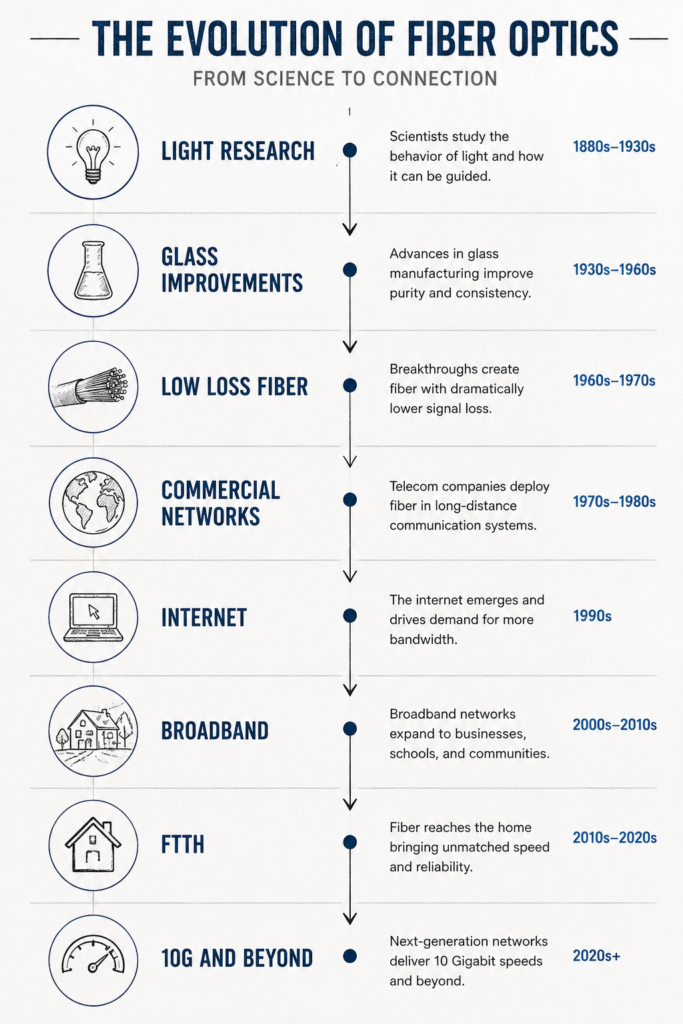
Early Discoveries in the History of Fiber Optics
Modern fiber optic networks exist because scientists first answered a simple question: Can light be controlled?
That question may sound straightforward today, but the answer took decades of research. Before engineers could use light to carry internet traffic, telephone calls, or television signals, they first had to understand how light behaves as it moves through different materials. Those discoveries became the scientific foundation that eventually allowed contractors to install millions of miles of fiber optic cable around the world.
Understanding Light Transmission
Light travels naturally through materials such as air, water, and glass. Early scientists understood that much, but they wanted to know whether light could be guided instead of simply traveling in every direction.
If light could be controlled, it could potentially carry information from one location to another.
That idea eventually became the foundation of optical communication.
Although today’s fiber networks move digital information, the underlying principle is still the same. Every email, phone call, video stream, or internet search is converted into pulses of light that travel through an optical fiber.
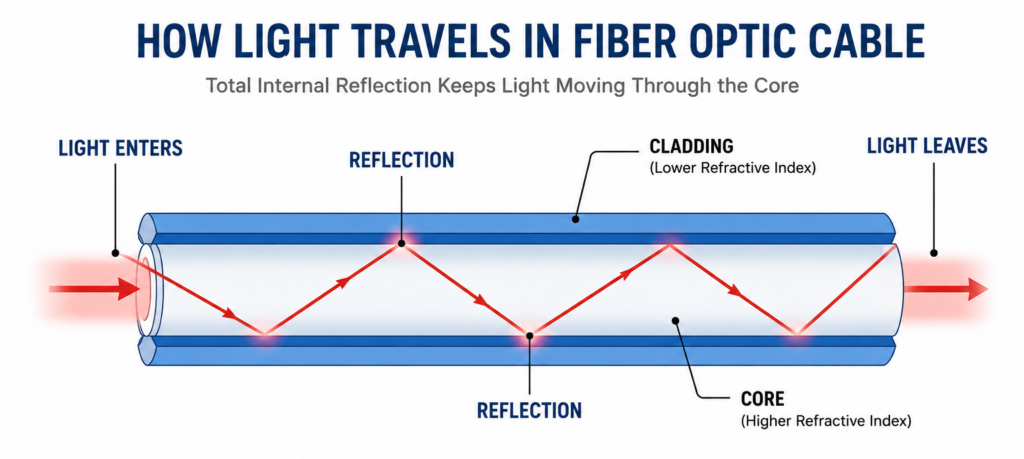
Understanding how light moves was the first step toward making that possible.
Definition: Light Transmission
Light transmission is the movement of light through a material such as air, water, or glass. Fiber optic communication depends on transmitting light through specially manufactured strands of glass while keeping as much of the light inside the fiber as possible.
The Discovery of Refraction
One of the earliest breakthroughs came from studying what happens when light passes from one material into another.
Scientists observed that light changes direction when it moves between materials with different optical properties. This phenomenon is called refraction.
A simple example can be seen by placing a straw into a glass of water. The straw appears bent where it enters the water, even though it remains perfectly straight. The light reflecting from the straw changes direction as it moves between water and air, creating the illusion of a bend.
Although this appears to be a simple experiment, it revealed an important principle that would later help engineers understand how light behaves inside an optical fiber.
Definition: Refraction
Refraction is the change in direction that occurs when light passes from one material into another. Fiber optic communication relies on carefully controlling refraction so light remains inside the optical fiber.
Understanding Reflection
Scientists also studied what happens when light strikes a surface instead of passing through it.
Sometimes light is absorbed.
Sometimes it passes through.
Sometimes it reflects.
Reflection occurs when light bounces off a surface rather than continuing forward. A household mirror is one of the most familiar examples.
Researchers eventually discovered that under the right conditions, light could repeatedly reflect inside transparent materials instead of escaping. That discovery would later lead to one of the most important concepts in fiber optics: total internal reflection, the principle that keeps light traveling through optical fiber for miles with very little loss.
Definition: Reflection
Reflection occurs when light strikes a surface and bounces away instead of passing through it. Fiber optic cable uses controlled reflection to keep light contained within the glass core.
Early Optical Experiments
During the nineteenth and early twentieth centuries, scientists performed numerous experiments to determine whether light could be guided along a controlled path.
One well-known demonstration directed light through a stream of flowing water. Instead of traveling in a straight line, the light followed the curve of the water. Other experiments used curved glass rods to achieve similar results.
These demonstrations proved that light could follow a path rather than simply spreading in every direction.
The materials available at the time, however, were not suitable for communication systems. Too much light escaped before it could travel any significant distance. Researchers still needed a way to dramatically reduce signal loss.
Those early experiments answered one critical question.
Guiding light was possible.
The challenge became guiding it efficiently.
Improvements in Glass Manufacturing
Understanding light was only part of the solution.
The quality of the glass itself also had to improve.
Early glass contained tiny impurities, bubbles, and inconsistencies that scattered light as it traveled through the material. Even small imperfections caused significant signal loss, making long-distance communication impossible.
Manufacturing technology gradually produced glass that was much purer and far more consistent. As impurities were removed, light traveled farther before weakening. Those improvements transformed optical fiber from an interesting scientific concept into a practical communication medium.
Even today, manufacturers continue refining fiber optic cable to improve strength, reduce attenuation, and increase long-term reliability.
The quality of the glass remains one of the most important factors affecting network performance.
Why These Discoveries Matter
None of these early discoveries created the fiber optic networks we use today.
Instead, they answered the scientific questions that later generations of engineers built upon.
Scientists learned how light behaves.
Manufacturers learned how to produce exceptionally pure glass.
Engineers combined those discoveries to create optical communication systems.
Construction professionals then developed the installation methods needed to build reliable fiber networks on a massive scale.
Every fiber optic cable installed today traces its origins back to these early discoveries. Without understanding light transmission, refraction, reflection, and glass manufacturing, modern broadband infrastructure would not exist.
Key Takeaways
- Fiber optics began as scientific research rather than a communication technology.
- Understanding light transmission was the first step toward optical communication.
- Refraction and reflection explained how light behaves inside transparent materials.
- Improvements in glass manufacturing made long-distance fiber communication practical.
- These discoveries provided the scientific foundation for every modern fiber optic network.
The Birth of Fiber Communications
Understanding how light behaves was a remarkable scientific achievement, but it did not immediately change the telecommunications industry. For many years, engineers still relied on copper conductors because they were proven, affordable, and capable of supporting the communication systems of the time.
As demand for communication increased, however, the limitations of copper became increasingly difficult to overcome. Telephone networks continued to expand. Businesses began exchanging more digital information. Computers became more common, and the internet introduced an entirely new level of data traffic. The world needed a communication system capable of carrying significantly more information than copper could economically support.
Fiber optics provided that solution.
Why Copper Was No Longer Enough
For much of the twentieth century, copper formed the backbone of communication networks. Telephone calls, television services, and early computer networks all depended on electrical signals traveling through copper wire.
Copper performed well for decades, but every communication medium has limits.
As more people connected to communication networks, the amount of information those networks needed to carry increased dramatically. Service providers needed higher speeds, greater capacity, and more reliable long-distance communication. Expanding copper networks often meant installing additional cables, adding electronic equipment, or constructing new infrastructure, all of which increased construction and maintenance costs.
Eventually, engineers recognized that simply adding more copper was no longer the most practical solution.
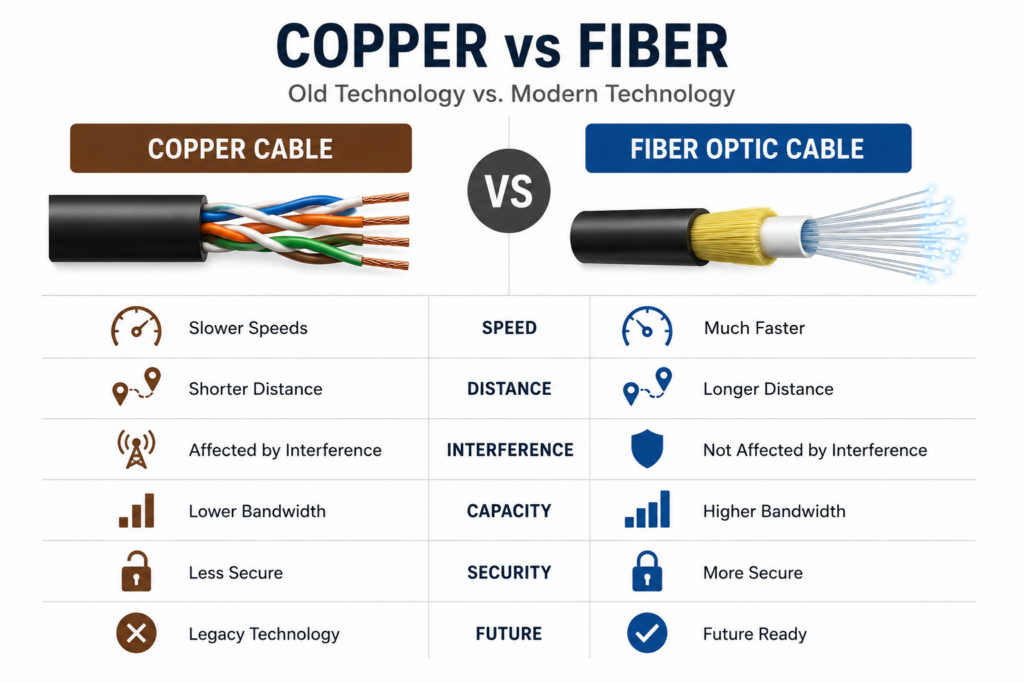
Before looking at the specific advantages of fiber optics, it is helpful to compare the two communication technologies at a high level. Figure F-005 summarizes the major differences between copper and fiber optic cable that ultimately drove the telecommunications industry toward fiber-based infrastructure.
The Need for Greater Bandwidth
One of copper’s biggest limitations was bandwidth.
Definition: Bandwidth
Bandwidth is the amount of information that can be transmitted through a communication system during a given period of time. Higher bandwidth allows more voice, video, and data traffic to move through the network at the same time.
As communication demands increased, copper systems struggled to provide enough capacity.
The rise of digital communication accelerated this problem. Email, websites, file transfers, online video, cloud computing, and streaming services all required substantially more bandwidth than traditional telephone systems.
Fiber optic cable solved this challenge by allowing enormous amounts of information to travel as pulses of light through a single optical fiber.
Reducing Signal Loss
Distance created another challenge for copper networks.
Electrical signals gradually weaken as they travel through copper conductors. This gradual reduction in signal strength is called attenuation.
Definition: Attenuation
Attenuation is the gradual loss of signal strength as information travels through a communication medium. Lower attenuation allows information to travel farther before requiring amplification or regeneration.
Because copper experiences relatively high attenuation, long communication routes require electronic equipment to restore the signal at regular intervals.
Fiber optic cable experiences significantly lower attenuation.
That means light can travel much greater distances before signal regeneration becomes necessary. Fewer regeneration sites reduce construction costs, operating expenses, equipment maintenance, and potential points of failure.
Eliminating Electrical Interference
Copper networks also face a challenge that fiber does not.
Because copper carries electrical current, nearby electrical equipment, power lines, lightning, radio transmitters, and other electromagnetic sources can interfere with the communication signal. This interference introduces noise into the network and can reduce communication quality.
Fiber optic cable works differently.
Information travels as light rather than electricity. Glass does not conduct electricity, making fiber naturally immune to electromagnetic interference. This allows fiber to operate reliably in environments where copper systems may experience performance problems.
For utilities, industrial facilities, transportation systems, and critical communication infrastructure, that advantage became increasingly important.
From Scientific Discovery to Practical Technology
The transition from laboratory research to commercial communication required more than understanding light.
Manufacturers had to develop optical fibers with extremely low attenuation.
Engineers designed lasers capable of producing stable light signals.
Receivers learned to convert pulses of light back into usable electronic information.
Connectors, splices, testing equipment, and communication electronics all had to improve before fiber could be deployed on a large scale.
As those technologies matured, fiber moved from research laboratories into real communication networks.
Initial deployments focused on long-distance routes where fiber’s advantages were greatest. Those early projects demonstrated that fiber could reliably carry far more information than copper while requiring less signal regeneration and providing greater long-term capacity.
That success changed the direction of the telecommunications industry.
Why Fiber Changed Everything
Replacing copper with fiber did more than improve communication speeds.
It fundamentally changed how communication networks would be designed for the next several decades.
Instead of constantly adding more copper to meet growing demand, network owners could install fiber infrastructure capable of supporting future technologies that had not yet been invented. In many cases, the same fiber installed decades ago continues carrying dramatically more data today simply because the equipment connected to each end has improved.
That long-term scalability remains one of fiber optics’ greatest advantages.
The glass itself often outlasts multiple generations of electronics, allowing network owners to upgrade capacity without replacing the physical cable.
Construction Perspective
For today’s construction professionals, this history explains why fiber projects are treated as long-term infrastructure investments rather than short-term utility installations. A conduit system, splice enclosure, or backbone cable installed today may remain in service for thirty years or more. Building it correctly the first time allows future generations to increase network capacity by upgrading electronics instead of rebuilding the underground infrastructure.
Key Takeaways
- Copper supported communication networks for many decades but eventually reached practical performance limits.
- Growing demand for internet and digital communication required significantly more bandwidth.
- Fiber optic cable carries far more information while experiencing lower signal attenuation.
- Fiber is immune to electromagnetic interference because it transmits light instead of electricity.
- The transition from copper to fiber reshaped the telecommunications industry and created the foundation for modern broadband networks.
From Laboratory to Construction Site
Developing fiber optic communication in a laboratory was a remarkable scientific achievement. Building millions of miles of reliable fiber infrastructure was an entirely different challenge.
A successful laboratory experiment might involve only a few feet of optical fiber in a controlled environment. Real-world communication networks had to survive manufacturing, shipping, storage, installation, weather, temperature changes, accidental excavation, and decades of continuous operation. Solving those challenges required more than advances in engineering. It required the construction industry to develop entirely new materials, equipment, installation methods, and quality standards.
The fiber networks being installed today are the result of that evolution.
Early Fiber Was Difficult to Install
The first generations of fiber optic cable were far less forgiving than modern products.
Although the glass fibers themselves were capable of transmitting enormous amounts of information, they were also extremely delicate. Excessive pulling force could damage the cable. Sharp bends could increase signal loss. Contamination during splicing could reduce performance. Even minor installation damage could affect a network long after construction was complete.
Copper cable had conditioned the industry to expect communication cables to tolerate rough handling. Fiber required a completely different approach.
Contractors quickly realized that protecting the cable during installation was just as important as designing the communication system itself.
Construction Perspective
This is one reason today’s installation specifications place so much emphasis on handling practices. Requirements for bend radius, pulling tension, storage, cable support, and splice protection all originated because contractors learned what happened when fiber was treated like copper.
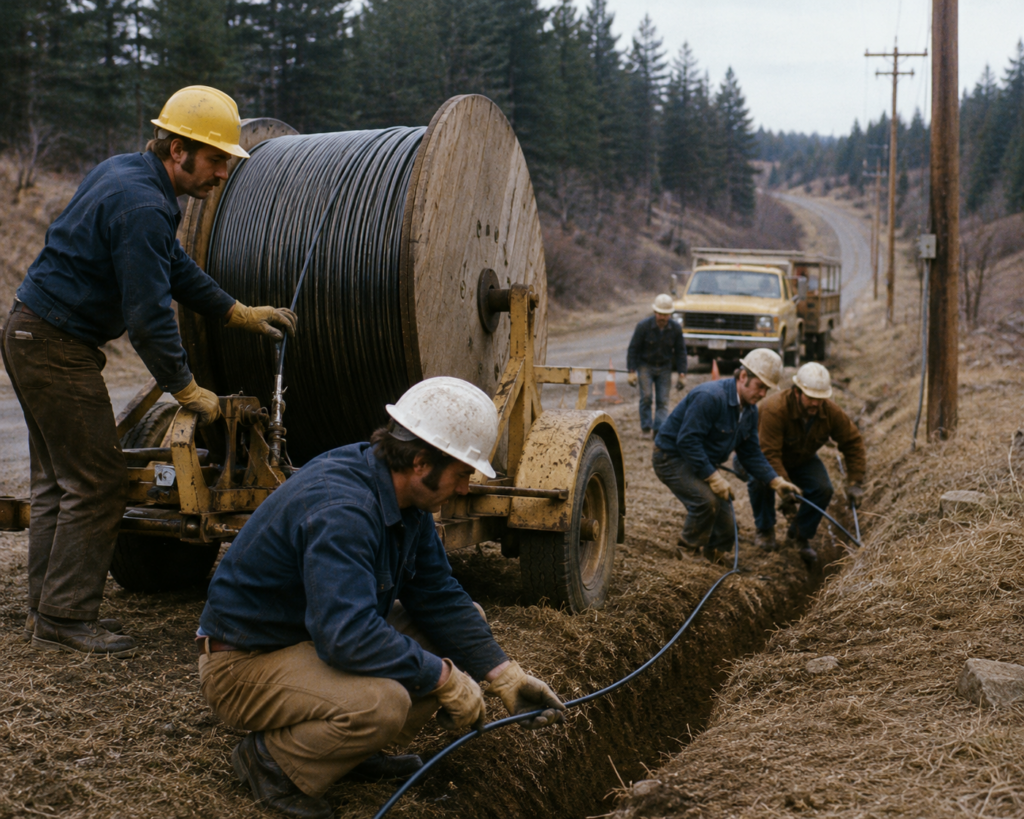
Early fiber deployments required construction crews to develop installation techniques that had never been used before. New materials, specialized equipment, and improved handling practices gradually replaced traditional methods that had been developed for copper cable. Figure F-006 shows a representation of an early fiber installation crew during the industry’s transition from copper-based construction to fiber optic infrastructure.
New Installation Methods Had to Be Developed
Traditional communication construction methods were designed around copper cable.
Fiber introduced new challenges.
Crews needed ways to install cable without exceeding pulling tension. Long conduit routes required techniques that minimized stress on the fiber. Underground crossings had to be completed without damaging existing utilities or exposing the cable to unnecessary risk.
Rather than modifying existing practices, the industry developed entirely new construction methods specifically for fiber optic infrastructure.
Many of those methods remain the standard today.
Equipment Changed With the Technology
As fiber deployment increased, manufacturers began developing equipment specifically designed for optical cable installation.
Cable Reels
Cable reels became larger and more sophisticated to safely transport longer lengths of fiber optic cable. Proper reel handling reduced unnecessary bending and mechanical stress before installation even began.
Cable Pullers
Mechanical cable pullers allowed crews to install fiber through conduit while carefully controlling pulling force. Unlike copper installations, fiber construction required close attention to manufacturer tension limits throughout the installation process.
Fiber Blowing Equipment
Compressed-air installation systems introduced another major advancement.
Rather than relying entirely on mechanical pulling force, fiber blowing machines use compressed air to propel lightweight fiber cable through conduit. This reduces installation stress and allows contractors to install cable over much longer distances.
Today, fiber blowing is widely used for backbone networks, distribution systems, and microduct installations.
Fusion Splicers
Connecting two copper conductors is relatively straightforward.
Joining two optical fibers requires far greater precision.
Fusion splicers align the ends of two optical fibers and permanently fuse them together using an electric arc. When performed correctly, a fusion splice introduces very little signal loss and creates a durable connection capable of lasting for decades.
Fusion splicing became one of the defining technologies that made large-scale fiber deployment practical.
OTDR Testing
Installing cable is only part of the construction process.
Contractors must also verify that the installation meets project requirements.
The Optical Time Domain Reflectometer, commonly called an OTDR, became one of the industry’s most important testing tools. By sending pulses of light through the fiber and measuring the reflected signal, an OTDR can identify splice locations, connectors, excessive loss, bends, and other potential defects.
Rather than waiting for customers to discover problems, contractors can identify and correct many issues before the network is placed into service.
Construction Methods Continued to Evolve
As demand for broadband increased, installation methods continued improving to make projects faster, safer, and more economical.
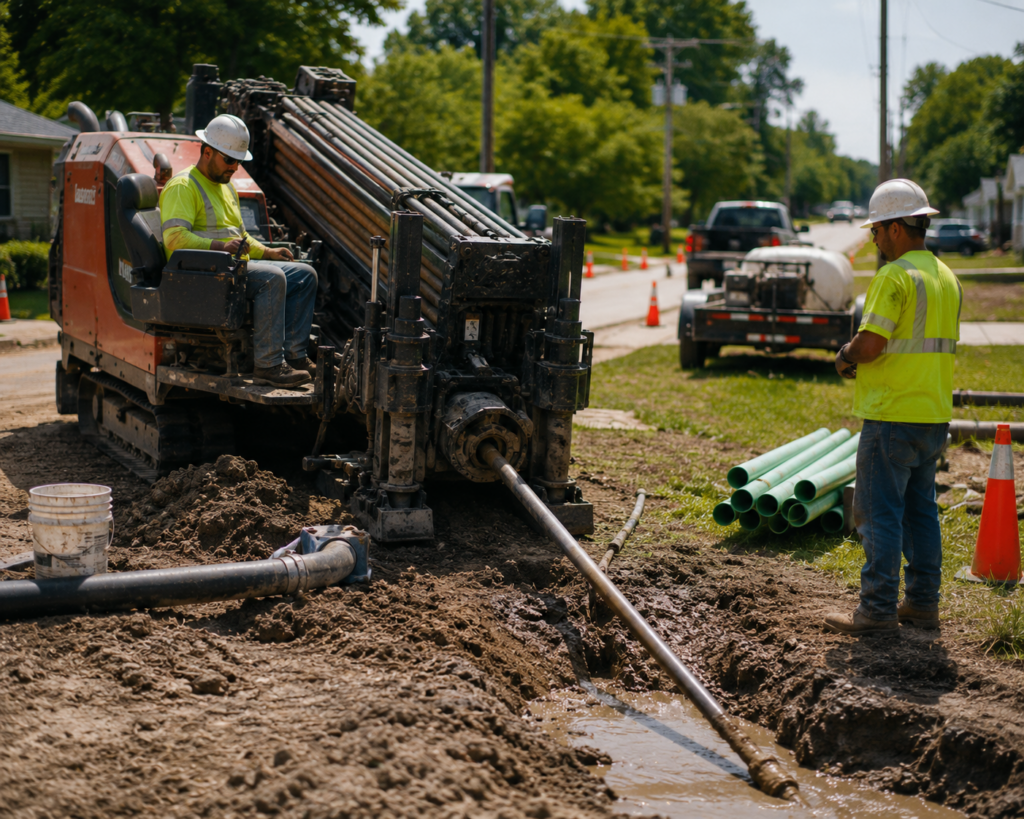
Horizontal Directional Drilling
Horizontal Directional Drilling (HDD) transformed underground fiber construction.
Instead of excavating an open trench across an entire project, contractors could install conduit beneath roads, rivers, railroads, parking lots, and existing utilities while leaving the surface largely undisturbed.
Today, HDD is one of the most common installation methods used for underground fiber construction because it minimizes restoration while reducing disruptions to traffic, businesses, and property owners.
Microduct Systems
Engineers also recognized that communication networks would continue growing long after the initial construction project.
Instead of installing a single conduit for one cable, many projects began incorporating microduct systems containing multiple smaller pathways. Additional fiber could then be installed in the future without reopening the ground.
This approach significantly reduced future construction costs while making network expansion much easier.
Air-Blown Fiber
Air-blown fiber took that concept even further.
Once microduct was installed, compressed air could be used to install additional fiber as demand increased. Network owners no longer needed to excavate new routes every time more capacity was required.
This approach remains popular in business parks, campuses, data centers, and rapidly growing communities where future expansion is expected.
Prefabricated Assemblies
Modern fiber construction also benefits from factory-built components.
Manufacturers now produce pre-terminated drop cables, hardened connectors, splice closures, multiport terminals, and other assemblies that arrive at the jobsite ready to install.
Performing more assembly work in controlled manufacturing environments improves consistency, reduces field labor, shortens installation schedules, and helps reduce installation errors.
Construction Drove the Success of Fiber
Scientific discoveries made fiber optic communication possible.
Engineering transformed those discoveries into practical communication systems.
Construction made widespread deployment possible.
Without reliable installation methods, specialized equipment, quality standards, testing procedures, and skilled contractors, fiber would have remained an impressive technology with limited real-world use.
Every modern broadband project builds upon decades of construction innovation. The equipment used on today’s jobsites, from fusion splicers and OTDRs to directional drills and fiber blowing machines, exists because previous generations continuously improved the way fiber networks are built.
Key Takeaways
- Early fiber optic cable required much different handling than copper cable.
- Construction practices evolved alongside fiber technology.
- Specialized equipment made large-scale fiber deployment practical.
- Directional drilling, fiber blowing, and microduct systems changed how networks are installed.
- Modern construction methods are the result of decades of continuous improvement.
Evolution of Fiber Network Design
As fiber optic technology matured, engineers faced a different challenge.
Knowing how to transmit information through fiber was only part of the solution. They also needed to determine how to organize an entire communication network capable of serving millions of customers efficiently.
The answer was not a single cable running from one location to another.
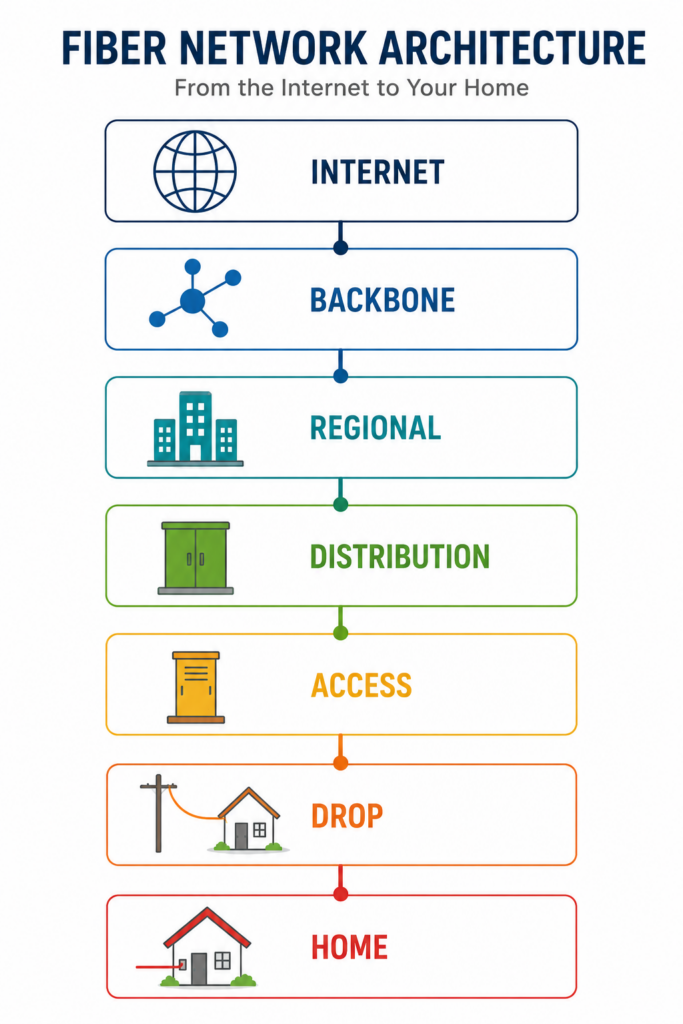
Instead, engineers developed a layered network architecture that moves large amounts of information across long distances before gradually distributing that capacity to individual communities, neighborhoods, businesses, and homes.
Although equipment has changed dramatically over the years, this basic network design remains the foundation of nearly every modern fiber network.
Long-Distance Backbone Networks
The first large-scale fiber deployments focused on long-distance communication.
These high-capacity routes connected major cities, regional communication hubs, international gateways, and data centers. Their purpose was simple: move enormous amounts of information over very long distances as efficiently as possible.
Backbone networks were never intended to connect directly to individual customers.
Instead, they served as the transportation system for the entire communications network.
A useful comparison is the interstate highway system.
Interstates move large volumes of traffic between major cities. Local roads then carry that traffic to neighborhoods and individual destinations.
Fiber backbone networks perform the same function for digital information.
Regional Backbone Networks
As fiber deployment expanded, communication providers extended those long-distance routes into regional backbone networks.
Regional backbones distribute capacity from national networks into states, metropolitan areas, and rural regions. They provide the connection between large transportation routes and the communities that ultimately use the network.
Without regional backbone infrastructure, individual cities would have no practical way to connect to national communication systems.
Distribution Networks
The next layer is the distribution network.
Distribution fiber carries communication services from backbone facilities into neighborhoods, commercial developments, schools, hospitals, industrial facilities, wireless towers, and other service areas.
Distribution networks typically contain cabinets, handholes, splice closures, and branching points where large fiber counts begin dividing into smaller service areas.
Most contractors spend a significant amount of time building this portion of the network because it connects major infrastructure to the communities being served.
Access Networks
As fiber moves closer to customers, it enters the access network.
The access network connects neighborhood distribution systems to the areas where individual subscribers receive service.
Depending on the network design, this may include passive optical networks (PON), cabinets, pedestals, terminals, or other equipment that prepares the network for individual customer connections.
The access network represents the transition from community infrastructure to customer service.
Last Mile Connections
The final outside plant connection is commonly called the last mile.
This portion of the network connects the access system directly to an individual home, business, school, or other customer location.
Although last-mile cable represents only a small percentage of the overall network, it is often the portion customers notice most because it delivers the service they use every day.
Customer Premises
Once fiber reaches the property, the network continues into the customer premises.
This includes the optical network terminal (ONT), interior fiber, Ethernet cabling, Wi-Fi equipment, and the devices used by the customer.
Although much of this equipment falls outside traditional outside plant construction, it completes the communication path that began hundreds or even thousands of miles away.
Why Modern Networks Use Layers
Every layer of a fiber network serves a specific purpose.
Large backbone cables efficiently transport enormous amounts of data across long distances.
Distribution networks divide that capacity into smaller service areas.
Access networks prepare the connection for customers.
Last-mile drops complete the final connection.
Organizing the network this way reduces construction costs, improves reliability, simplifies maintenance, and allows capacity to grow as demand increases.
Without this layered design, modern broadband deployment would be far more expensive and much more difficult to maintain.
Construction Perspective
Understanding network architecture helps contractors appreciate why different cable sizes, conduit systems, splice locations, and equipment appear throughout a project. A crew installing a 432-count backbone cable is building a completely different part of the network than a crew placing a single residential drop, yet both installations are essential to delivering reliable broadband service.
Key Takeaways
- Modern fiber networks use a layered architecture rather than a single continuous cable.
- Backbone networks move large amounts of information across long distances.
- Distribution and access networks divide capacity into service areas.
- Last-mile connections deliver service directly to customers.
- Every layer influences construction methods, material selection, and long-term network performance.
Evolution of Construction Methods
Fiber optic cable may be the most visible part of a communication network, but the methods used to install it have evolved just as much as the cable itself. As broadband demand increased, contractors needed faster, safer, and more efficient ways to build networks across cities, farmland, mountains, neighborhoods, and existing utility corridors.
No single construction method works everywhere. Soil conditions, terrain, existing utilities, traffic, environmental concerns, project budgets, and restoration requirements all influence how fiber is installed. Over time, the industry developed several specialized construction methods, each designed to solve a specific problem while protecting the long-term performance of the network.
Open Trenching
Open trench construction was one of the earliest methods used to install underground communication infrastructure and remains one of the most common today.
This method involves excavating a continuous trench, installing conduit or cable, backfilling the excavation, and restoring the surface. Open trench construction gives crews direct access to the work area, making it easier to verify installation depth, inspect conduit placement, identify existing utilities, and ensure proper backfill.
Although it typically creates more surface disturbance than other installation methods, open trench construction is often the most practical choice in new developments, undeveloped rights-of-way, and locations where restoration requirements are relatively simple.
Aerial Construction
Not every fiber network is buried underground.
In many parts of the country, especially rural communities, fiber is installed on existing utility poles. This approach allows network owners to expand broadband service without excavating long underground routes.
Aerial construction generally reduces excavation costs and speeds installation. At the same time, it introduces different engineering and construction challenges. Pole loading, attachment clearances, wind, ice, vegetation management, and weather exposure all become important considerations.
Many communication providers continue using aerial construction because it offers an economical solution in areas where suitable pole infrastructure already exists.
Horizontal Directional Drilling
As communities became more developed, traditional trenching became increasingly difficult.
Roadways, sidewalks, railroads, rivers, landscaping, parking lots, and existing underground utilities often made open excavation impractical. Contractors needed a way to install conduit beneath these obstacles without disturbing the surface.
Horizontal Directional Drilling (HDD) solved that problem.
HDD allows crews to drill a guided underground path between two excavation points before installing conduit through the completed bore. The surface above remains largely undisturbed, reducing restoration costs and minimizing disruptions to traffic, businesses, and property owners.
Today, HDD is one of the most widely used construction methods for underground fiber deployment.
Plowing
In rural environments, production often becomes just as important as precision.
Vibratory plowing allows contractors to install conduit or cable directly into the ground through a narrow slit without excavating a traditional trench.
This method dramatically increases installation speed in suitable soil conditions while minimizing surface disturbance. Long rural utility easements, agricultural land, and open rights-of-way often provide ideal conditions for plow construction.
Rocky terrain, congested utility corridors, and dense urban environments generally require different installation methods.
Microtrenching
Urban environments created another challenge.
Cities wanted expanded broadband infrastructure but wanted to avoid the cost and disruption associated with large excavation projects.
Microtrenching offered another solution.
Instead of excavating a conventional trench, contractors cut a narrow slot into pavement or concrete, install microduct or small conduit, and seal the opening with specialized restoration materials.
When properly designed and installed, microtrenching can reduce construction time, minimize traffic disruption, and lower restoration costs. Successful projects depend on proper pavement conditions, local regulations, quality restoration, and careful planning.
Microduct Systems
As fiber demand continued growing, engineers began designing networks that could expand without repeated excavation.
Microduct systems accomplish this by installing several small conduits inside a larger pathway. Rather than placing every fiber cable during the initial construction project, contractors install empty pathways that can be used as future demand increases.
This approach reduces future construction costs while allowing network owners to expand capacity without disturbing existing infrastructure.
Air-Blown Fiber
Microduct systems also made another innovation possible.
Instead of mechanically pulling cable through conduit, contractors can install fiber using compressed air.
Air-blown fiber places significantly less stress on the cable while allowing remarkably long installation distances. If additional capacity is needed years later, another cable can often be installed through an unused microduct without reopening the ground.
This flexibility makes air-blown systems popular for campuses, business parks, data centers, and rapidly expanding communities.
Prefabricated Assemblies
The industry continues finding ways to improve construction efficiency.
One of the newest trends involves factory-built components that arrive at the jobsite ready for installation.
Pre-terminated drop cables, hardened connectors, multiport service terminals, and factory-assembled splice closures reduce the amount of work that must be completed in the field.
Performing more assembly work in controlled manufacturing environments improves consistency, shortens installation schedules, and reduces the likelihood of installation errors.
Construction Methods Continue to Evolve
Construction has advanced alongside fiber technology for decades, and that evolution continues today.
Modern contractors have access to equipment and installation methods that previous generations could only imagine. GPS machine guidance, digital bore logging, electronic documentation, GIS integration, drone mapping, and intelligent project management software continue improving how fiber networks are designed, built, documented, and maintained.
The goal, however, remains unchanged.
Install high-quality infrastructure safely, efficiently, and in a manner that allows the network to perform reliably for decades.
Construction Perspective
Every installation method represents a tradeoff. Open trench provides direct access and easier inspection. HDD minimizes surface disruption. Plowing increases production. Microtrenching reduces urban impacts. Understanding the strengths and limitations of each method allows contractors to select the right approach for each project instead of applying the same solution everywhere.
Key Takeaways
- Construction methods evolved alongside fiber technology.
- Different installation methods solve different construction challenges.
- HDD, plowing, aerial construction, and open trench each serve important roles.
- Microduct and air-blown fiber simplify future expansion.
- Modern construction focuses on both installation efficiency and long-term network performance.
Major Milestones in the Evolution of Fiber Optics
The history of fiber optics is often presented as a timeline filled with dates and inventors. While those events are important, construction professionals benefit more from understanding how each milestone changed the industry.
Every breakthrough expanded what fiber networks could accomplish. Some advances improved the cable itself. Others changed how networks were engineered, constructed, tested, or maintained. Together, these milestones transformed fiber from an experimental technology into the backbone of modern communications.
The Development of Low-Loss Fiber
The single most important breakthrough was the development of low-loss optical fiber.
Early optical fibers lost too much light to be useful for long-distance communication. Even though scientists understood how light behaved, the available materials simply could not carry signals far enough to compete with copper.
Advances in glass manufacturing dramatically reduced attenuation.
For the first time, light could travel practical distances while maintaining enough signal strength for communication systems.
Without low-loss fiber, the modern broadband industry would not exist.
Commercial Fiber Deployment
Once manufacturers could produce reliable optical fiber, telecommunications companies began installing it in operational networks.
Early deployments focused on long-distance routes connecting major communication centers because those projects benefited most from fiber’s increased capacity and lower signal loss.
These installations proved that fiber could reliably outperform copper in demanding communication environments.
Confidence in the technology grew rapidly.
Modern fiber networks are organized into layers rather than being built as one continuous cable connecting every customer. Each layer serves a specific purpose, moving information from the global internet to individual homes and businesses. Figure F-003 provides a simplified view of this architecture before each layer is explained in greater detail.
The Internet Changed Everything
Few technologies have influenced fiber deployment more than the internet.
Early communication networks primarily carried voice traffic. The internet introduced websites, email, file sharing, cloud computing, streaming media, online gaming, video conferencing, and countless other applications that dramatically increased demand for bandwidth.
Communication providers needed infrastructure capable of supporting exponential growth.
Fiber became the obvious solution.
Broadband Expansion
As internet use became part of everyday life, communities required reliable broadband access for education, healthcare, business, public safety, and economic development.
Fiber deployment expanded well beyond national backbone routes.
Networks extended into cities, neighborhoods, industrial parks, schools, hospitals, wireless towers, and commercial developments.
Construction activity increased dramatically as providers worked to expand broadband availability.
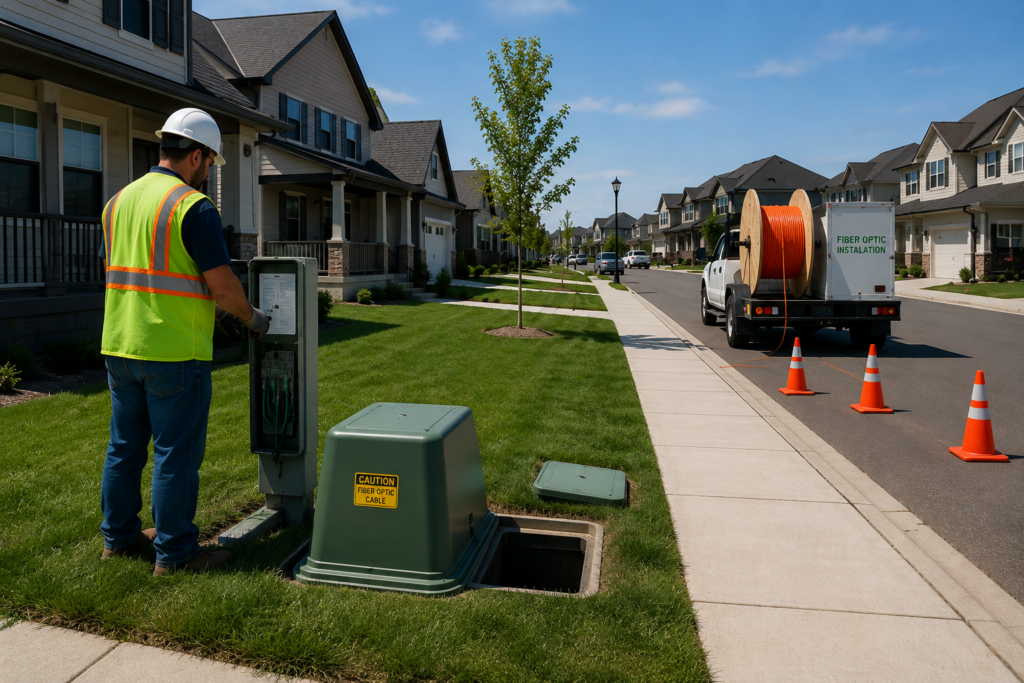
Fiber to the Home (FTTH)
One of the industry’s biggest shifts occurred when providers began extending fiber directly to homes.
Instead of stopping at neighborhood cabinets and relying on copper for the final connection, Fiber to the Home (FTTH) delivered optical fiber all the way to the customer.
This significantly increased available bandwidth while reducing many of the limitations associated with aging copper infrastructure.
FTTH also changed construction practices by increasing the need for neighborhood distribution systems, drop installations, service terminals, and customer premise equipment.
Rural Broadband Expansion
For many years, rural communities lacked access to the same broadband services available in urban areas.
The combination of public investment, private funding, and improved construction methods accelerated rural fiber deployment across the country.
Today’s rural broadband projects connect farms, schools, healthcare facilities, businesses, tribal lands, and underserved communities that previously had limited internet access.
For many contractors, rural broadband has become one of the largest sectors of the fiber construction industry.
10 Gigabit Networks and Beyond
Fiber continues evolving.
Modern passive optical networks support speeds that would have seemed impossible only a few decades ago. Equipment continues improving while the fiber installed years earlier often remains in service.
One of fiber’s greatest strengths is that the cable itself frequently outlasts several generations of electronics.
Instead of rebuilding the network, providers often increase capacity by replacing equipment connected to each end of the fiber.
That makes fiber one of the most future-ready forms of communication infrastructure ever developed.
Construction Perspective
Contractors are not simply building networks for today’s internet speeds. The conduit, handholes, splice closures, and backbone routes installed today may continue serving equipment that has not yet been invented. That is why quality construction, accurate documentation, and planning for future expansion remain so important.
Key Takeaways
- Low-loss fiber made practical communication possible.
- Commercial deployments proved fiber could outperform copper.
- The internet dramatically accelerated fiber construction.
- FTTH extended fiber directly to customers.
- Rural broadband continues expanding fiber into underserved communities.
- Modern fiber infrastructure is designed to support future technologies through equipment upgrades rather than complete reconstruction.
How History Shapes Today’s Construction
Every modern fiber construction specification has a story behind it.
When contractors receive a set of project standards, it can be tempting to view them as a checklist created by engineers or network owners. In reality, most of those requirements exist because the industry learned difficult lessons through decades of real-world experience. Failures uncovered weaknesses. Repairs revealed better solutions. Successful projects established best practices that eventually became industry standards.
Understanding that history helps construction professionals appreciate that today’s specifications are not arbitrary rules. They are practical solutions developed to build networks that perform reliably for decades.
Bend Radius Requirements
One of the earliest lessons involved bending fiber optic cable too sharply.
Unlike copper conductors, optical fibers rely on light remaining inside the glass core. Tight bends can cause light to escape the fiber, increasing signal loss and reducing network performance. In severe cases, excessive bending can permanently damage the glass itself.
Definition: Bend Radius
Bend radius is the minimum amount a fiber optic cable can safely bend without affecting its performance or damaging the optical fibers inside the cable.
Modern manufacturers publish minimum bend radius requirements for every cable they produce. Contractors are expected to follow these requirements during storage, transportation, installation, and cable management.
Today, respecting bend radius is considered one of the most fundamental principles of fiber construction.
Pulling Tension Limits
As fiber deployment expanded, contractors discovered another important limitation.
Fiber cable cannot withstand unlimited pulling force.
Excessive tension can stretch strength members, damage buffer tubes, deform the cable structure, or place unnecessary stress on the optical fibers. Damage may not always be visible immediately, yet it can reduce the long-term reliability of the network.
Manufacturers now specify maximum pulling tensions for their cables, and contractors use pulling grips, breakaway swivels, lubricants, and tension monitoring equipment to stay within those limits.
What seems like a simple installation requirement today was developed through years of field experience.
Conduit Became More Than Physical Protection
Early communication systems often focused on installing cable as efficiently as possible.
As networks matured, owners realized they also needed to think about maintenance, repairs, and future expansion.
Conduit solved several problems at once.
It protects fiber from accidental excavation and environmental hazards. It simplifies future cable replacement. It provides a pathway for network expansion without reopening the ground.
Modern conduit standards address much more than simply placing pipe underground. They define burial depth, conduit sizing, bend radius, separation from other utilities, pull box spacing, identification methods, and sealing requirements.
Each requirement improves the long-term usability of the network.
Protecting Every Splice
Every splice represents an important connection within the fiber network.
Early installations demonstrated that poorly protected splices could become points of failure. Moisture, dirt, temperature changes, accidental movement, and mechanical stress all reduced long-term reliability.
Modern splice enclosures solve these problems by protecting fusion splices from environmental conditions while organizing fibers for future maintenance.
Today’s splice closures are designed not only to survive the weather but also to make future troubleshooting, restoration, and network expansion much easier.
Testing Became a Quality Requirement
In the early years of fiber deployment, simply confirming that light passed through the cable was often considered acceptable.
The industry quickly learned that this was not enough.
A cable may pass light while still containing excessive splice loss, damaged connectors, tight bends, or installation defects that reduce long-term performance.
Modern projects typically require continuity testing, insertion loss testing, OTDR testing, and connector inspection before work is accepted.
Testing verifies that the network meets design requirements before customers depend on it.
More importantly, testing establishes a performance baseline that future maintenance crews can use when troubleshooting the network years later.
Documentation Protects the Investment
Some of the most expensive problems in telecommunications have nothing to do with damaged cable.
They occur because nobody knows exactly what was built.
Missing splice records.
Incomplete as-builts.
Unknown conduit routes.
Incorrect fiber assignments.
Poor documentation increases restoration time, complicates future expansion, and raises maintenance costs throughout the life of the network.
Modern construction projects place significant emphasis on documentation because the network will likely outlive the people who built it.
Good records preserve knowledge long after construction has ended.
Quality Inspections Reduce Future Problems
Quality inspections represent another lesson learned through experience.
Waiting until customers report service problems is both expensive and disruptive.
Inspecting the work before project acceptance allows deficiencies to be corrected while crews, equipment, and materials are still available.
Modern inspections verify much more than workmanship.
Inspectors review conduit installation, handhole placement, splice quality, restoration, documentation, labeling, testing results, and compliance with project specifications.
The objective is simple.
Identify problems before they become outages.
Standards Continue to Evolve
Fiber construction standards continue changing because the industry continues learning.
New cable designs create new installation requirements.
Improved testing equipment reveals conditions that previous generations could not detect.
New construction methods introduce better ways to install infrastructure.
Every improvement builds upon lessons learned from previous projects.
That process of continuous improvement has helped make modern fiber networks among the most reliable communication systems ever constructed.
Construction Perspective
When contractors understand why a specification exists, they are far more likely to appreciate its importance. Bend radius, pulling tension, testing, documentation, and inspection are not separate tasks added to slow production. Together, they protect the long-term performance of the network and reduce future maintenance costs for the owner.
Key Takeaways
- Most construction standards were developed after real-world failures identified better solutions.
- Bend radius and pulling tension requirements protect the optical fibers during installation.
- Conduit standards improve both protection and future accessibility.
- Testing verifies installation quality before the network is activated.
- Documentation and inspections reduce maintenance costs throughout the life of the network.
Industry Standards
Fiber construction involves thousands of individual decisions, from selecting materials and installing conduit to splicing fiber and documenting the completed network. If every contractor followed a different approach, maintaining consistent quality across the industry would be nearly impossible.
Industry standards provide a common framework that helps manufacturers, engineers, contractors, inspectors, and network owners work toward the same objective: building reliable communication infrastructure that performs consistently regardless of where it is installed.
These standards are not intended to replace engineering judgment or project specifications. Instead, they establish common terminology, testing methods, design practices, and quality expectations that improve consistency throughout the telecommunications industry.
Institute of Electrical and Electronics Engineers (IEEE)
The Institute of Electrical and Electronics Engineers, commonly known as IEEE, develops standards covering many areas of electrical engineering, networking, and telecommunications.
Many communication technologies operating over fiber optic infrastructure are based on IEEE standards. While contractors may not reference IEEE documents every day, the networking equipment installed within fiber systems often relies on specifications developed by this organization.
Telecommunications Industry Association (TIA)
The Telecommunications Industry Association develops standards focused on communication infrastructure.
Its work includes structured cabling systems, fiber optic installations, labeling practices, testing procedures, pathways, spaces, and telecommunications infrastructure used throughout commercial and institutional facilities.
Many contractors encounter TIA standards when working on projects that extend beyond the outside plant and into buildings or campuses.
International Organization for Standardization (ISO)
The International Organization for Standardization develops standards used across industries around the world.
Within telecommunications, ISO promotes consistency in manufacturing, quality management, testing, and technical requirements. International manufacturers frequently design products that comply with ISO standards, allowing equipment from different companies to operate together more effectively.
International Electrotechnical Commission (IEC)
The International Electrotechnical Commission develops standards related to electrical and electronic technologies, including many optical communication components.
IEC standards help establish common methods for evaluating fiber optic cable, connectors, testing equipment, and optical performance. This consistency supports manufacturers while helping network owners specify products that meet recognized performance requirements.
Project Specifications Matter Too
Industry standards provide the foundation, but every fiber project also includes project-specific requirements.
Internet service providers, electric cooperatives, municipalities, utilities, government agencies, and private network owners often publish their own construction standards based on local regulations, environmental conditions, maintenance practices, and operational preferences.
Contractors should always understand both the applicable industry standards and the project specifications before beginning construction.
One establishes generally accepted practices.
The other defines the owner’s specific expectations.
Construction Perspective
Successful contractors understand that quality is measured against project requirements, not personal preference. Industry standards establish the baseline, while project specifications define how that baseline is applied to a particular network.
Key Takeaways
- Industry standards improve consistency across the telecommunications industry.
- IEEE supports many networking technologies used over fiber infrastructure.
- TIA publishes guidance for telecommunications infrastructure and installation practices.
- ISO promotes international consistency in manufacturing and quality.
- IEC develops standards for electrical and optical communication technologies.
- Project specifications always take precedence when they are more restrictive than general industry guidance.
How This Affects the Overall Fiber Network
Looking back at the history of fiber optics reveals something that is easy to overlook during day-to-day construction.
Every handhole, conduit, splice enclosure, marker post, and fiber cable exists because someone solved a problem.
The fiber network being installed today represents more than a century of continuous improvement. Scientists discovered how to guide light through glass. Manufacturers learned how to produce fiber with extremely low signal loss. Engineers developed communication systems capable of transmitting enormous amounts of information. Construction professionals created the installation methods, equipment, and quality standards needed to build those systems in the real world.
That history continues to influence every fiber project.
When contractors install conduit at the proper depth, they protect the network from future damage. When technicians organize fibers inside a splice enclosure, they simplify future maintenance. When inspectors verify workmanship before acceptance, they help prevent outages years later. When documentation accurately records what was built, future crews can maintain and expand the network without unnecessary delays or additional excavation.
Construction is only one phase of a fiber network’s life, but it is the phase that has the greatest influence on everything that follows.
A well-built network is easier to maintain, less expensive to operate, simpler to expand, and more reliable for the customers who depend on it. Poor construction decisions, on the other hand, often remain hidden until they create expensive maintenance problems years after the original project has been completed.
Understanding the history of fiber optics helps place today’s work into a much larger context. Contractors are not simply installing conduit, placing handholes, or pulling cable. They are contributing to infrastructure that may support communication, education, healthcare, public safety, business, and economic development for decades to come.
Every generation of the fiber industry has improved upon the work of the generation before it.
The responsibility of today’s construction professionals is to continue that tradition by building networks that future generations can rely on with confidence.
Frequently Asked Questions
What is fiber optics?
Fiber optics is a communication technology that transmits information as pulses of light through extremely thin strands of glass called optical fibers. Unlike copper cable, which carries electrical signals, fiber optic cable uses light to deliver voice, video, internet, and data services over long distances with very little signal loss.
Who invented fiber optics?
Fiber optics was not invented by a single person. It is the result of contributions from scientists, engineers, manufacturers, and telecommunications companies over many decades. Early researchers studied the behavior of light, while later engineers developed low-loss optical fiber and the equipment needed to transmit information through it.
Why was fiber optic cable developed?
Fiber optic cable was developed to overcome the limitations of copper communication systems. As telephone networks, computer networks, and internet traffic continued growing, copper could no longer provide the bandwidth, transmission distance, and reliability required for modern communications.
Why is fiber replacing copper?
Fiber offers several advantages over copper. It provides significantly greater bandwidth, lower signal attenuation, longer transmission distances, immunity to electromagnetic interference, and the ability to support future technologies without replacing the physical cable.
How does fiber transmit information?
Fiber optic systems convert digital information into pulses of light. Those light pulses travel through the core of the optical fiber until they reach their destination, where they are converted back into electronic signals that computers, televisions, telephones, and other devices can understand.
Why is fiber better for long-distance communication?
Light traveling through optical fiber experiences much less signal loss than electrical signals traveling through copper. Because of this, fiber can carry information much farther before the signal must be regenerated, reducing both equipment requirements and operating costs.
Why can’t fiber be installed like copper cable?
Although fiber optic cable is protected by a durable outer jacket, the glass fibers inside require much more careful handling. Excessive pulling tension, tight bends, crushing forces, or poor splicing can reduce network performance or permanently damage the cable.
Why are modern fiber construction standards so strict?
Most construction standards were developed after the industry identified recurring problems in earlier installations. Requirements for bend radius, pulling tension, conduit installation, testing, documentation, and inspections all exist to improve long-term reliability and reduce maintenance costs.
Why is conduit used for underground fiber?
Conduit protects fiber optic cable from physical damage, simplifies future maintenance, and allows additional cable to be installed without reopening the ground. Properly designed conduit systems also make future network expansion much easier.
What is the difference between a backbone network and a distribution network?
A backbone network transports large amounts of information over long distances between major communication facilities. A distribution network carries that capacity into neighborhoods, businesses, schools, hospitals, and other service areas where customers receive service.
What is Fiber to the Home (FTTH)?
Fiber to the Home is a network architecture that extends fiber optic cable directly to individual homes or businesses instead of relying on copper for the final connection. This approach provides higher bandwidth, improved reliability, and greater long-term performance.
Will fiber optic cable eventually become obsolete?
The electronics connected to fiber continue evolving, but the fiber itself often remains in service for decades. Many existing fiber networks support dramatically higher speeds today than when they were originally installed because providers upgraded the equipment rather than replacing the cable.
Glossary
Attenuation
The gradual loss of optical signal strength as light travels through fiber optic cable.
Backbone Network
The high-capacity portion of a communication network that transports large amounts of data between major communication facilities.
Bend Radius
The minimum amount a fiber optic cable can safely bend without damaging the optical fibers or reducing performance.
Distribution Network
The portion of the network that carries communication services from the backbone into neighborhoods, businesses, schools, hospitals, and other service areas.
Fiber Optics
A communication technology that transmits information as pulses of light through thin strands of glass.
Fusion Splicing
A process that permanently joins two optical fibers by aligning and melting their ends together.
Horizontal Directional Drilling (HDD)
A trenchless construction method used to install conduit beneath roads, rivers, railroads, and other obstacles with minimal surface disturbance.
Last Mile
The final section of the communication network that connects the access network to the customer’s home or business.
Microduct
A small conduit installed within a larger conduit system to simplify future fiber installation and network expansion.
OTDR
Short for Optical Time Domain Reflectometer, an OTDR is a testing instrument that measures optical loss and identifies events such as splices, connectors, bends, and faults along a fiber optic cable.
Refraction
The change in direction that occurs when light passes from one material into another.
Reflection
The process of light bouncing off a surface instead of passing through it.
Signal Loss
The reduction in optical power as light travels through a fiber optic cable due to attenuation or other factors.
Total Internal Reflection
The optical principle that keeps light traveling inside the core of a fiber optic cable by continuously reflecting it within the glass.