
Category: Fiber Fundamentals
Reading Time: 13 Minutes
Skill Level: Beginner
Quick Answer
What is fiber? Fiber is an extremely thin strand of glass that carries information as pulses of light through modern broadband networks.. Those glass strands are protected inside a fiber optic cable and used to build communication networks that connect homes, businesses, schools, hospitals, wireless towers, data centers, and communities around the world. Because fiber can carry enormous amounts of information over long distances with very little signal loss, it has become the foundation of modern broadband infrastructure.
What You’ll Learn
By the end of this article, you will understand:
- What fiber is and how it differs from fiber optic cable.
- Why fiber has become the world’s preferred communication medium.
- How fiber transmits information using light.
- What fiber is made of and how it is protected.
- Where fiber is used throughout modern communication networks.
- Why fiber construction requires different installation practices than copper.
- How one strand of fiber becomes part of a much larger broadband network.
Introduction
Every day, billions of people use fiber without ever seeing it.
When you stream a movie, join a video conference, send an email, use online banking, browse social media, or make a phone call, there is a good chance that information travels across a fiber optic network. Businesses rely on fiber to connect offices and data centers. Hospitals depend on it to transfer medical records and diagnostic images. Schools use it to provide online learning. Wireless carriers connect cellular towers with fiber, and utility companies use it to monitor and control critical infrastructure.
Despite its importance, many people are surprised to learn that fiber is simply an incredibly small strand of glass.
That small strand has changed the way the world communicates.
Unlike traditional copper cable, which carries electrical signals, fiber transmits information using pulses of light. This allows enormous amounts of data to travel farther, faster, and with much less signal loss than older communication technologies. As internet usage has grown and digital services have become part of everyday life, fiber has become the preferred communication medium for broadband networks around the world.
For construction professionals, understanding what fiber is involves much more than understanding how it carries information.
Contractors are responsible for installing infrastructure that may remain in service for thirty years or more. Engineers design networks around the capabilities of fiber. Inspectors verify that it has been installed correctly. Project managers coordinate its deployment across entire communities. Every person involved in a fiber project benefits from understanding what fiber is, why it behaves differently than copper, and how construction practices protect its long-term performance.
This article explains fiber from a construction perspective. You’ll learn what fiber is made of, how it works, where it is used, why it has become the foundation of modern broadband networks, and how proper construction helps ensure reliable service for decades.
What Is Fiber?
Fiber is an extremely thin strand of specially manufactured glass designed to carry information as pulses of light.
Although people often use the words fiber, fiber optic cable, and fiber network interchangeably, they describe three different things. Understanding the difference is important because each plays a different role in a communication system.
Fiber is the individual glass strand that carries the light.
A fiber optic cable is the protective assembly that contains one or more optical fibers along with coatings, strength members, water-blocking materials, and an outer jacket designed to protect the fibers during installation and throughout their service life.
A fiber optic network is the complete communication system built from thousands or even millions of individual fibers connected together through splice closures, cabinets, handholes, terminals, electronics, and customer equipment.
A useful comparison is the highway system.
An individual lane is similar to a single optical fiber.
The roadway is comparable to the fiber optic cable that protects those lanes.
The complete interstate system represents the fiber network, connecting cities, businesses, neighborhoods, and homes into one transportation system.
Each component serves a different purpose, but all three work together to move information efficiently from one location to another.
Definition: Fiber
Fiber, also called optical fiber, is a strand of extremely pure glass that carries digital information as pulses of light.
Definition: Fiber Optic Cable
A fiber optic cable is a protective cable assembly containing one or more optical fibers along with materials that protect the fibers from moisture, mechanical damage, environmental conditions, and installation stresses.
Definition: Fiber Optic Network
A fiber optic network is the complete communication infrastructure that uses fiber optic cable to transport information between internet providers, businesses, schools, hospitals, wireless towers, and customers.
Why Fiber Is Made From Glass
One of the most common questions people ask is why communication systems use glass instead of metal.
The answer begins with light.
Fiber optic communication depends on transmitting light over long distances while keeping as much of that light contained inside the fiber as possible. Glass has unique optical properties that make this possible. When manufactured to extremely high levels of purity, it allows light to travel remarkable distances with very little signal loss.
The glass used in optical fiber is not the same as the glass found in household windows or drinking glasses.
It is manufactured under carefully controlled conditions to remove impurities that would scatter or absorb light. Even microscopic imperfections can reduce network performance, which is why optical fiber manufacturing is one of the most precise manufacturing processes in the world.
Although the glass itself is extremely thin, it does not remain exposed.
Each optical fiber receives multiple protective layers that shield it from moisture, physical damage, bending forces, temperature changes, and handling during construction. Once installed inside a properly designed fiber optic cable, the glass fibers become surprisingly durable and are capable of remaining in service for decades.
This combination of exceptional optical performance and long-term durability makes glass the ideal material for modern communication networks.
Construction Perspective
Construction crews rarely work directly with exposed optical fibers. Most of the time they handle complete fiber optic cables that have been specifically engineered to protect the delicate glass inside. Understanding that difference helps explain why installation requirements focus on protecting the cable rather than treating the glass itself as exposed during construction.
Key Takeaways
- Fiber is an individual strand of specially manufactured glass.
- Fiber optic cable protects one or more optical fibers during installation and long-term service.
- A fiber network consists of thousands of connected fiber optic cables and network components.
- Optical fiber uses light instead of electricity to carry information.
- Extremely pure glass makes long-distance communication possible because it minimizes signal loss.
Why Fiber Matters
Fiber is much more than a communication technology.
It has become one of the most important forms of infrastructure in the modern world.
Roads move people.
Railroads move freight.
Pipelines move water, oil, and natural gas.
Power lines move electricity.
Fiber moves information.
In today’s economy, information is just as essential as transportation, utilities, and energy. Nearly every industry depends on the ability to send and receive enormous amounts of data quickly and reliably. As that demand continues to grow, fiber has become the foundation that makes modern communication possible.
For construction professionals, this means every project contributes to infrastructure that supports far more than internet service. Fiber networks connect emergency responders, hospitals, schools, financial institutions, manufacturers, utility companies, government agencies, and millions of homes and businesses. Every conduit installed, every splice completed, and every fiber tested becomes part of a system that communities rely on every day.
Fiber Connects the Modern World
Communication has changed dramatically over the past several decades.
Early telephone systems primarily carried voice conversations.
Today’s networks simultaneously transport voice, video, internet traffic, cloud computing, streaming media, online gaming, financial transactions, industrial automation, security systems, and countless other digital services.
Instead of building separate communication systems for every application, fiber provides a common infrastructure capable of carrying virtually all forms of digital information.
One fiber network can support residential internet, business services, mobile communications, public safety systems, utility monitoring, and future technologies that have not yet been developed.
That flexibility is one of the primary reasons fiber has become the preferred communication medium around the world.
Communities Depend on Fiber
Many people think of fiber simply as faster internet.
Its impact extends much further.
Hospitals depend on fiber to exchange medical records, diagnostic images, and real-time communications between healthcare providers.
Schools use fiber to support online learning, digital classrooms, research, and campus networks.
Businesses rely on fiber for cloud computing, video conferencing, e-commerce, and secure communication with customers and suppliers.
Utility companies use fiber to monitor substations, coordinate electrical distribution systems, and communicate with remote facilities.
Wireless carriers connect cellular towers using fiber because every mobile phone call and data session must eventually enter a wired communication network.
Government agencies depend on fiber for emergency communications, public safety systems, and critical services that communities rely on every day.
Without reliable fiber infrastructure, many of the services people use daily would function more slowly, less reliably, or not at all.
Fiber Supports Economic Growth
Broadband infrastructure has become a significant factor in economic development.
Communities with reliable fiber networks are often better positioned to attract new businesses, support remote workers, encourage investment, and provide access to education and healthcare.
Manufacturers depend on reliable communication with suppliers and customers.
Technology companies require high-capacity connections to cloud services and data centers.
Small businesses process online payments, manage inventory, communicate with customers, and market their services using internet-based platforms.
As more industries become digitally connected, reliable fiber infrastructure becomes increasingly valuable.
For many communities, fiber is no longer considered a luxury.
It is essential infrastructure.
Fiber Enables Future Technologies
One of fiber’s greatest advantages is its ability to support technologies that continue evolving over time.
The fiber installed today will likely carry significantly more information twenty years from now than it does when first placed into service.
This happens because communication equipment continues improving while the fiber itself often remains unchanged.
Network owners can frequently increase capacity by upgrading electronics instead of replacing underground infrastructure.
That makes fiber one of the most future-ready investments available in modern communications.
A conduit system installed correctly today may support several generations of fiber cable.
The fiber installed inside that conduit may support multiple generations of communication equipment.
Construction decisions made today continue creating value for decades.
Why This Matters to Construction Professionals
Contractors sometimes describe their work as installing conduit or pulling cable.
Those activities are only one part of the larger picture.
Every fiber construction project creates infrastructure that supports an entire community.
The quality of a conduit installation affects future maintenance.
The accuracy of documentation influences future expansions.
The workmanship of a splice affects network performance.
The location of a handhole determines how easily technicians can restore service years later.
Construction decisions influence far more than the completion of today’s project.
They affect the reliability, operating cost, maintainability, and lifespan of the entire communication network.
Understanding why fiber matters helps construction professionals recognize the importance of building every component correctly the first time.
Construction Perspective
Fiber projects are often measured in feet installed, handholes placed, or customers connected. Those metrics are important, but they do not fully represent what is being built. Every completed project becomes part of a communication system that may support education, healthcare, emergency services, business operations, and community growth for thirty years or longer. Construction quality determines how well that infrastructure performs throughout its entire life.
Key Takeaways
- Fiber has become one of the world’s most important infrastructure systems.
- Modern communication depends on fiber to move enormous amounts of digital information.
- Hospitals, schools, businesses, utilities, wireless networks, and government agencies all rely on fiber.
- Reliable broadband infrastructure supports economic growth and community development.
- Construction professionals build infrastructure that will continue serving future generations long after the original project is complete.
How Fiber Works
Understanding that fiber carries information using light is only part of the story.
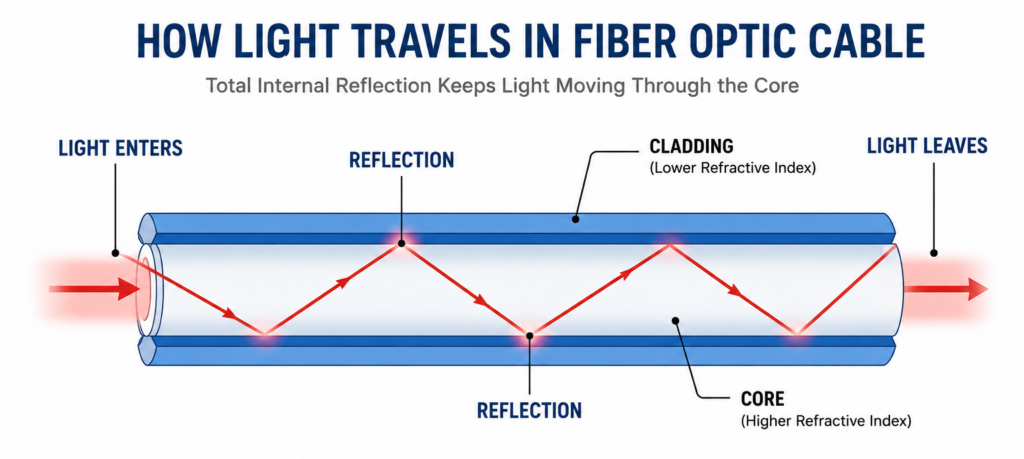
The next question is usually, how does light actually travel through a strand of glass?
The complete physics behind fiber optics involves several scientific principles that are covered in greater detail throughout the Fiber Fundamentals series. For this article, it is enough to understand the basic process that allows information to move through an optical fiber.
Every text message, email, video stream, or phone call begins as digital information.
Before that information enters the fiber network, communication equipment converts it into a series of rapid pulses of light.
Those light pulses travel through the center of the optical fiber until they reach their destination, where specialized equipment converts them back into electronic information that computers, televisions, telephones, and other devices can understand.
Although this process happens almost instantly, several important components work together to keep the light moving through the fiber.
The Core Carries the Light
At the center of every optical fiber is the core.
The core is an extremely pure strand of glass that serves as the pathway for light.
Nearly all communication takes place inside this tiny area.
The diameter of the core depends on the type of fiber being used, but regardless of size, its purpose remains the same.
Guide light from one location to another with as little signal loss as possible.
Definition: Core
The core is the central glass portion of an optical fiber through which light travels.
The Cladding Keeps the Light Contained
Surrounding the core is another layer of glass called the cladding.
Although it may appear similar to the core, it has different optical properties.
These differences allow light to remain trapped inside the core instead of escaping into the surrounding materials.
Without the cladding, fiber optic communication would not be possible.
Definition: Cladding
The cladding is the layer of glass surrounding the core that helps keep light contained within the optical fiber.
Total Internal Reflection
One of the most important principles in fiber optics is total internal reflection.
As light travels through the core, it repeatedly reflects from the boundary between the core and cladding.
Instead of escaping the fiber, the light continues bouncing forward until it reaches the opposite end.
This process happens incredibly quickly and with very little loss when the fiber is properly manufactured and installed.
Although the science behind total internal reflection deserves its own discussion, understanding the basic concept helps explain why fiber can transmit information over such long distances.
Figure F-002 illustrates this process and shows how light remains contained within the optical fiber as it travels from one end to the other.
Light Carries Digital Information
The light traveling through a fiber is not continuous like a flashlight.
Instead, communication equipment rapidly turns the light on and off to create digital information.
These tiny pulses represent the ones and zeros that computers use to process data.
The pulses move through the fiber at incredibly high speeds, allowing enormous amounts of information to travel simultaneously across a single optical fiber.
Modern communication systems can transmit voice, video, internet traffic, and countless other services through the same fiber at the same time.
Light Must Be Protected
Although light travels efficiently through optical fiber, it can still be affected by poor construction practices.
Sharp bends, excessive pulling tension, damaged connectors, poor splices, crushed conduit, or contaminated fiber ends can increase signal loss and reduce network performance.
That is why construction quality is so important.
The communication equipment depends on the physical infrastructure being installed correctly.
Protecting the cable helps protect the light traveling inside it.
Construction Perspective
Contractors never actually see the light moving through the fiber, but every installation decision affects its ability to travel. Respecting bend radius, protecting the cable during installation, producing high-quality fusion splices, and performing proper testing all help ensure the light reaches its destination with minimal signal loss.
Key Takeaways
- Fiber transmits information using pulses of light rather than electrical signals.
- The core carries the light while the cladding keeps it contained.
- Total internal reflection allows light to travel long distances through the optical fiber.
- Digital information is converted into pulses of light before entering the network.
- Construction quality directly affects how efficiently light travels through the completed fiber network.
What Is Fiber Made Of?
At first glance, fiber optic cable looks similar to many other underground utility cables. It has an outer jacket, identification markings, and is shipped on large reels for installation. The real difference is found inside the cable.
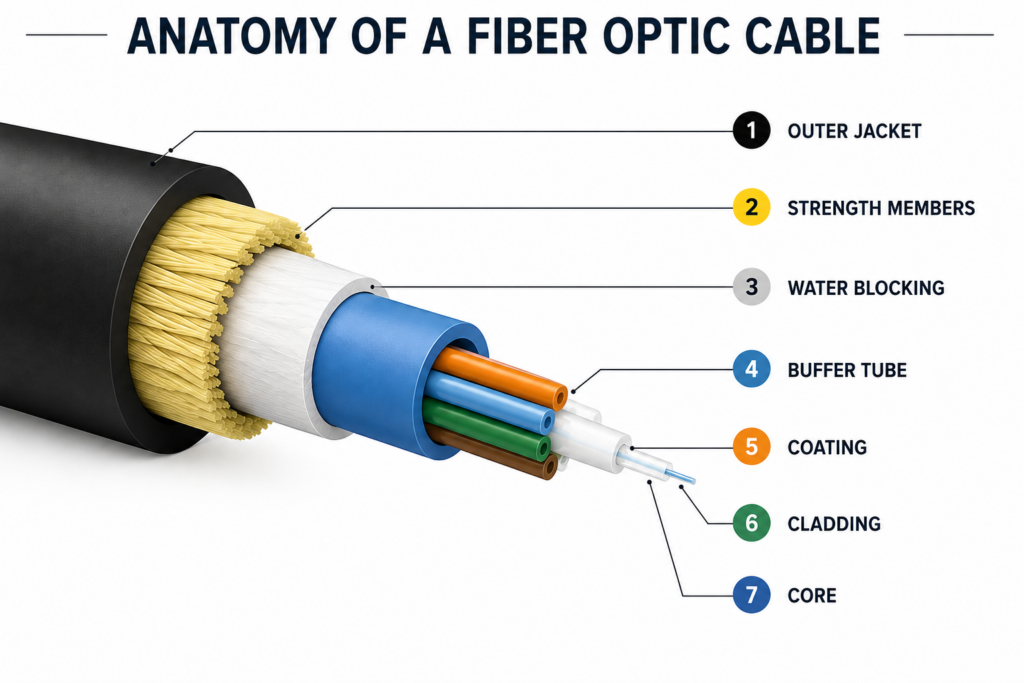
Unlike electrical cable, which carries electricity through metal conductors, fiber optic cable protects extremely thin strands of glass that carry information using light.
Each layer inside the cable has a specific purpose. Some layers protect the glass from moisture. Others provide strength during installation. Some organize the fibers for identification, while others shield the cable from crushing forces, rodents, ultraviolet light, and environmental conditions.
Understanding the basic construction of a fiber optic cable helps contractors appreciate why installation requirements exist. Every component contributes to the cable’s long-term performance.
Figure F-009 illustrates the major components of a typical fiber optic cable.
The Optical Fiber
The optical fiber is the communication pathway.
It consists of two glass layers working together to guide light from one end of the cable to the other.
The center is called the core.
Surrounding the core is the cladding.
Together, these two layers allow light to travel through the fiber using total internal reflection.
Although the glass is extremely small, it is manufactured to incredibly tight tolerances. Even microscopic imperfections can increase signal loss or reduce performance.
Definition: Optical Fiber
An optical fiber is a strand of ultra-pure glass consisting of a core and cladding that transmits information as pulses of light.
Primary Coating
Immediately surrounding the glass is the primary coating.
This protective polymer coating cushions the fiber against minor impacts, vibration, and handling during manufacturing and installation.
The coating does not carry light or strengthen the cable.
Its purpose is to protect the delicate glass from everyday mechanical stresses that could eventually cause damage.
Although crews rarely see the coating during normal construction, it plays an important role in preserving the long-term reliability of the optical fiber.
Buffer Tubes
Individual fibers are rarely installed by themselves.
Instead, multiple fibers are grouped together inside buffer tubes.
These tubes organize the fibers, provide additional protection, and allow manufacturers to identify different fiber groups using standardized color codes.
Buffer tubes also create space that allows the fibers to move slightly as temperatures change.
Without this flexibility, expansion and contraction could place unnecessary stress on the glass.
Definition: Buffer Tube
A buffer tube is a protective tube that contains one or more optical fibers while shielding them from environmental conditions and mechanical stress.
Water-Blocking Materials
Underground communication systems are constantly exposed to moisture.
Even though the cable jacket protects the interior, small amounts of water can eventually enter damaged cables through cuts, punctures, or improperly sealed openings.
To reduce this risk, manufacturers include water-blocking materials throughout many fiber optic cables.
These materials may include water-blocking yarns, tapes, powders, or gels that prevent moisture from traveling the length of the cable.
By limiting water migration, these materials help protect the optical fibers and simplify future repairs.
Strength Members
The glass fibers inside the cable are designed to carry light.
They are not designed to withstand the pulling forces created during installation.
That responsibility belongs to the strength members.
Strength members absorb installation loads so the optical fibers experience as little stress as possible.
Depending on the cable design, these may include fiberglass rods, aramid yarn, fiberglass reinforced plastic rods, or other structural components.
When contractors pull fiber through conduit, the strength members carry much of the installation force.
This is one reason manufacturers publish maximum pulling tension limits for every cable.
Definition: Strength Members
Strength members are structural components within a fiber optic cable that absorb pulling forces and protect the optical fibers during installation.
Ripcords
Many fiber optic cables also include one or more ripcords.
A ripcord is a strong cord installed beneath the cable jacket that allows technicians to safely open the cable without accidentally cutting into the buffer tubes or optical fibers.
Although simple, ripcords improve both safety and efficiency during splicing and cable preparation.
Outer Jacket
The outer jacket is the layer contractors see most often.
It protects every internal component from abrasion, moisture, sunlight, chemicals, temperature changes, and physical damage during transportation, installation, and long-term service.
Different projects require different jacket materials depending on whether the cable will be installed underground, aerially, inside buildings, underwater, or in other specialized environments.
The outer jacket also provides important identification information, including manufacturer markings, cable type, footage markings, and other project-specific information.
Every Layer Has a Purpose
It is easy to think of fiber optic cable as simply a protective covering around a glass strand.
In reality, every layer serves a specific engineering purpose.
The optical fiber carries the information.
The coating protects the glass.
The buffer tube organizes the fibers.
Water-blocking materials reduce moisture migration.
Strength members absorb installation loads.
The outer jacket protects the entire assembly.
Removing or damaging any one of these components can reduce the cable’s ability to perform as designed.
That is why proper handling during construction is so important.
Construction Perspective
Contractors rarely work directly with individual optical fibers until the splicing process begins. Most installation work involves protecting the cable as a complete system. Respecting pulling tension, bend radius, storage requirements, and manufacturer recommendations helps ensure every internal component continues performing its intended function long after construction is complete.
Key Takeaways
- Fiber optic cable contains much more than glass fibers.
- Every internal layer serves a specific protective or structural purpose.
- Strength members absorb pulling forces during installation.
- Water-blocking materials protect the cable from moisture intrusion.
- The outer jacket protects the cable from environmental and mechanical damage.
- Construction practices are designed to protect every component inside the cable.
Types of Fiber
Not all optical fiber is the same.
Different communication systems require different fiber designs depending on transmission distance, bandwidth requirements, network architecture, and equipment being used.
Fortunately, most construction professionals only need a high-level understanding of the major fiber types. The detailed engineering decisions are typically made during network design, while contractors focus on installing the specified cable correctly.
The two primary categories are singlemode fiber and multimode fiber.
Although both transmit information using light, they are designed for different applications.
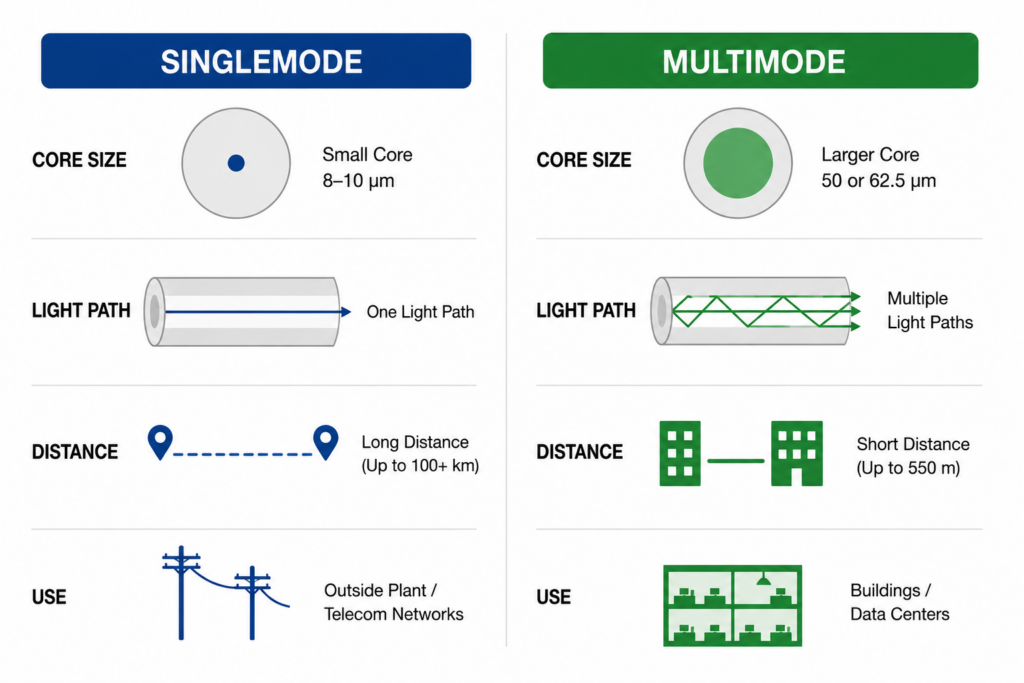
Although both singlemode and multimode fiber transmit information using light, they are designed for different applications. The differences involve core size, how light travels through the fiber, transmission distance, and where each type is commonly used. Figure F-010 provides a high-level comparison before each fiber type is discussed in more detail.
Singlemode Fiber
Singlemode fiber has a very small core that allows only a single path of light to travel through the fiber.
Because the light remains highly focused, signal distortion is minimized over long distances.
This makes singlemode fiber the preferred choice for nearly all outside plant construction.
Internet service providers, telecommunications companies, electric utilities, municipalities, and long-distance communication networks primarily use singlemode fiber because it supports extremely long transmission distances and very high bandwidth.
Nearly every underground backbone, distribution, and access network built today relies on singlemode fiber.
Multimode Fiber
Multimode fiber has a larger core that allows multiple paths of light to travel through the fiber at the same time.
This design works well over shorter distances but introduces more signal dispersion as transmission distances increase.
Because of these characteristics, multimode fiber is commonly used inside buildings, campuses, manufacturing facilities, and data centers where cable runs are relatively short.
It is rarely used for long-distance outside plant broadband construction.
Understanding the Difference
From a construction standpoint, singlemode and multimode cable may appear very similar.
The installation practices remain largely the same.
Contractors still protect bend radius.
They still respect pulling tension.
They still perform high-quality splicing and testing.
The primary differences involve network design, transmission performance, and the communication equipment connected to the cable rather than major changes in construction methods.
Construction Perspective
Most outside plant broadband projects use singlemode fiber because it supports the long transmission distances required between central offices, cabinets, neighborhoods, and customer locations. Knowing which type of fiber is being installed helps contractors verify they are using the correct materials and testing procedures throughout the project.
Key Takeaways
- Fiber is generally divided into singlemode and multimode categories.
- Singlemode fiber is the standard for most outside plant broadband construction.
- Multimode fiber is commonly used for shorter communication links inside buildings and campuses.
- Both fiber types require careful installation and protection during construction.
- Network design determines which type of fiber is appropriate for a particular application.
Where Fiber Is Used
One of the biggest misconceptions about fiber is that it is only used to provide internet service to homes.
Residential broadband is certainly one of its most visible applications, but it represents only one part of a much larger communication system.
Fiber has become the preferred communication medium for nearly every industry that depends on moving large amounts of information quickly and reliably. It forms the backbone of the internet, connects businesses to cloud services, links cellular towers to wireless networks, supports public safety communications, enables industrial automation, and provides the infrastructure that allows communities to remain connected.
For construction professionals, understanding where fiber is used helps explain why different projects have different designs, cable counts, installation methods, and construction standards.
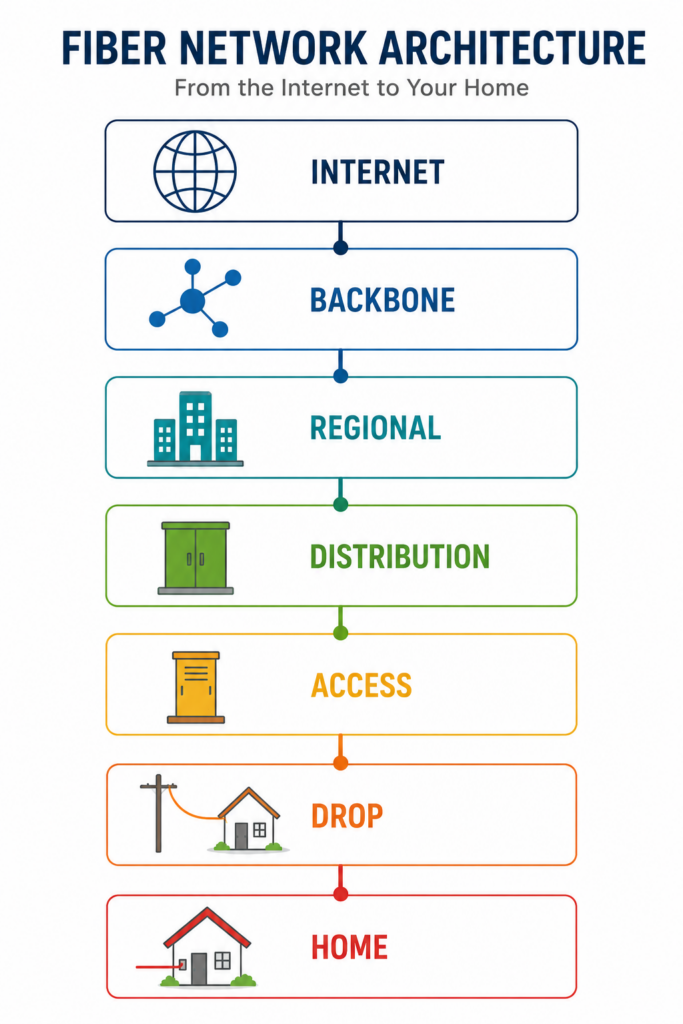
Figure F-011 illustrates the major applications of fiber optic infrastructure.
Long-Distance Backbone Networks
Every communication network begins with a backbone.
Backbone networks transport enormous amounts of information between major cities, data centers, internet exchange points, and regional communication hubs. These routes often contain very high fiber counts because they must support traffic for entire regions rather than individual customers.
Backbone construction typically involves large conduit systems, long installation distances, major utility crossings, and carefully planned splice locations.
The quality of these installations affects thousands or even millions of users downstream.
Regional and Distribution Networks
Information leaving the backbone enters regional and distribution networks.
These networks transport capacity into cities, towns, neighborhoods, industrial parks, schools, hospitals, and business districts.
Distribution networks branch repeatedly as they move closer to customers.
Large backbone cables gradually transition into smaller distribution cables that serve increasingly smaller geographic areas.
Much of today’s outside plant construction focuses on expanding and maintaining these distribution systems.
Residential Broadband
One of the fastest-growing applications for fiber is residential broadband.
Fiber to the Home (FTTH) extends optical fiber directly to individual homes, replacing older copper infrastructure that once provided telephone and internet service.
Residential fiber projects typically include feeder routes, distribution cables, neighborhood terminals, drop cables, and customer premise equipment.
Although individual residential drops may appear relatively small, they are connected to an extensive communication system extending far beyond the neighborhood itself.
Commercial and Business Networks
Businesses often require communication services beyond those needed by residential customers.
Office buildings, manufacturing facilities, warehouses, shopping centers, and corporate campuses rely on fiber to connect employees, customers, equipment, and cloud-based applications.
Many businesses also require redundant fiber connections to improve reliability and reduce downtime.
Construction for commercial projects frequently includes larger conduit systems, dedicated service entrances, campus distribution networks, and specialized communication rooms.
Data Centers
Every website, online application, streaming service, and cloud platform depends on data centers.
These facilities contain thousands of servers that process and store enormous amounts of digital information.
Fiber provides the high-capacity connections required between servers, storage systems, internet providers, and customers around the world.
Modern data centers may contain hundreds or even thousands of individual fiber connections within a single building.
Wireless Networks
Although wireless technology appears to eliminate cables, every cellular tower ultimately depends on fiber.
When someone uses a smartphone, information travels wirelessly only a short distance between the device and the nearest cell tower.
From that point forward, the communication usually enters a fiber optic network.
As wireless technologies continue advancing, fiber becomes even more important because faster wireless speeds require greater capacity between cellular towers and the rest of the communication network.
Fiber and wireless technologies work together rather than replacing one another.
Utilities and Critical Infrastructure
Electric utilities, water systems, natural gas companies, railroads, airports, ports, and industrial facilities all use fiber for communication.
Fiber allows operators to monitor equipment, collect operational data, coordinate remote facilities, and improve system reliability.
Many utility companies install fiber alongside electrical transmission and distribution systems to support both utility operations and broadband expansion.
Education and Healthcare
Schools and universities rely on fiber to support online learning, research, administrative systems, campus security, and communication between buildings.
Hospitals use fiber to transfer medical imaging, electronic health records, laboratory information, and real-time communication between healthcare providers.
Reliable communication has become an essential part of both education and healthcare.
Fiber provides the bandwidth and reliability these institutions require.
Government and Public Safety
Police departments, fire departments, emergency management agencies, military facilities, and government offices all depend on secure communication networks.
Fiber supports emergency dispatch centers, surveillance systems, traffic management, public safety radio systems, and communication between government facilities.
Reliable infrastructure becomes especially important during natural disasters and emergency response operations when communication systems are under increased demand.
Fiber Is Everywhere
Many people never notice the fiber networks surrounding them.
Fiber runs beneath roads, through neighborhoods, across utility poles, inside buildings, beneath rivers, along railroad corridors, and between cities.
Every community depends on fiber in ways that are often invisible to the public.
Construction professionals see these systems differently.
They understand that every conduit, handhole, splice enclosure, cabinet, and terminal contributes to a much larger communication network serving thousands of people.
Construction Perspective
Different applications require different construction approaches. A long-distance backbone project is built differently than a residential FTTH development. A data center installation differs from a rural broadband expansion. Understanding where fiber will be used helps contractors understand why different projects have different specifications, materials, testing requirements, and quality standards.
Key Takeaways
- Fiber is used in far more applications than residential internet service.
- Backbone and distribution networks move information across entire regions.
- Businesses, data centers, schools, hospitals, and utilities all depend on fiber.
- Wireless networks rely on fiber to connect cellular towers to the broader communication network.
- Different applications require different network designs and construction methods.
Why Fiber Replaced Older Technologies
Fiber did not replace older communication technologies overnight.
For many decades, copper cable, coaxial cable, microwave systems, and satellite communications each played important roles in connecting communities and supporting communication networks. Many of those technologies continue serving valuable purposes today.
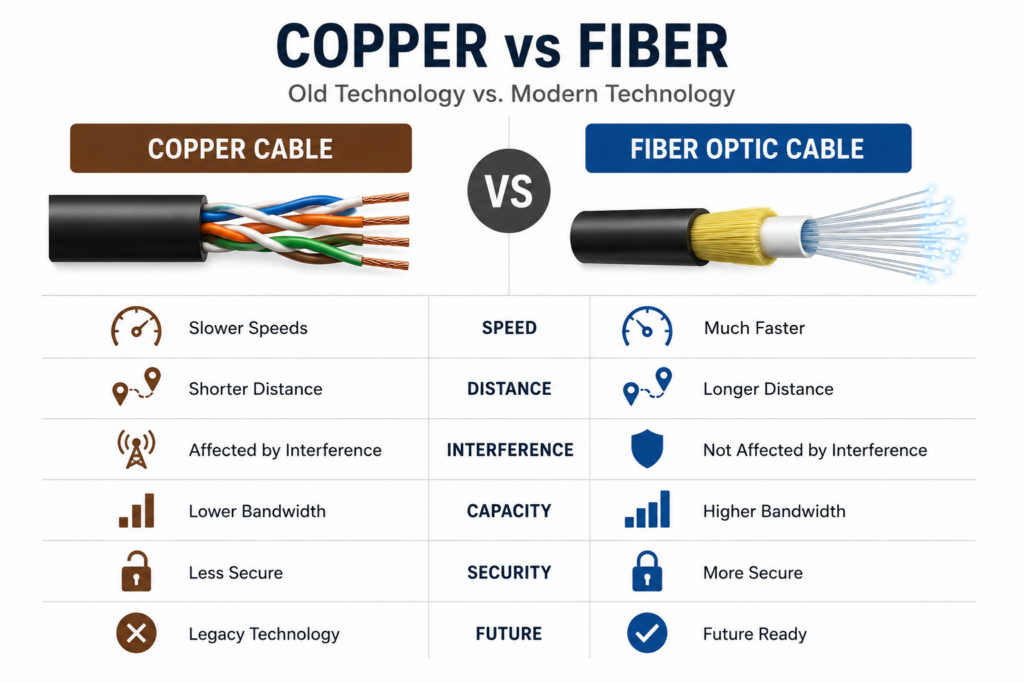
So why has fiber become the preferred choice for building modern broadband infrastructure?
The answer is not that fiber is perfect.
The answer is that fiber solves many of the limitations that older communication technologies face as demand for data continues increasing.
The following sections introduce the major advantages of fiber. Separate articles throughout the Fiber Fundamentals series explore each comparison in greater detail.
Greater Bandwidth
One of fiber’s greatest advantages is its ability to carry enormous amounts of information.
As internet usage, cloud computing, streaming media, and connected devices continue growing, communication networks require significantly more capacity than previous generations.
Fiber provides room for that growth.
Rather than repeatedly replacing physical infrastructure, providers often increase capacity simply by upgrading the communication equipment connected to existing fiber.
Longer Transmission Distances
Signal loss occurs in every communication system.
Fiber experiences much lower attenuation than traditional copper communication systems.
Because the signal remains stronger over longer distances, communication providers require fewer regeneration sites, reducing both construction costs and long-term maintenance.
This makes fiber particularly valuable for regional backbone networks and rural broadband deployments.
Immunity to Electromagnetic Interference
Copper carries electricity.
Fiber carries light.
Because fiber contains no electrical current, it is naturally immune to electromagnetic interference from nearby power lines, industrial equipment, lightning, or radio frequency sources.
This improves communication reliability in many environments where electrical interference can affect copper systems.
Greater Long-Term Capacity
Fiber is often described as future-ready.
That description reflects one of its greatest strengths.
The physical cable installed today may remain in service for decades while communication equipment continues improving around it.
Instead of replacing underground infrastructure every few years, network owners frequently upgrade electronics while continuing to use the existing fiber.
That approach reduces future construction costs while allowing networks to support continually increasing bandwidth requirements.
Fiber Is Not the Right Solution for Everything
Although fiber offers many advantages, every communication technology involves tradeoffs.
Wireless systems provide mobility that fiber cannot.
Satellite communication reaches remote locations where terrestrial infrastructure is unavailable.
Coaxial cable continues supporting many television and broadband systems.
Copper remains useful for electrical systems and certain communication applications.
Successful network design involves selecting the right technology for each situation rather than assuming one solution fits every application.
Construction Perspective
Contractors build fiber because it provides the long-term infrastructure modern communities require. Understanding both the advantages and limitations of fiber helps construction professionals appreciate why network owners continue investing in fiber while still using other communication technologies where they make the most sense.
Key Takeaways
- Fiber offers greater bandwidth than many older communication technologies.
- Lower signal attenuation allows communication over much longer distances.
- Fiber is immune to electromagnetic interference because it carries light instead of electricity.
- Existing fiber infrastructure can often support future technologies through equipment upgrades.
- Different communication technologies continue serving different purposes depending on the application.
Common Misconceptions About Fiber
As fiber has become more common, so have misunderstandings about what it is and how it performs.
Some misconceptions come from comparing fiber to copper. Others result from confusing fiber with wireless technology or assuming that all communication systems work the same way.
Understanding these common misconceptions helps contractors, inspectors, project managers, and network owners make better decisions throughout the life of a fiber project.
“Fiber Is Fragile”
This is one of the most common misconceptions in the industry.
The glass inside an optical fiber is extremely small and can be damaged if it is handled improperly.
However, construction crews do not install bare optical fibers.
They install fiber optic cable that has been engineered to protect those fibers from moisture, pulling forces, crushing, temperature changes, and environmental exposure.
When handled according to manufacturer specifications, fiber optic cable is remarkably durable.
Problems usually occur because installation requirements were ignored rather than because the cable itself was inherently weak.
“Fiber Carries Electricity”
Fiber does not transmit electricity.
Instead, it carries information using pulses of light.
This difference provides several important advantages.
Fiber is immune to electromagnetic interference, does not create electrical sparks, and is not affected by nearby power lines in the same way as copper communication systems.
Construction crews should still follow all required utility safety procedures because fiber is often installed near energized electrical facilities, but the fiber itself does not carry electrical current.
“Fiber Can Never Be Bent”
Fiber can absolutely bend.
Every fiber optic cable is designed with a minimum bend radius that allows it to flex safely during installation and throughout its service life.
Problems occur when contractors exceed those limits.
Bending the cable more sharply than the manufacturer’s recommendations can increase signal loss or permanently damage the optical fibers.
Respecting bend radius is one of the most important principles in fiber construction.
“Fiber Never Fails”
Fiber is extremely reliable, but it is not indestructible.
Utility strikes, rodent damage, poor splices, damaged connectors, water intrusion, excessive pulling tension, improper storage, and poor workmanship can all reduce network performance or cause service interruptions.
Most fiber failures are related to physical damage or installation deficiencies rather than problems with the glass itself.
Quality construction greatly reduces the likelihood of future failures.
“Fiber Is Only Used for Internet”
Internet service is only one application.
Fiber also supports telephone systems, television services, cellular networks, data centers, hospitals, schools, industrial automation, public safety communications, electrical utilities, transportation systems, military facilities, and countless business applications.
Modern society depends on fiber for far more than residential broadband.
“Wireless Will Replace Fiber”
Wireless technology continues improving every year.
So does fiber.
Rather than competing against each other, the two technologies work together.
Every cellular tower must connect back into a wired communication network.
In most cases, that connection is fiber.
As wireless speeds increase, demand for fiber capacity also increases because more information must move between wireless infrastructure and the broader communication network.
Fiber enables wireless.
It does not compete with it.
“Fiber Construction Is Just Pulling Cable”
Installing the cable is only one step in building a fiber network.
Successful projects involve engineering, permitting, utility locating, conduit installation, handholes, splice closures, testing, documentation, restoration, inspections, and long-term maintenance planning.
Every component contributes to the performance of the finished network.
The cable alone does not create reliable broadband infrastructure.
Construction Perspective
Many construction problems begin with incorrect assumptions. Believing that fiber is fragile may cause unnecessary hesitation during installation. Believing that fiber cannot be damaged may encourage poor handling practices. Understanding how fiber actually behaves allows contractors to follow installation requirements with confidence while avoiding unnecessary risks.
Key Takeaways
- Fiber optic cable is durable when installed according to manufacturer requirements.
- Fiber carries light, not electricity.
- Fiber can bend within specified bend radius limits.
- Most fiber failures result from construction damage or poor workmanship.
- Wireless technology depends heavily on fiber infrastructure.
- Building a fiber network involves much more than installing cable.
Construction Considerations
Understanding what fiber is provides only part of the picture.
Construction professionals must also understand what fiber requires.
Unlike many other utility systems, fiber optic performance depends heavily on how the infrastructure is installed. Poor construction practices may not prevent the network from working immediately after installation, but they often create maintenance problems, increased operating costs, and reduced reliability years later.
Building a fiber network is not simply about placing cable underground.
It is about protecting the communication system throughout its entire service life.
Protect the Cable During Installation
The optical fibers inside the cable are protected by carefully engineered materials, but those materials still have limits.
Excessive pulling tension, sharp bends, crushing forces, improper storage, and rough handling can damage the cable before it is ever placed into service.
Following manufacturer recommendations throughout transportation, storage, installation, and pullback helps preserve the cable’s long-term performance.
Protect Future Access
Construction should never focus only on today’s installation.
Future technicians will eventually need to inspect, repair, expand, or restore the network.
Properly placed handholes, organized splice closures, accessible conduit systems, and adequate slack storage make future work significantly easier.
Building for maintenance is just as important as building for installation.
Produce High-Quality Splices
Every fusion splice becomes a permanent part of the communication network.
Poor splice preparation, contamination, improper cleaving, or inadequate protection can increase optical loss and reduce long-term reliability.
Careful workmanship, proper equipment, and verification testing help ensure every splice performs as intended.
Test Before Acceptance
Construction quality should never be based on appearance alone.
A fiber cable may look perfect while containing hidden defects that reduce performance.
Testing verifies that the completed installation meets project requirements before the network is placed into service.
Continuity testing, insertion loss testing, OTDR testing, and connector inspection all contribute to a comprehensive quality assurance program.
Testing also establishes baseline performance that future maintenance crews can use for troubleshooting.
Document Everything
One of the most valuable products delivered at the end of a project is documentation.
Accurate as-built drawings, splice records, bore logs, daily reports, test results, photographs, and asset information preserve knowledge about the network long after construction crews have left the project.
Good documentation reduces maintenance costs, simplifies future expansions, and improves restoration following utility damage.
Build for Decades, Not Days
Most fiber networks are expected to remain in service for several decades.
Construction decisions should reflect that expectation.
Choosing proper materials.
Following installation standards.
Protecting the cable.
Performing thorough testing.
Completing accurate documentation.
These activities require additional effort during construction, but they provide significant value throughout the life of the network.
Construction Perspective
Contractors are not measured solely by how quickly they install fiber. They are ultimately judged by how well that infrastructure performs years after construction is complete. Networks built with long-term reliability in mind require less maintenance, experience fewer outages, and provide greater value to both network owners and customers.
Key Takeaways
- Construction quality directly influences long-term network performance.
- Protecting the cable begins before installation and continues through project completion.
- Proper splicing, testing, and documentation are essential parts of every fiber project.
- Future maintenance should always be considered during construction.
- Successful contractors build infrastructure designed to perform reliably for decades.
Industry Standards
Fiber optic construction depends on consistency.
Communication networks are often built by multiple contractors working across different cities, states, and even countries. Without common standards, every project would use different terminology, installation practices, testing procedures, and quality expectations.
Industry standards provide a common foundation that helps manufacturers, engineers, contractors, inspectors, and network owners build compatible, reliable communication systems.
Several organizations have played significant roles in developing these standards.
The Telecommunications Industry Association (TIA) publishes standards covering telecommunications cabling systems, pathways, labeling, and testing practices used throughout the communications industry.
The Institute of Electrical and Electronics Engineers (IEEE) develops standards supporting many of the communication technologies that operate over fiber optic infrastructure.
The International Organization for Standardization (ISO) promotes consistency in manufacturing, quality management, and international technical standards.
The International Electrotechnical Commission (IEC) develops standards for electrical and optical communication technologies, including many fiber optic components and testing methods.
In addition to these organizations, nearly every network owner develops project-specific construction standards that reflect local conditions, maintenance practices, and operational requirements.
Successful contractors understand both the general industry standards and the specific project requirements before construction begins.
Construction Perspective
Industry standards create consistency, but project specifications define success. Contractors should always understand the owner’s requirements in addition to the broader industry guidance that supports modern fiber construction.
Key Takeaways
- Industry standards improve consistency throughout the fiber optic industry.
- TIA, IEEE, ISO, and IEC all contribute to modern fiber communications.
- Project specifications often build upon industry standards.
- Understanding applicable standards helps contractors deliver consistent, high-quality work.
How This Affects the Overall Fiber Network
It is easy to think of fiber as nothing more than a strand of glass inside a cable.
In reality, every optical fiber becomes part of a much larger communication system.
A single strand of fiber may begin at a customer’s home, pass through a neighborhood distribution network, connect to a regional backbone, travel hundreds of miles across the country, and eventually reach a data center serving millions of users. Every splice, connector, conduit, handhole, cabinet, and piece of equipment along that path contributes to the performance of the network.
Because every component depends on every other component, construction quality affects far more than the section of cable being installed today.
Network Reliability
Reliable communication begins with reliable construction.
Proper conduit installation protects the cable from future damage.
Correct bend radius preserves optical performance.
High-quality fusion splices minimize signal loss.
Accurate testing verifies that every connection performs as intended.
Attention to these details during construction reduces the likelihood of outages after the network is placed into service.
Reliable networks rarely happen by accident.
They are the result of consistent engineering, careful construction, thorough inspections, and disciplined quality control.
Future Maintenance
Every fiber network will eventually require maintenance.
Utilities will be struck.
Storms will damage infrastructure.
New customers will be connected.
Existing systems will be expanded.
Technicians performing that work depend heavily on the quality of the original construction.
Well-organized splice closures, clearly labeled cables, accessible handholes, accurate documentation, and properly installed conduit make maintenance faster, safer, and less expensive.
Poor construction has the opposite effect.
Simple repairs become time-consuming investigations.
Construction Costs
Good construction often costs less over the life of the network.
Although proper installation practices may require additional planning, testing, documentation, and quality inspections during construction, they significantly reduce the cost of repairs, warranty work, emergency restoration, and future upgrades.
Network owners are rarely interested in building the cheapest network.
Their goal is to build the network that delivers the lowest total cost of ownership over several decades.
Construction quality plays a major role in achieving that objective.
Long-Term Performance
Most fiber networks are expected to remain in service for thirty years or more.
During that time, communication equipment will likely be upgraded several times.
Internet speeds will continue increasing.
New technologies will emerge.
Customer demand will continue growing.
The fiber installed today must support all of those changes.
That is only possible when the physical infrastructure has been installed correctly from the beginning.
Protecting the cable during construction protects the network for decades.
Customer Experience
Customers rarely think about conduit, splice closures, or handholes.
They think about whether their internet works.
Reliable video calls.
Fast downloads.
Stable online gaming.
Cloud applications.
Remote work.
Streaming television.
Every one of those experiences depends on thousands of construction decisions made long before the customer was ever connected.
Construction quality ultimately becomes customer experience.
Building More Than Infrastructure
Fiber construction is sometimes viewed as another underground utility project.
In reality, it is the construction of a communication system that supports nearly every aspect of modern life.
Communities depend on fiber for education, healthcare, business, emergency services, public safety, manufacturing, transportation, government operations, and countless everyday activities.
Every completed project becomes part of infrastructure that future generations will depend on.
Understanding what fiber is helps construction professionals recognize the importance of every installation decision.
They are not simply placing conduit or pulling cable.
They are building the communication backbone of modern society.
Construction Perspective
Every foot of conduit, every fusion splice, every test report, and every as-built drawing contributes to the long-term success of the network. Quality construction protects the owner’s investment, simplifies future maintenance, improves reliability, and helps ensure customers receive dependable service for decades.
Key Takeaways
- Every optical fiber becomes part of a much larger communication network.
- Construction quality directly affects reliability, maintenance, and operating costs.
- Proper installation protects infrastructure expected to remain in service for decades.
- Customer experience begins with quality construction.
- Building fiber means building critical infrastructure for future generations.
Frequently Asked Questions
What is fiber?
Fiber, also called optical fiber, is an extremely thin strand of specially manufactured glass that carries digital information using pulses of light instead of electrical signals.
What is the difference between fiber and fiber optic cable?
Fiber is the individual glass strand that carries the light.
Fiber optic cable is the protective assembly that contains one or more optical fibers along with strength members, water-blocking materials, and an outer jacket designed to protect the fibers during installation and long-term service.
What is fiber made from?
Most communication fiber is made from ultra-pure silica glass manufactured to extremely strict quality standards. The glass is then protected by multiple layers that help prevent mechanical and environmental damage.
Does fiber carry electricity?
No.
Fiber carries information using light rather than electricity.
Why is fiber faster than copper?
Fiber can carry significantly more information over much longer distances with lower signal loss. It is also immune to electromagnetic interference, allowing communication systems to operate more efficiently.
Can fiber break?
Yes.
Although fiber optic cable is very durable when installed correctly, excessive pulling tension, sharp bends, crushing forces, utility strikes, and poor handling practices can damage the cable or the optical fibers inside it.
Is fiber waterproof?
Fiber optic cable is designed to resist moisture and many underground cables include water-blocking materials. However, damaged cables or improperly sealed closures can still allow water intrusion, making proper construction and maintenance important.
How long does fiber last?
Many fiber optic cables remain in service for thirty years or longer. In many cases, communication equipment is upgraded several times while the original fiber infrastructure continues operating.
Is all fiber the same?
No.
Most outside plant broadband networks use singlemode fiber, while multimode fiber is commonly used for shorter communication links inside buildings and data centers.
Why is fiber important to construction?
Construction determines how well the network performs throughout its life. Proper installation, testing, documentation, and quality control help reduce maintenance costs, improve reliability, and protect the owner’s investment for decades.
Glossary
Backbone Network
The high-capacity communication network that transports large amounts of data between major communication facilities.
Buffer Tube
A protective tube that contains one or more optical fibers while shielding them from environmental and mechanical stress.
Cladding
The layer of glass surrounding the fiber core that helps keep light contained through total internal reflection.
Core
The central portion of an optical fiber through which light travels.
Fiber
An extremely thin strand of specially manufactured glass that carries information using pulses of light.
Fiber Optic Cable
A protective cable assembly containing one or more optical fibers along with structural and environmental protection components.
Fusion Splice
A permanent connection created by aligning and melting two optical fibers together.
Optical Fiber
Another term for fiber. It refers to the glass strand that carries light through the communication network.
Strength Members
Structural components inside the cable that absorb installation forces and protect the optical fibers during pulling operations.
Total Internal Reflection
The optical principle that keeps light traveling inside the fiber core by repeatedly reflecting it from the boundary between the core and cladding.
Continue Your Fiber Fundamentals Journey
Now that you understand what fiber is, continue exploring the fundamentals of fiber optic construction with these related articles.
Fiber Fundamentals
Article Summary
Fiber is far more than a strand of glass.
It is the communication medium that powers modern broadband infrastructure and enables the exchange of information across nearly every industry. From backbone networks connecting cities to individual drop cables serving homes, fiber has become the foundation of today’s digital economy.
Understanding what fiber is also helps explain why construction quality matters. Every conduit installed, every splice completed, every cable tested, and every document produced contributes to a network expected to perform reliably for decades. Although the optical fibers themselves are incredibly small, the systems they support are among the largest and most important infrastructure investments being built today.
Whether you are a contractor, engineer, inspector, project manager, municipality, utility owner, or internet service provider, understanding fiber provides the foundation for understanding every other part of fiber optic construction. Everything else in the Fiber Done Right knowledge library builds upon the concepts introduced in this article.
Related reading: What Is Fiber? (Part 1), The Internet Is Just a Giant Mail System, Valor Academy