What You Are Learning
By the end of this lesson, you will understand what a “pathway” is in outside plant fiber construction: the continuous, protected route that fiber cable travels through from one point to another. You will know the difference between the pathway (the route) and the cable (the thing that carries the signal), and you will recognize the basic parts of a pathway when you see them in the field.
Start With the Basics
Think about a city subway system. Before any train ever runs, somebody has to dig the tunnels, build the stations, and lay the tracks. The tunnel is not the train. The tunnel is the route the train will use someday. Fiber construction works the same way. Long before a fiber optic cable carries a single pulse of light, somebody builds a route for it to travel through. That route is the pathway.
A pathway is the combination of the route and the protection around it. The route says where the cable goes. The protection keeps the cable safe once it is there. When you understand the pathway, the rest of outside plant construction starts to make sense, because nearly everything else (design, permitting, inspection, cable installation) is organized around it.
What Is It?
A pathway is a continuous, protected route built for fiber optic cable to travel through, from one point to another.
Let us take that definition apart piece by piece.
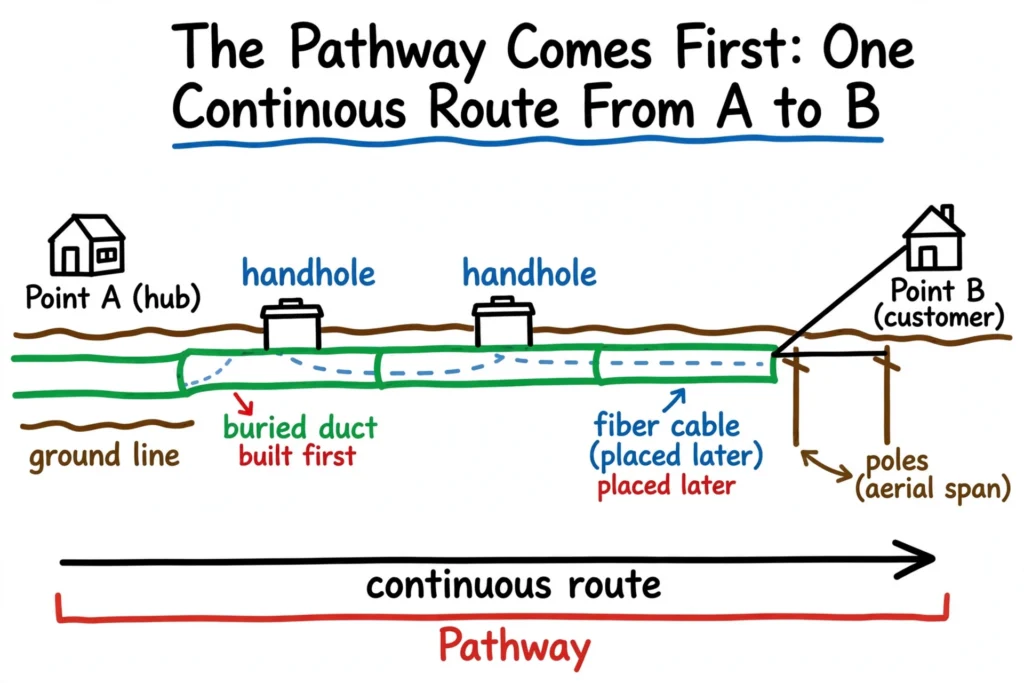
Route means the line the pathway follows across the land. Every pathway has a starting point (say, a network hub) and an ending point (say, a neighborhood or a customer building), and a planned line between them.
Continuous means unbroken from end to end. A pathway cannot have a gap in it. If you want to pull a cable through a tube that runs for a mile, that tube has to connect, segment to segment, for the whole mile. One missing link and the cable cannot get through.
Protected means the cable inside is shielded from harm. For buried pathways, that protection usually comes from the tube the cable sits inside and from the soil around it. For aerial pathways, the protection comes from the cable design itself and from keeping the cable up in the air, clear of excavation equipment and most ground-level hazards. That height does not make aerial cable safe from everything. Storms, ice, falling trees, and vehicle strikes damage aerial cable regularly, and buried plant actually sees fewer physical faults. (Lessons 4, 5, and 6 go into the physical parts in detail.)
A pathway is not the cable. This is the most important distinction in this lesson. The pathway is the route. The cable is the thing that travels the route and carries the data. They are separate decisions, often made by separate crews, sometimes years apart.
What Does It Look Like?
A pathway looks different depending on how it is built, but it always runs from point to point in connected pieces.
Underground pathways are common, and you mostly cannot see them. What you see are the signs that a buried pathway is there. A line of small lids or access boxes set in the ground at intervals tells you a pathway runs beneath that line. Orange flags and orange spray paint on the ground mark the approximate location of buried communications lines (orange is the color code for communications, telephone, and cable lines, used by utility locators across the United States). Small posts or signs that say “buried cable” or “fiber optic cable” mark where a route turns or crosses. A strip of plastic warning tape, printed with words like “CAUTION: FIBER OPTIC CABLE,” is often buried in the soil above a conduit. If you ever see a trench open during construction and catch a glimpse of that colored tape before any pipe shows up, that tape is a warning layer sitting above the pathway.
Aerial pathways are visible: a pole line, which is a series of utility poles running in a line with cable strung between them. The pathway here is the route the poles follow plus the space between them where cable can be lashed (attached) along a support strand. You can see an aerial pathway plainly by looking up.
A real pathway often mixes the two. A common layout is an underground run of duct between access boxes for most of a route, then a short aerial span on poles to cross a river or reach a building. The pathway is still one continuous route, even though the construction type changes.
You do not need to memorize dimensions for this lesson. There is no universal size, depth, or length that defines a pathway. Those numbers come from the design documents and the contract for each specific project.
What Does It Do?
A pathway does three jobs.
First, it protects the fiber. Fiber optic cable carries data as pulses of light through strands of glass, and glass does not like to be crushed, kinked, or dug into. The pathway keeps the cable away from those hazards. Buried pathways put earth and tubing between the cable and the surface world. Aerial pathways put height between the cable and everything on the ground.
Second, it provides a route for future cable. This is the subtle one. The pathway separates two decisions: where the cable will go, and when (or whether) cable goes in. A company can build the pathway now and place the cable later, when funding arrives or when customers sign up. The route decision is settled up front; the cable decision can wait.
Third, it makes cable installation possible. Pulling, pushing, or blowing fiber cable through an existing continuous tube is far easier and faster than digging a new trench every time you need to add cable. A well-built pathway turns a future construction project into a simple cable placement job. (Those placement methods, pulling, pushing, and blowing, are discussed in a later lesson. For now, just know they all depend on the pathway already being there and being clear.)
Where Does It Fit?
The pathway comes first in the build sequence, and almost everything else depends on it.
Design decides where the pathway goes. Designers choose the route, avoid obstacles, and decide which parts are buried and which are aerial.
Permitting usually follows the pathway. Permits are tied to where you dig or set poles, which is the pathway route, not the cable inside it.
Inspection checks the pathway at multiple stages: while it is being built (was the trench right, is the tube connected?) and before cable goes in (is the pathway continuous, clear, and usable?). An inspector’s main job on a pathway is to confirm it is ready to receive cable.
Cable placement comes last, sometimes much later. It is common in this industry for a pathway to sit in the ground for months or even years before the fiber cable is installed. When the cable crew finally arrives, their first assumption is that the pathway is continuous, protected, and clear of blockages. If it is not, they cannot do their job.
This lesson connects to the lessons around it. Lesson 2 compared underground and aerial construction; pathways are what those two methods build. Lesson 4 defines conduit in detail (the tube that forms most underground pathways). Lesson 5 defines handholes (the access boxes you see at intervals along a buried route). Lesson 6 covers poles and aerial construction.
Why Does It Matter?
Because the pathway is built first, every mistake in it multiplies. If the pathway is wrong, damaged, or blocked, the fiber cable cannot go in, or goes in and fails later. And fixing a pathway problem is always harder than building it right the first time.
Consider what a blocked tube means in practice. The pathway was built. The trench is closed and paved over. Landscaping is done. Then the cable crew arrives, feeds a line into the tube, and hits a blockage halfway through. Now someone has to figure out where the blockage is, dig up finished ground, cut out the bad section, repair it, and restore the surface. That rework costs money and time that nobody budgeted, and the project schedule slips while the repair is designed, permitted, and dug. A pathway problem discovered late is an expensive and disruptive problem in fiber construction.
There is also a schedule consequence that is easy to miss. Projects are sequenced around the assumption that the pathway will be ready. If it is not, crews downstream (cable placement, splicing, testing) stand idle or get rescheduled, and the delay cascades.
What Does Good Look Like?
A usable pathway has three basic qualities: continuous, protected, and documented. Note that these are general good practice, not universal acceptance criteria. Every project has its own contract documents and specifications, and those are what a pathway is actually judged against.
Continuous. The pathway connects unbroken from one end to the other. Every segment joins the next. In an underground run, the tube sections are connected at every joint, and the route can be traced from access box to access box without a gap.
Protected. The cable inside is shielded from the environment it will live in. For buried pathways, that means the tubing is intact and buried, with warning tape or other marking layers above it where the design calls for them. For aerial pathways, it means the route keeps the cable clear of hazards at the height and clearance the design specifies.
Clear and usable. Nothing inside the pathway blocks a cable from passing through. This matters because pathways often sit empty for a long time. Dirt, water, collapsed sections, or construction debris can get in between the pathway build and the cable installation. Common practice in the industry is to “proof” a conduit before cable goes in: pushing a rigid gauge (called a mandrel) through the tube to confirm it is clear and undamaged. Manufacturer guidance, such as CommScope’s conduit construction manual, recommends proofing existing conduit to confirm that obstructions are cleared and that continuity and alignment are good. Whether proofing is required on a given project depends on the contract; the point for this lesson is that “clear” is something you verify, not something you assume.
Documented. The pathway is recorded: where it runs, what it is made of, and where its access points are. Documentation is what lets a future crew find the pathway, verify the route, and place cable in it years later. A pathway nobody can find or verify is barely better than no pathway at all.
What Can Go Wrong?
Four common pathway problems, and what each one causes.
Blockages. Dirt, rocks, or construction debris get inside the tube, or a section collapses. Consequence: cable cannot be placed through that section. The blockage must be located and cleared or the section repaired, which usually means digging. (Water gets into buried tube too, but water alone does not stop a cable. The stoppers are solids and collapsed walls.)
Crushed or damaged sections. Heavy equipment drives over an unprotected tube, or a joint was poorly connected and separates under load. Consequence: the pathway loses its protection, and possibly its continuity. Water and dirt enter; future cable is at risk even if it can be placed.
Missing sections. A segment of tube was never installed, or an access box was never set where the design required one. Consequence: the pathway is not continuous. Cable cannot pass, and the missing work has to be built, often after the surface above it was already finished.
Wrong route. The pathway was built somewhere other than the designed and permitted location. Consequence: the cable ends up in the wrong place, the pathway may cross property it has no right to be on, and the fix involves either legal correction or rebuilding the route.
None of this is meant to frighten you. Every one of these problems is preventable with careful construction and inspection, which is exactly why inspectors check pathways before cable goes in.
What Should Someone Notice in the Field?
You do not need to be qualified to build or inspect a pathway to start recognizing one. Here are beginner-level observations anyone can make. Recognizing these things is not the same as being qualified to perform the work; regulated and hazardous tasks belong to trained and authorized people.
- Lids and boxes in a line. A row of small access lids or boxes set in the ground at intervals usually means a buried pathway runs beneath that line. If the line of boxes turns, the pathway probably turns with it.
- Route markers. Posts or signs that say “buried cable” or “fiber optic” mark a pathway’s location. They are there so the route can be found years later and so future diggers know something is below.
- Paint and flags. Colored paint lines and small flags on the ground mark buried utilities. Orange marks communications lines. If you see orange paint or flags, treat it as a sign that a fiber or telecom pathway is near the surface there. (These marks come from utility locating, the process where buried lines are marked before digging. In the US, the free 811 “call before you dig” service coordinates that marking.)
- Warning tape in an open trench. If you see excavation work and notice a strip of colored plastic tape printed with a warning message in the soil, that tape sits above a buried pathway. It is a deliberate warning layer.
- A pole line. Poles in a row with cable or support strand between them are an aerial pathway. Where the poles stop and the ground shows access boxes, the pathway likely transitions from aerial to underground.
- Open trench with tube being placed. If you see a trench with long sections of tube being joined and laid in it, you are watching a pathway being built. The cable is not there yet, and may not be for a long time. That is normal.
Practical Example
The following example is hypothetical. It is invented to illustrate the concepts in this lesson, not a report of a real incident.
A developer is building a new subdivision. The fiber company wants to serve it, so during the subdivision’s road construction, a contractor installs a pathway: a run of buried tube from the road entrance to a series of access boxes, one near each street. No fiber cable is placed. The roads are paved, the landscaping goes in, and the pathway sits empty for two years.
Then the first homeowners move in and order service. A cable crew arrives, opens the access boxes, and places fiber through the existing pathway in a matter of days. No new trenching. No torn-up streets. The pathway did its job: the route decision was made and built during road construction, and the cable decision waited until there were customers.
Now imagine the alternative. Suppose one joint in that tube had separated during backfill two years earlier, letting dirt pour in. The cable crew’s line stops dead halfway through the run. Now the finished street has to be cut open, the bad joint found and repaired, and the street repaved. Same pathway, same cable, but one unnoticed defect turned a days-long cable job into a weeks-long excavation project. That is why the pathway matters, and why it gets inspected before cable goes in.
Key Terms
Pathway. A continuous, protected route built for fiber optic cable to travel through, from one point to another. The route plus the protection around it. Not the cable.
Conduit. A tube, usually buried, that forms an underground pathway and protects the cable inside it. (Defined in full in Lesson 4.)
Duct. In outside plant work, a large tube or pipe, often buried, that carries cable or smaller tubes. Conduit and duct are closely related terms; the industry uses both.
Innerduct. Smaller tubes placed inside a larger conduit or duct. One large tube can hold several innerducts, and each innerduct can carry its own cable. This lets one pathway serve multiple future cables.
Microduct. A very small tube, often installed in bundles, designed for small fiber cables. Used where many small cables will be placed over time.
Handhole. A small underground box with a lid, set at intervals along a buried pathway, that gives workers access to the pathway for placing or servicing cable. (Defined in full in Lesson 5.)
Pole line. A row of utility poles with cable or support strand strung between them, forming an aerial pathway.
Continuity. The quality of being unbroken from end to end. A pathway has continuity when every segment connects to the next with no gaps.
Blockage. Anything inside a pathway that stops cable from passing through: dirt, debris, a collapsed or crushed section.
Proofing. Checking that a conduit is clear and undamaged before cable is placed, commonly by pushing a rigid gauge (a mandrel) through the tube.
Warning tape. A strip of printed plastic tape buried in the soil above a conduit, warning future diggers that a cable or pathway is below.
Route marker. A post or sign at the surface marking where a buried pathway runs, so the route can be found and avoided by future excavation.
Check Your Understanding
1. A contractor finishes building a pathway along a new road. No fiber cable is installed yet. Is the project incomplete? Explain why or why not.
2. You are walking a site and see a row of small lids set in the ground, turning a corner at the end of a block. What does that most likely tell you about what is underground?
3. A cable crew feeds a line into a tube and it stops halfway through the run. Name two possible causes, and explain why fixing this problem now is more expensive than it would have been during the original construction.
4. Why is it useful to separate the “route decision” (where the pathway goes) from the “cable decision” (when cable gets installed)? Give one practical reason.
5. True or false: a pathway and a fiber optic cable are the same thing. Explain your answer.
Answer Key
1. Not necessarily. A pathway is the route, and the cable is a separate decision that often comes later. The pathway phase is complete when the route is continuous, protected, clear, and documented. Cable placement is a later phase that depends on the pathway being ready.
2. It most likely means a buried pathway runs beneath that line of lids, and the pathway turns the corner where the lids turn. The lids are access points along the route.
3. Possible causes include a blockage (dirt, debris, or a collapsed section inside the tube) or a crushed or separated section of tube. Fixing it now is more expensive because the ground above is finished: locating the problem, excavating, repairing, and restoring the surface all cost money and time that the original open-trench construction did not require.
4. It lets the expensive, disruptive work (trenching, boring, setting poles) happen once, at the best time (for example, during road construction), while the cable, which is also expensive, is only purchased and installed when it is actually needed (for example, when customers sign up). Any practical reason along these lines is correct.
5. False. The pathway is the continuous, protected route. The cable is the thing that travels the route and carries the data signal. They are separate parts of the network, often built and installed at different times.
Lesson Takeaway
A pathway is the route plus the protection: a continuous, protected path built for fiber cable to travel through, from point A to point B. It is not the cable. It gets built first, sometimes long before the cable arrives, and everything downstream depends on it being continuous, protected, clear, and documented. When you see a line of access lids, a row of poles, orange paint on the ground, or a route marker post, you are looking at the visible signs of a pathway. The next three lessons define the parts that make pathways up: conduit (Lesson 4), handholes (Lesson 5), and poles (Lesson 6).
Sources and Technical References
- The Fiber Optic Association (FOA) Reference Guide, Outside Plant: https://foa.org/tech/ref/OSP/jargon.html. FOA’s illustrated jargon reference; defines cable as providing protection to the fiber for its environment, and distinguishes cable types for OSP applications.
- FOA Lesson Plan: Fiber Optic Cable (Fiber U): http://fiberu.org/OSP/LP6.html. Covers OSP cable types (underground, direct burial, aerial) and how cable choice relates to the installation environment.
- CommScope, ConQuest Conduit Construction Manual: https://ja.commscope.com/globalassets/digizuite/2325-conduit-const-manual-co-107146.pdf. Manufacturer guidance recommending “proofing” existing conduit (rigid mandrel, roughly 90 percent of inner diameter) to confirm obstructions are cleared and continuity and alignment are good before cable work. (Referenced via search snippet; the specific 90-percent figure is CommScope’s recommendation, not a universal rule.)
- POTS and PANs blog, “Installing Fiber in Conduit”: http://potsandpansbyccg.com/2015/09/18/installing-fiber-in-conduit/comment-page-1/. Describes the build sequence (conduit buried first, fiber placed later by pulling, pushing, or blowing), innerduct as smaller tubes inside a larger conduit, and factory-installed pull cords.
- NYSDOT specification excerpt, “Rod and Clean Conduit”: https://www.dot.ny.gov/portal/page/portal/spec-repository-local/680.995600MO.pdf. Example of a contract specification requiring a mandrel passed through the full conduit run before cable installation. Contract-specific, not universal.
- 811 utility locate marking practices (orange = communications): https://www.dekalbcountyonline.com/811-the-number-to-call-before-digging/, https://www.centerpointenergy.com/en-us/safety/call-before-you-dig. US practice; paint color codes and 811 procedures vary by state.
Could not verify: I could not verify a single authoritative industry-wide definition of “pathway” as a standalone term from the FOA’s published reference pages. The lesson’s definition (continuous, protected route; route plus protection; distinct from the cable) is consistent with how FOA, CommScope, and industry sources describe duct/conduit systems and cable placement sequencing, but it is written as a teaching definition rather than quoted from one standard. Exact proofing and mandrel requirements vary by contract and jurisdiction; no universal acceptance criteria are stated in this lesson.
← Previous: Lesson 2: Underground vs. Aerial | Level 1 Hub | Next: Lesson 4: What Is a Conduit? →