
What You Are Learning
By the end of this lesson, you will understand what a utility pole is, what it does, and how to recognize one in the field. You will know the main parts you can see from the ground, why electric lines sit above communications lines, what the markings on a pole can tell you, and why a damaged or crowded pole matters to a fiber build. You will not be qualified to climb a pole, touch a pole or anything attached to it, lean a ladder against it, or work on it. Poles carry energized electric conductors. Recognition from the ground is your job. Work on a pole belongs to qualified and authorized crews only.
Start With the Basics
Think of the last time you drove down a street and saw a row of tall poles following the road. Wires ran from pole to pole above your head. A gray can hung on one pole. A thinner black cable ran lower down, below the power wires. That row is an aerial plant, and each pole in it is a utility pole.
Here is the basic idea before we add any terminology. Some fiber cable travels underground in conduit, which Lessons 3, 4, and 5 covered. Other fiber cable travels overhead. It needs something strong to hold it up, span after span, in wind, heat, cold, and storms. The utility pole is that support. It is a vertical post set in the ground that holds wires and cables up in the air, off the ground, and separated from each other in an organized way.
A pole rarely holds only one thing. A single pole can carry electric power wires at the top, then telephone, cable television, and fiber lines below them, plus a streetlight, a transformer, and support wires. That shared use is normal, and it is why a beginner needs to learn to read a pole from the ground: what is up there, in what order, and what condition it is in.
What Is It?
A utility pole is a vertical post, set partly into the ground, that supports overhead wires and equipment. In outside plant work, the word pole usually means this support structure itself, not the wires on it. The wires, cables, and hardware attached to the pole are separate things with their own names, and this lesson will name the main ones as we go.
Most utility poles in the United States are wood, pressure treated with preservatives to resist decay and insects. Poles are also made of steel, concrete, and composite materials such as fiberglass reinforced polymer. Aluminum poles exist in specialized uses. The material varies by owner, by region, by load, and by environment. There is no single pole material for all jobs, and there is no single pole size for all jobs. Height, strength, and setting depth are chosen for the specific line, span, soil, and loading on that project. Those values come from the pole owner standards, the project design, and applicable codes. They are not universal numbers a beginner should quote from memory.
A utility pole is also shared infrastructure. The pole has an owner. The owner is often an electric utility, sometimes a telephone company, sometimes a municipality or cooperative, and sometimes two owners share ownership under a joint use arrangement. Other companies do not own the pole just because their cable is on it. They attach under an agreement with the owner. That agreement is commonly called a pole attachment agreement. It controls where a new cable may be placed, what hardware may be used, and what work must be done first to make room. That preparation work is commonly called make ready work.
Standards sit behind all of this, and they come from different places. The National Electrical Safety Code, often shortened to NESC and published as ANSI/IEEE C2, is an industry safety code for utility installations. States and owners adopt and apply it in different ways. The USDA Rural Utilities Service, shortened to RUS, publishes construction standards for many rural electric and communications borrowers. ANSI O5.1 is an industry standard that covers wood pole specifications and dimensions, including how a wood pole is branded. OSHA rules are federal workplace safety rules, and they restrict pole work to qualified employees with specific training and equipment. In short: federal safety rules, industry codes, owner standards, and contract specifications can all apply to the same pole at the same time. When this lesson describes a general pattern, it will say so. When a value varies, it will say it varies.
What Does It Look Like?
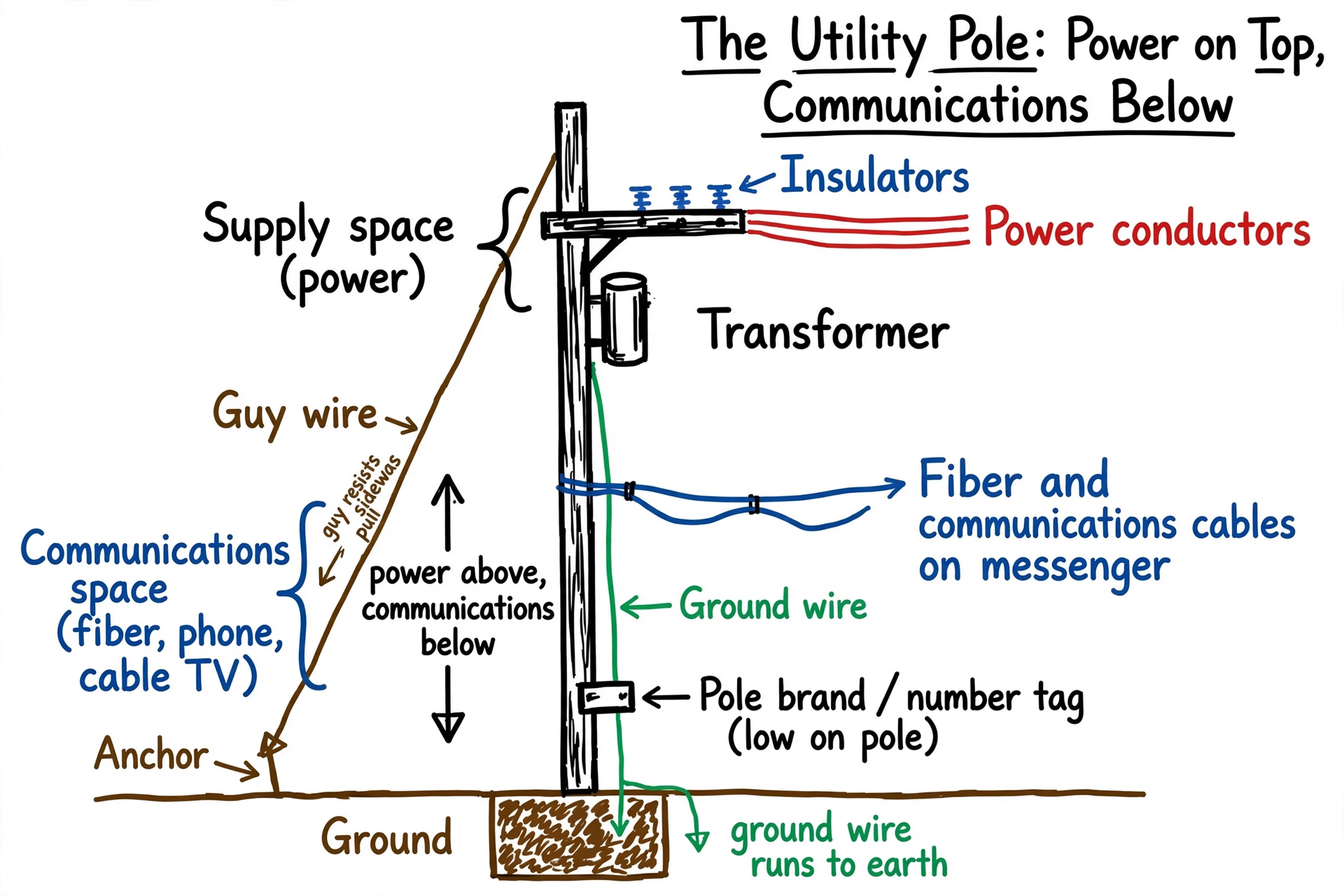
From the ground, a utility pole looks like a tall, straight, slightly tapered post with wires leaving it in two directions along the street or across lots. The bottom part is plain. The top part is busy. Learning to read that busy top, at a beginner level, is the core field skill in this lesson.
Start at the top and work down:
- The pole top and crossarm. A crossarm is a horizontal beam attached near the top of the pole. Its job is to hold conductors apart at a set spacing so they do not touch each other. Crossarms are commonly made of wood, fiberglass, or steel. Some poles have one crossarm, some have several, and some carry a conductor directly on the pole top with no crossarm at all. The arrangement depends on the voltage, the number of conductors, and the owner design.
- Insulators. An insulator is a nonconductive fitting that supports a conductor while keeping electric current from flowing into the pole or crossarm. Insulators are commonly made of porcelain, glass, or polymer. You will see them as ribbed or bell shaped pieces where a wire meets the crossarm or the pole. You do not need to identify insulator types as a beginner. You only need to know what they are for: holding the wire up while electrically isolating it.
- Conductors. A conductor is a wire that carries electric current. The power conductors sit highest on the pole. They may look like bare wire, and a beginner must assume every overhead power conductor is energized at all times, even if it looks plain or a line looks quiet.
- Transformer. A transformer is a device that changes voltage from one level to another. On a distribution pole it steps higher distribution voltage down to the lower voltage used by homes and businesses. It usually looks like a large gray cylindrical can or a box mounted on the side of the pole. Not every pole has one. Where you see one, you are looking at a pole that feeds electric service to nearby customers.
- Ground wire. A ground wire is a wire that runs down the side of the pole to the earth, connecting pole equipment to the ground. It provides a path for fault current and lightning. You may see it as a thin wire stapled down the pole face, sometimes covered near the ground by a protective molding. Do not touch it. A ground wire that is cut or missing is a condition to report, not to handle.
- Guy wire and anchor. A guy wire is a tensioned steel cable that helps a pole resist a sideways pull. One end attaches to the pole. The other end goes at an angle down to an anchor set in the ground. Guys are most common where the line ends, where it turns a corner, or where the pull of the wires is unbalanced. A yellow or colored guard often covers the lower part of a guy so people and vehicles can see it. A special insulating section is sometimes fitted near the top of a guy for public protection. If you see a diagonal wire from a pole to the ground, that is a guy, and the buried rod it connects to is its anchor.
- Communications attachments below. Below the power equipment, you will usually see one or more black cables running pole to pole. These can include telephone cable, cable television cable, and fiber optic cable. Fiber for outside plant is often lashed to a steel messenger strand, which is a strong steel support wire installed between poles to carry the cable, or it may be a self supporting aerial fiber cable designed to carry its own weight. Splice closures, slack coils, and terminals for communications lines may also be mounted on the pole.
Two zones organize all of this, and you only need them at a beginner level:
- Supply space. The upper part of the pole reserved for electric supply conductors and equipment. This is the power company zone at the top.
- Communications space. The lower part of the pole where communications cables such as telephone, cable television, and fiber are attached.
Power sits above communications for safety. Qualified electric workers work in and near the supply space under strict rules. Communications workers work in the communications space, also under training and clearance rules that vary by code, owner, and project. A beginner works in neither space. A beginner observes from the ground.
Low on many wood poles, above the ground line, look for the pole brand and tags. A brand is information burned or stamped into the wood, sometimes supplemented by a metal tag nailed to the pole. On a United States wood pole, a brand commonly records the manufacturer, the year the pole was treated or made, the wood species, the original preservative, a strength class, and the pole length. Abbreviations are used, and they follow ANSI O5.1 practice for wood poles. Separate small metal tags or number plates may show an owner pole number, an inspection result, or a treatment record. The exact layout varies by owner and by era, so read what is there and record it exactly. Do not guess at a code you do not know. Photograph it and let the project team interpret it.
Pole shape varies too. A straight line pole carries the line forward. A corner pole sits where the line changes direction and often has a guy. A dead end pole is where a section of line ends or is anchored off, and it carries heavier hardware and often one or more guys. You do not need to classify every pole on sight. You do need to notice that poles at ends and corners work harder than poles in a straight run, and they fail differently.
What Does It Do?
A utility pole does four practical things.
First, it holds wires and cables in the air. Elevation keeps conductors and cables away from people, vehicles, water, and ground level damage, and it lets a line cross roads, yards, and terrain that would be hard or expensive to bury under.
Second, it keeps different wires separated and organized. The crossarm spacing, the vertical order of supply space above communications space, and the attachment positions on the pole all exist to maintain separation between power conductors, between power and communications cables, and between each cable and the pole itself. Separation is a safety and reliability function, not decoration.
Third, it carries a load over a span. A span is the distance between two poles, and the wire or cable crossing that span pulls on both poles. The pole, its setting in the ground, and any guy wires together resist the weight of the wires and equipment, the sideways pull at corners and dead ends, and added loading from wind and, in some regions, ice. Pole strength, pole length, and setting are engineered for those loads. That engineering is done by the pole owner and the project designer. It is never something a beginner estimates by eye.
Fourth, for a fiber build, it provides the aerial pathway. Instead of trench and conduit underground, the fiber route goes pole to pole. The designer chooses which poles to use, where on each pole the new fiber or its messenger will attach, and what make ready work is needed first. The crew then installs the strand, the cable, the hardware, and the splice and slack storage at the poles the design calls for. The pole is to the aerial pathway what the handhole is to the underground pathway: the recurring access and support point that makes the route buildable and maintainable.
Where Does It Fit?
Utility poles fit into Lesson 2, the choice between underground and aerial construction, and into Lesson 3, what a pathway is. An aerial pathway is a designed route in the air, and poles are its support structures in sequence. Pole 1 to pole 2 is one span. Pole 2 to pole 3 is the next. The full line of poles, with the strand and cable across every span, is the aerial route.
Poles are usually already there before a fiber project starts. New fiber on poles is commonly an attachment to existing poles owned by someone else, not a line of brand new poles set for fiber alone. That is why pole work on a fiber project so often starts with records and field verification: confirming the owner, confirming the pole number, checking the existing attachments, and checking whether there is room to add the new cable where the design wants it. Where there is no room, or a pole is too weak or too damaged for the added load, the project may need make ready work, a stronger replacement pole, or a different route. Those decisions belong to the pole owner and the project engineer.
Setting a new pole, replacing a pole, and transferring wires from an old pole to a new one also happen on fiber projects, but they are utility work with heavy equipment, engineered loading, and energized lines nearby. A fiber beginner may observe and document that work. A fiber beginner does not perform it.
Inspection touches poles at several points. During design, poles are inventoried. During construction, attachment height, hardware, bonding and grounding connections where required, slack storage, and splice placement are checked against the project requirements. After construction, the owner may inspect the attachment before accepting it. The beginner role in all of this is ground level observation and accurate reporting.
Why Does It Matter?
The pole is the structure the whole aerial route depends on. If a pole is rotten, cracked, leaning, overloaded, or hit by a vehicle, every wire and cable on it is at risk at once: power, telephone, cable television, and fiber together. One pole failure can drop live power conductors, tear down communications spans on both sides, block a road, and take a neighborhood out of service. The consequence is shared because the structure is shared.
Poles also control whether a fiber build can happen on schedule. A route can be fully designed on paper and still stall in the field because a pole needs replacement, a crowded pole needs rearrangement, an attachment agreement is not complete, or an owner requires work that was not in the original plan. Experienced aerial builders treat pole condition and pole permission as schedule risks from day one. Beginners should learn the same habit: the pole is not scenery. It is a permitted, engineered, inspected structure, and the build inherits its condition.
Finally, poles matter because of safety in a way no underground lesson can match. The top of the pole carries energized electric conductors. That fact governs everything a beginner is allowed to do near a pole, which is observe only, from the ground, without touching. The next sections keep returning to that boundary because it is the most important thing in this lesson.
What Does Good Look Like?
A good utility pole, in general good practice terms, looks like this:
- The pole stands straight and plumb, with no visible lean beyond what the project and owner allow, and no fresh ground movement, cracking, or erosion at its base.
- The pole body shows no obvious major defect from the ground: no large cracks opening through it, no deep decay or hollow sound area visible at the base, no woodpecker or insect damage that has clearly weakened it, no fire damage, and no vehicle impact damage.
- The crossarm is level, sound, and not split, sagging, or rotted at the ends. Conductors sit on their insulators, and insulators are not visibly broken or missing.
- Wires and cables are organized in their proper order, with power in the supply space above and communications cables below in the communications space, each attached with proper hardware and no cable resting where it does not belong.
- Guy wires, where fitted, are taut, properly guarded at the bottom where a guard is required, connected to their anchor, and not broken, slack, or detached.
- The ground wire is continuous down the pole and not cut, dangling, or missing.
- Communications attachments are neat: messenger and cable are properly supported at the pole, slack is coiled and secured to the pole or strand as the project requires, splice closures are mounted and supported, and nothing hangs loose down the pole.
- The pole brand or number tag is present and readable where the owner requires one, so the pole can be matched to records.
Important distinction: these are general recognition signs. Whether a pole is strong enough, whether an attachment is accepted, and whether a pole must be replaced are engineering and owner decisions made under the applicable code, the owner standards, and the contract specifications. A pole can look acceptable from the ground and still fail a detailed inspection, because important decay can be below ground or inside the wood where a beginner cannot see it. Never report a pole as safe or as approved. Report what you observed, with photos, and let qualified inspectors decide.
What Can Go Wrong?
Several things go wrong with utility poles in the field. A beginner who can name them can report them early, when they are cheapest to address.
- Decay and insect damage. Wood poles decay, most seriously at and just below the ground line where moisture and organisms attack the wood, and insects and woodpeckers can damage a pole further. Decay can hollow a pole from the inside while the surface still looks fair. This is why owners run inspection and treatment programs and why ground level appearance alone never proves a pole is sound.
- Cracks, splits, and broken tops. Weathering opens checks and cracks in wood. Severe splits, a broken pole top, or a failed crossarm can drop conductors or let a span fall out of position.
- Leaning and foundation failure. A pole leans when the soil, the setting, a vehicle hit, a broken guy, or an unbalanced wire load overcomes its support. A leaning pole is a changed load condition, not a cosmetic issue. The wires on it pull differently, clearances change, and the lean usually gets worse, not better.
- Overloading and crowding. Every added cable, transformer, and piece of hardware adds weight and wind load. A pole that was adequate for its original line can become overloaded after years of added attachments, especially where records are poor and no one recalculated the load. Crowded poles also leave no proper place for a new fiber attachment, which triggers make ready work or replacement.
- Damaged guys and anchors. A guy cut by a mower, hit by a vehicle, corroded at the ground, or pulled loose at its anchor no longer does its job. The pole it was supporting now carries a sideways load it was not meant to carry alone.
- Vehicle strikes and storm damage. Poles along roads get hit. Storms load poles with wind and ice and throw trees and limbs into spans. A pole can be cracked or loosened by an impact without falling over on the spot, which makes prompt reporting after any known strike or storm important.
- Vegetation contact. Trees growing into conductors and communications cables abrade cable jackets, add load, and pull spans out of place. Vegetation growing up a pole and into the supply space is also a serious hazard sign.
- Failed or missing hardware. Broken insulators, loose bands and bolts, a failed messenger clamp, or a splice closure hanging by its cable instead of its mount all mean the attachment is no longer supported the way it was designed.
None of these conditions is a beginner repair job. Every one of them is a report it accurately job.
What Should Someone Notice in the Field?
A beginner job in the field is to notice, from the ground, without touching the pole or anything attached to it. Here are specific things to observe:
- Identifying the pole. Read the owner number plate or tag and the pole brand if one is present. Record the pole number exactly as shown, photograph it, and note the street, the nearest address or intersection, and the side of the road. Records that cannot be matched to the right pole are of little use.
- Counting and ordering attachments. From the ground, note what is on the pole in order from top to bottom: power conductors and any crossarms, transformer if present, then communications cables below, and how many there appear to be. Note whether the place the design wants for the new fiber attachment looks occupied or clear. Do not estimate heights or clearances with numbers. If the attachment point looks crowded or wrong, describe it and photograph it.
- Noticing condition. Walk around the pole at a safe distance on the ground. Look for lean, cracks, splits, decay at the base, holes, fire or vehicle damage, a damaged or missing crossarm, broken insulators, a cut ground wire, a broken or slack guy, a missing guy guard, vegetation growing into the wires, and anything hanging loose. Look at the base for digging, erosion, or a recently disturbed setting.
- Noticing the spans. Look along the spans on both sides. A cable hanging much lower than its neighbors, a span full of tree contact, or a splice closure or slack coil hanging unsupported are all worth reporting with the pole number.
Safety, stated plainly:
- Assume every overhead power conductor is energized at all times. There is no visual way for a beginner to tell whether a conductor is live, and lines can be re energized without warning.
- Never climb a utility pole. Never touch a utility pole, a guy wire, a ground wire, a transformer, or any hardware or cable attached to a pole. Never lean a ladder against a pole. Never attach anything to a pole, and never remove anything from a pole.
- Never step over, move, or touch a fallen pole or a wire on the ground. Keep other people away and call the utility and emergency services through your project emergency process.
- Work on poles, including inspection methods that involve climbing, sounding, boring, or climbing aids, is restricted to qualified and authorized workers with specific training, protective equipment, and fall protection under federal and owner rules. Reading this lesson does not qualify you for any of that work, for work near energized conductors, or for judging that a pole is safe to climb or attach to.
- Your safe working position for this lesson is simple: both feet on the ground, at a distance, looking and photographing. That observation work is genuinely valuable. A leaning, rotten, or overloaded pole reported before a crew attaches new cable to it prevents rework, delay, and a dangerous surprise at height.
Practical Example
This is a hypothetical example, not a report of a real incident.
A fiber crew is scheduled to attach new cable to a row of existing poles along a county road. The design was drawn from records. The day before the crew arrives, a trainee walks the route on the ground with the pole list, photographing each pole number and its attachments, touching nothing.
At the seventh pole, the trainee notices three things. The pole leans noticeably toward the road. A guy wire on the opposite side hangs slack, with its lower end damaged near the anchor. And the communications space is already full: two existing cables occupy the positions shown on the design, plus an older cable that is not in the records at all. The trainee records the pole number exactly, takes wide photos showing the lean and the full pole, close photos of the damaged guy and the crowded attachments, and sends them to the project team the same day.
The project engineer reviews the photos, sends a qualified inspector to examine the pole, and the pole owner determines that the pole must be replaced and the attachments rearranged before any new cable is added. The fiber crew is rescheduled to another street instead of arriving to a pole they cannot use. The replacement and make ready work add time, but they add it on paper, in a plan, rather than as a stopped crew, a dispute about records, or a new cable attached to a failing pole.
The beginner lesson in this story is the noticing: accurate pole numbers, honest condition notes, and clear photos from the ground changed the project schedule while it was still cheap to change.
Key Terms
- Utility pole. A vertical post set in the ground that supports overhead wires, cables, and equipment. It is the support structure for an aerial pathway.
- Span. The distance between two poles, and by extension the section of wire or cable crossing between them.
- Crossarm. A horizontal beam attached near the top of a pole that holds conductors apart at a set spacing.
- Insulator. A nonconductive fitting, commonly porcelain, glass, or polymer, that supports a conductor while keeping electric current from flowing into the pole or crossarm.
- Conductor. A wire that carries electric current. Overhead power conductors must always be assumed energized.
- Transformer. A pole mounted device that changes voltage. On a distribution pole it steps higher distribution voltage down to the voltage used by homes and businesses.
- Supply space. The upper part of a pole reserved for electric supply conductors and equipment.
- Communications space. The lower part of a pole where communications cables such as telephone, cable television, and fiber are attached, below the supply space.
- Messenger strand. A strong steel support wire installed between poles to carry an attached cable, such as a lashed fiber optic cable.
- Guy wire. A tensioned steel cable from a pole at an angle down to a ground anchor, fitted to resist a sideways pull on the pole, most often at corners and dead ends.
- Anchor. The device set in the ground that a guy wire connects to, holding the guy against the pull of the pole and its wires.
- Ground wire. A wire running down the pole into the earth, connecting pole equipment to the ground for fault and lightning protection.
- Pole brand. Information burned or stamped into a wood pole, or shown on an attached tag, commonly recording manufacturer, year, wood species, preservative, strength class, and pole length.
- Pole attachment agreement. The agreement between a pole owner and another company that sets the terms for attaching that company cable to the owner poles.
- Make ready work. Work done before a new attachment, such as rearranging existing attachments or replacing a pole, so the new cable can be attached properly.
- Dead end pole. A pole where a section of line ends or is anchored off. It carries heavier loads and commonly uses guy wires.
Check Your Understanding
1. On a typical joint use pole, which sits higher: the electric power conductors or the fiber optic cable? What are the two zones called, and why is the order arranged that way? 2. A pole has a diagonal steel cable running from high on the pole down to the ground. What is it, what is it doing, and where do you most often find one? 3. You read a brand on a wood pole. What kinds of information does a pole brand commonly record, and what should you do if you do not understand an abbreviation on it? 4. A fiber design shows a clear attachment position on a pole, but in the field that position is already occupied by a cable that is not in the records. What is the likely next step on the project, and who decides it? 5. A trainee says a pole looks fine from the ground, so it must be safe to attach new cable to and safe to climb. Give two reasons that conclusion is wrong.
Answer key
1. The power conductors sit higher. The upper zone is the supply space, reserved for electric supply conductors and equipment. The lower zone is the communications space, where telephone, cable television, and fiber cables attach. Power sits above communications for safety, so the energized supply work stays separated above the communications attachments. 2. It is a guy wire. It is a tensioned steel cable connected to an anchor in the ground, and it resists a sideways pull on the pole. You most often find guys where a line ends at a dead end pole, where the line turns a corner, or anywhere the pull of the wires is unbalanced. 3. A brand commonly records the manufacturer, the year the pole was treated or made, the wood species, the original preservative, a strength class, and the pole length. If you do not understand an abbreviation, do not guess. Record and photograph the brand exactly as shown and let the project team interpret it. 4. The likely next step is make ready work: the existing attachments may need to be rearranged, or the pole may even need replacement, before the new cable can be attached. That decision belongs to the pole owner and the project engineer under the pole attachment agreement, not to the field trainee and not to the attaching crew on the day. 5. First, important pole decay can be below ground or inside the wood, so a sound appearance from the ground does not prove the pole is strong enough for an added load. Strength and attachment acceptance are engineering and owner decisions. Second, climbing and working on a pole is restricted to qualified and authorized workers with specific training and equipment, and the pole carries energized conductors. Reading the lesson qualifies no one to climb or to judge a pole safe to climb.
Lesson Takeaway
A utility pole is the shared vertical support that carries an aerial route: power conductors and equipment in the supply space at the top, communications cables including fiber in the communications space below, held up span after span by the pole, its setting, its crossarms and insulators, and where needed its guy wires and anchors. It has an owner, a number, a brand that records what it is, and an engineered limit to what it can carry. In the field, your job is ground level only: identify the pole exactly, read its order of attachments, notice lean, damage, decay, crowding, and broken guys or grounds, and report all of it with clear photos. Never climb, touch, or lean anything on a pole. The pole does the holding. You do the noticing.
Sources and Technical References
- The FOA Reference for Fiber Optics, Outside Plant Construction, Aerial Cable Installation. Covers aerial fiber installation on poles, messenger wire and cable definitions, span length, sag, and tension, dead ends and pass through attachments, and the warning that work on poles can mean working in proximity to electrical power lines. https://www.thefoa.org/tech/ref/OSP_Construction/Aerial%20Cable%20Installation.html
- The FOA Reference for Fiber Optics, Fiber Optic Installation. Covers aerial cable types and attachment hardware at a general level, including dead end and pass through mounts and added slack for splicing on aerial plant. http://thefoa.org/tech/ref/OSP/install.html
- Utility pole overview, including supply space, communications attachments, crossarms, insulators, transformers, and pole materials. General reference used for anatomy and material variety only, not for project requirements. https://en.wikipedia.org/wiki/Power_pole
- Utility pole branding under ANSI O5.1 practice, including manufacturer, year, wood species, preservative, strength class, and pole length recorded in the brand. https://en.wikipedia.org/wiki/Telephone_pole
- Guy wire, utility pole section. Covers why guys are fitted on dead end and angle poles to support unbalanced lateral loads, and the use of a strain insulator and a visible guard on the lower section for public protection. https://en.wikipedia.org/wiki/Guy-wire
- Nashville Electric Service, Pole Attachment and Conduit Usage Guidelines. An example owner document that shows pole attachment rules, the supply space concept, and owner inspection markings in practice. Owner specific, not a universal standard. https://www.nespower.com/-/media/project/nes/common/pdfs/builders-and-developers/poleattachmentguidelines.pdf
- USDA Rural Utilities Service, Bulletin 1751F-626, on staking and design for communications outside plant, including joint use of poles with another utility and the need to understand NESC requirements alongside local authority requirements. http://www.rd.usda.gov/files/UTP_Bulletins_1751F-626.pdf
- USDA Rural Utilities Service, Bulletin 1724E-200, Design Manual for Electric Distribution and Transmission Lines. Covers structure spotting, pole lengths, setting depths, and clearance checks as engineered design work, which supports this lesson position that pole dimensions are project specific, not universal. https://www.rd.usda.gov/files/UEP_Bulletin_1724E-200.pdf
- OSHA construction standards for electric power transmission and distribution work, 29 CFR 1926 Subpart V excerpts hosted by govinfo, including the rule that poles or structures unsafe for climbing shall not be climbed until made safe. Federal workplace safety rules for qualified work, cited here only to establish the beginner boundary. https://www.govinfo.gov/content/pkg/CFR-2011-title29-vol8/pdf/CFR-2011-title29-vol8-sec1926-955.pdf
Could not verify: a single universal pole height, setting depth, clearance, strength class, or load rating that applies to all utility poles. Verified sources consistently treat those values as functions of the applicable code, the pole owner standards, the project design, the span, the soil, and the loading. This lesson therefore states no universal numbers for them. Also could not verify one universal pole brand layout: brands and tags vary by manufacturer, owner, material, and era, so this lesson describes the kinds of information a brand commonly records and directs the reader to record any specific brand exactly and have the project team interpret it.
Previous lesson: Lesson 5: What Is a Handhole? | Back to Level 1 hub | Next lesson: Lesson 7: What Is Fiber Cable?